
When Andy Met Mick
Recent Acquisitions
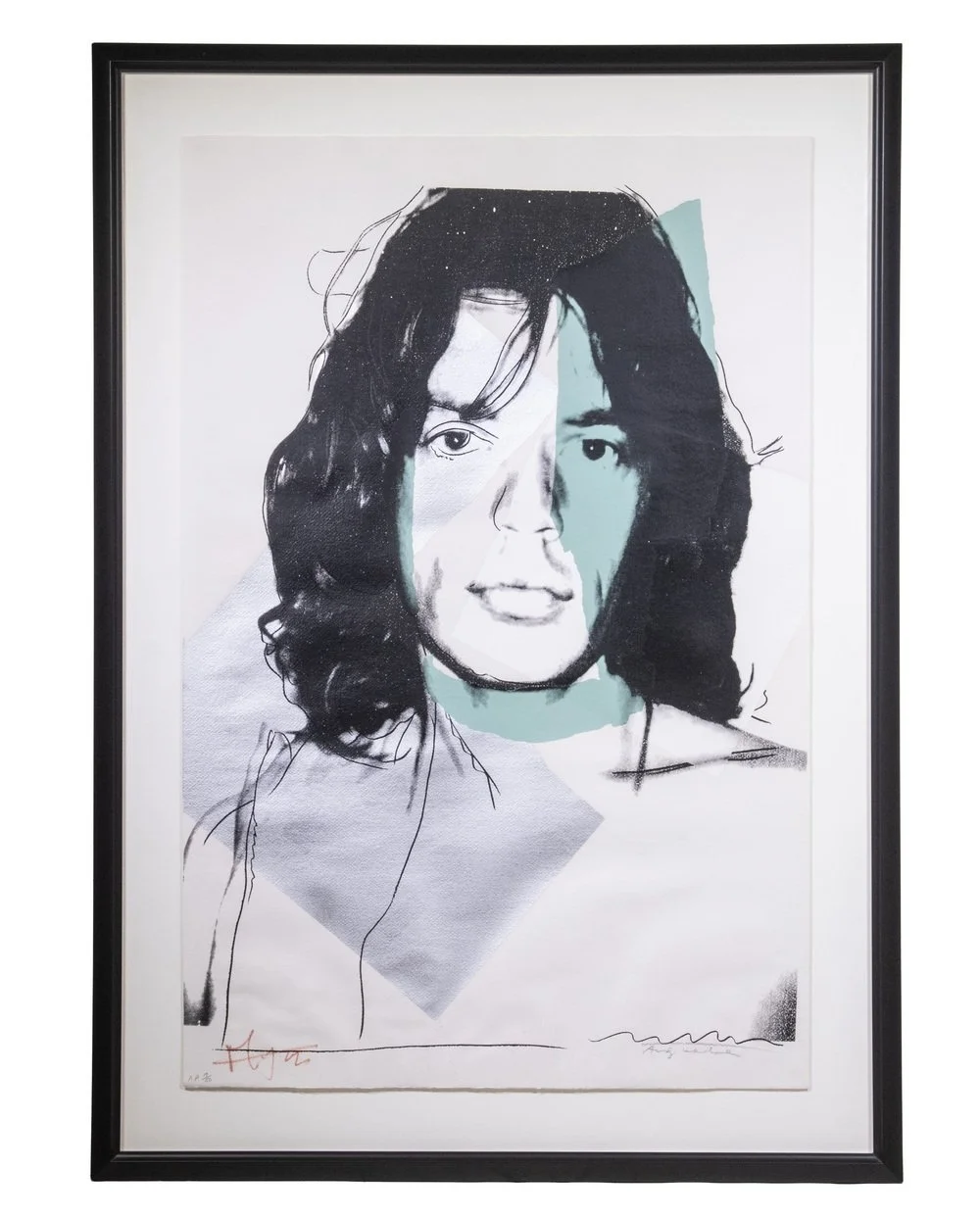
What's the connection between two pop culture titans?
Find it in our Autumn Majestic Auction!
Andrew Warhola, a coal miner's son growing up in the hardscrabble world of Depression-era Pittsburgh. Michael Philip Jagger, middle-class son of a gym teacher and a hairdresser, navigating the fraught society of postwar England. What are the chances they'd ever meet, let alone become two of the most recognized figures of the last third of the 20th century? And yet, if you know and understand their personalities and the courses of their careers, how could they not?
Warhola was fifteen years the older of the two, and his childhood was such that it was never entirely certain that he would survive to adulthood. Frequent illnesses often confined him to his bed, where he spent the endless hours poring over cheap magazines, newspapers, comics, and other flotsam of 1930s popular media. The slick commercial artwork that illustrated the blaring advertisements fascinated this inquisitive boy. Studying art in high school, he learned to draw, to paint, and to photograph, and his talents earned him a scholarship to Carnegie Tech, where he explored the mechanical processes that translated commercial art from the drawing board to the printed page. He spent his summers working at jobs as varied as street-corner produce peddler to department-store window dresser, experiences that offered him, to say the least, exposure to a unique cross-section of the human experience that would in turn inform the future direction of his art.
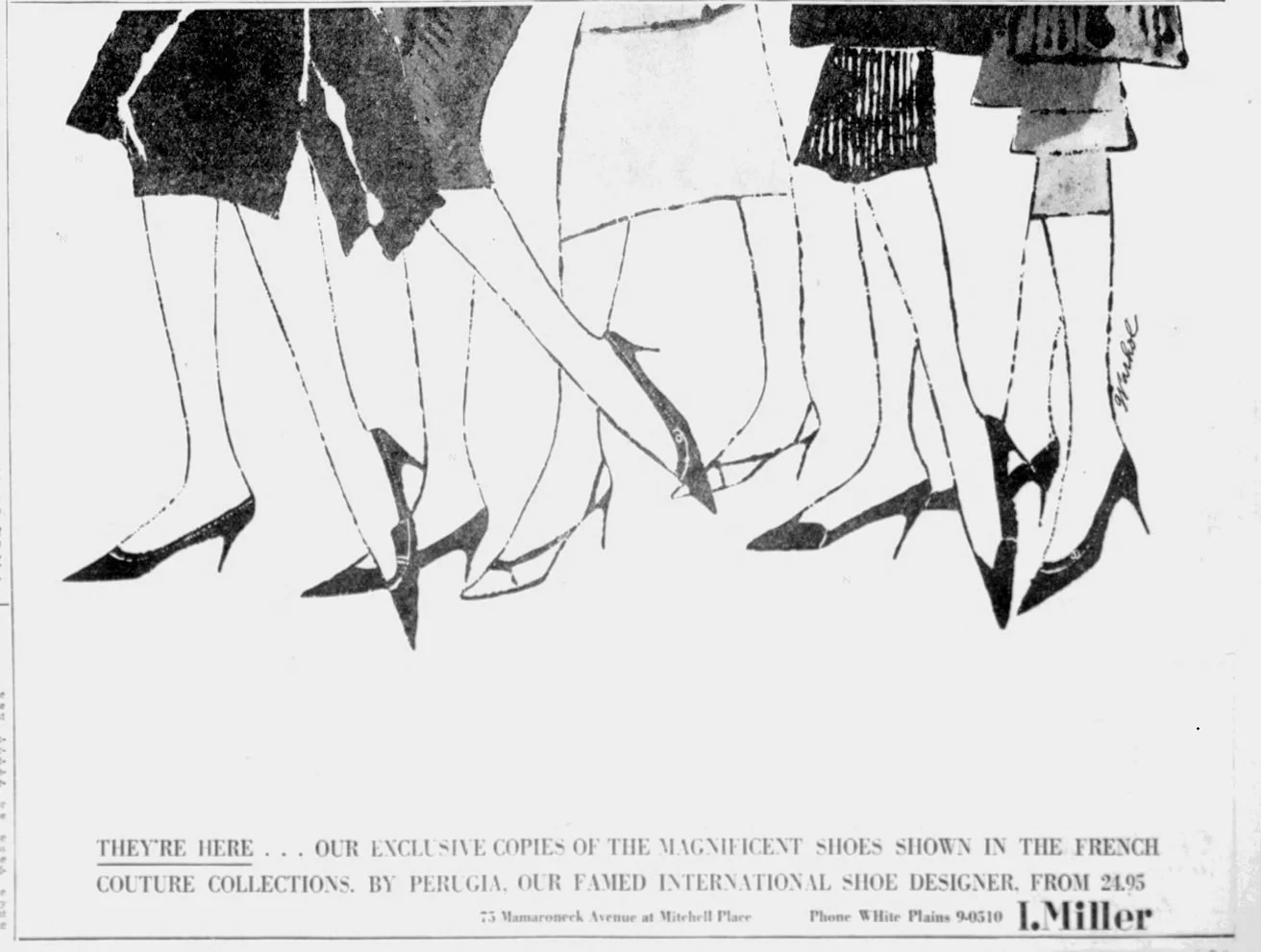
Warhol's sketchy-but-dynamic style made him a force to be reckoned with in the world of 1950s fashion art. Newspaper ad, White Plains Reporter-Dispatch, October 5, 1955.
Thirty-seven hundred miles to the east, young Michael Philip Jagger was drawn to music from his earliest years, first discovering his talent singing along with radio programs, and as a member of a church choir. He was seven years old when he met a schoolmate who shared his interest in music, a neighborhood boy with a gift for the guitar. Young Mick and his friend Keith Richards would be separated for a time when the Jagger family relocated, but fate had other ideas. They met again when Mick was an accounting student at the London School of Economics and discovered they had experienced a similar evolution in their musical tastes, moving from the simplistic style of early rock-and-roll toward a more sophisticated appreciation for pure rhythm and blues. Joined soon by a third friend, guitarist Brian Jones, in 1962, they formed a band they called "The Blues Boys," a stopgap name they soon abandoned in favor of "The Rolling Stones." At first cultivating a Beatlesque mop-top image, the band grew progressively shaggier as its blues-driven music grew more aggressive.
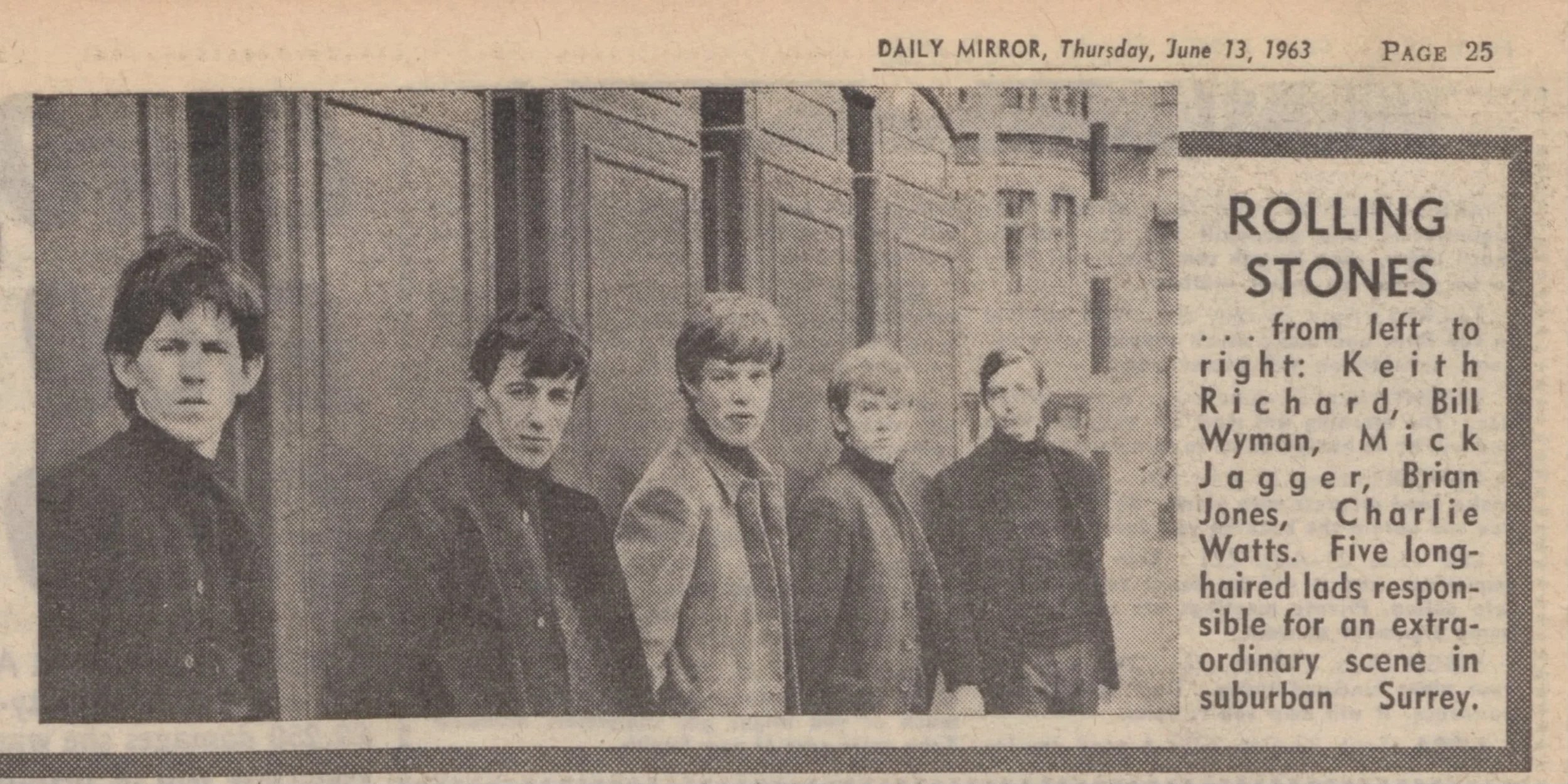
The earliest mention of Mick Jagger and the Rolling Stones in the London press. Daily Mirror, June 13, 1963.
Back in the USA, Andy Warhola shed the terminal "A" from his name and spent much of the 1950s as a commercial artist, drawing spare, elegant images for advertisements in fashion magazines. His sketches for a high-end Manhattan shoe firm gained particular attention not just for their effectiveness in selling shoes but for their artistic merit. His work became increasingly experimental, and the fine art world, not known for its appreciation of mere commercial illustrators, began to take note as the Pop Art movement gathered momentum, a movement drawing from the manufactured imagery of the mid-20th century as viewed through a lens of detached irony. First shown in the summer of 1962, Warhol's paintings of thirty-two different varieties of Campbell's Soup cans, their red, white, black, and gold labels identical in everything but the name of the flavor, epitomized that movement. The series brought Warhol national attention, and from the soup company, baffled by the meaning of it all, a complimentary case of Campbell's Tomato.
The intersection of these two unique talents occurred as a byproduct of the Rolling Stones' first American tour in the summer of 1964, as popular music's British Invasion phase reached flood tide. When the band arrived in New York for a series of appearances that included two dates at Carnegie Hall and a featured spot on television's Ed Sullivan Show, its members made the social rounds. Warhol, with his inborn talent for sensing any rising trend, was among the guests at a Park Avenue cocktail party thrown to welcome the Stones and immediately found common ground with the group's leader. Both of them self-made men, both of them highly conscious of the power of a self-created public image, Warhol and Jagger soon became fast friends, and for Warhol, Jagger also became a recurring artistic muse. "He's androgynous for almost anyone," commented the artist. "That's always been his basic appeal, mixed with the facts that (1) he's very talented, (2) he's very intelligent, (3) he's very handsome, (4) he's very adorable, (5) he's a great business person, (6) he's a great movie star, (7) I like his fake Cockney accent." In 1971, Warhol designed a unique outer sleeve for the Stones' album "Sticky Fingers," featuring a suggestive image of a male figure in tight blue jeans, with a die-cut opening at the center closed by a functional zipper, a project which generated publicity well in excess of the $18,000 fee the artist received for the project.
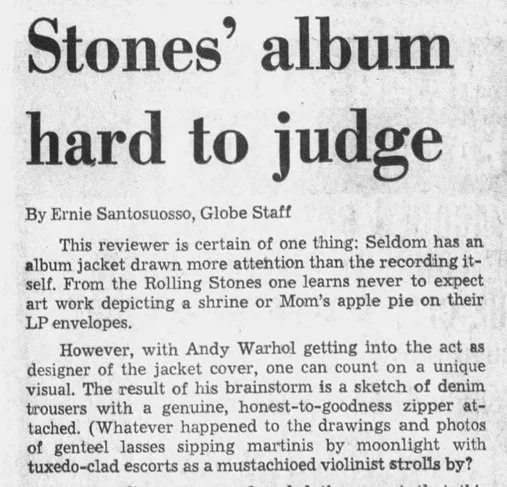
Not every critic was enthralled with the Warhol-created "Sticky Fingers" album cover. But they all talked about it. Boston Globe, May 2, 1971.
The success of "Sticky Fingers" ensured further artistic collaborations, and in 1975, Jagger approached Warhol to commission a portrait. The artist took several Polaroid photos and used selected images from this sitting as the basis for several painted portraits, and then, using additional images, manipulated, rearranged, and overlaid with various embellishments, Warhol created an entire series of ten Jagger screenprints. "If a person has one," Warhol declared, "he should have ten. I wanted more pictures of Mick around."
Master screen printer Alexander Heinrici, Warhol's printer of choice for much of the 1970s, executed the original edition of the Jagger series, on Arches Aquarelle paper, under Warhol's supervision. That edition consisted of two hundred and fifty complete portfolios, along with fifty artist's proofs of each print. The original release was pencil-signed, numbered by Warhol, and signed by Jagger in varying colors of felt-tip pen, some in green, some in red, and some in black. The complete portfolio was first sold through Seabird Editions of London at $25,000 per set. As ever with Warhol, the commodification of celebrity through the commercialization of art is itself its own work of art.
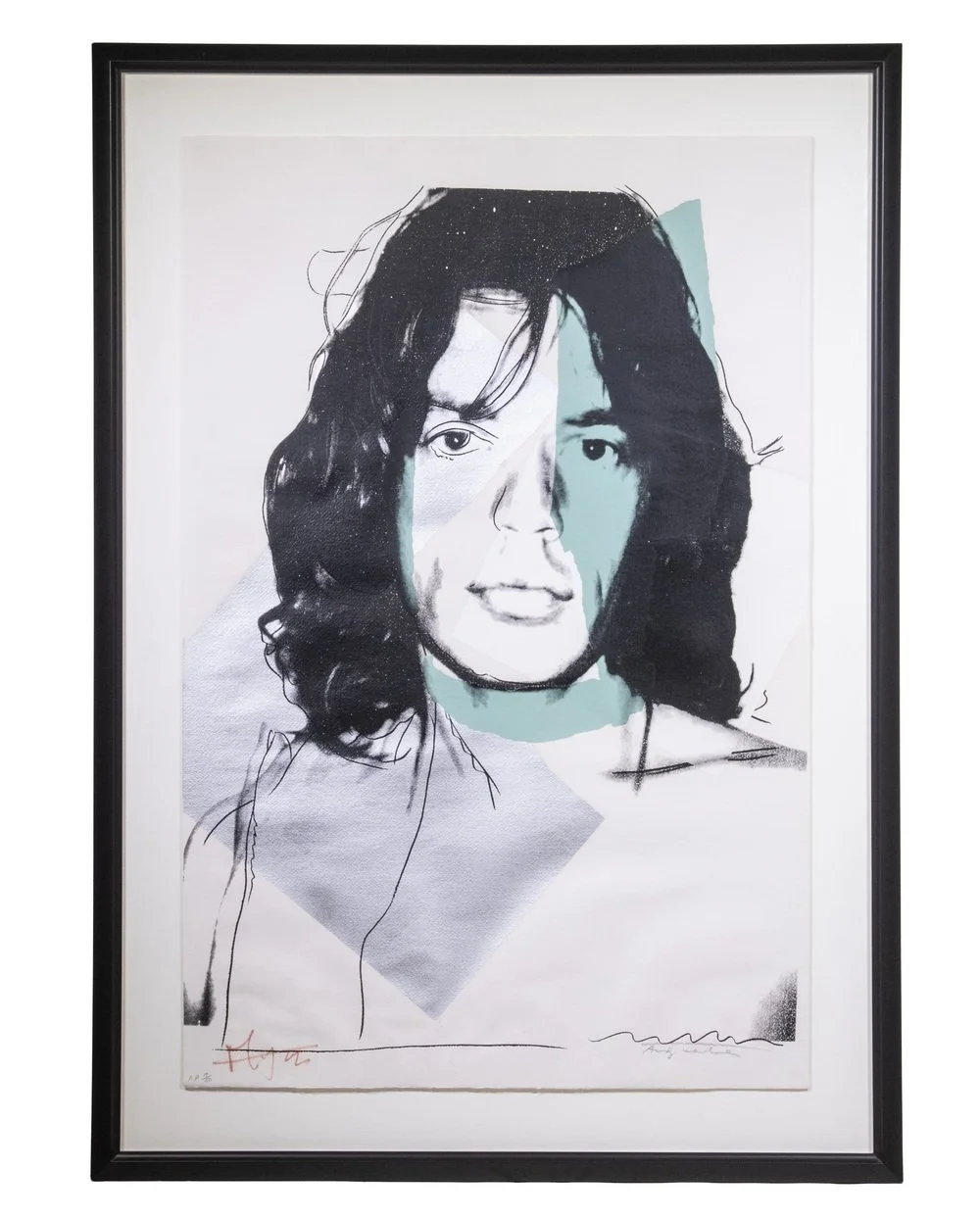
ANDY WARHOL (NY/PA, 1928-1987)
Lot 4083 | November 14, 2026
One of the most striking images from the 1975 Jagger portfolio appears as lot 4083 in our 2026 Autumn Majestic auction. Listed as "Mick Jagger 138" in Volume II of Feldman & Schellman's "Andy Warhol: Prints, A Catalogue Raisonné 1962-1987," the image presents an enigmatic full-face view of the singer, his features set not in the familiar aggressive pout of his stage persona, but in a calm, pensive expression. Blocks of a hard metallic silver color, of pale cream, and a tranquil sage green assert themselves across the image, and thin black ink lines trace and augment Jagger's face, hair, and shoulders. One eye is carefully outlined in black, while the other recedes into the green color field, giving the face a hint of dimensional depth. Simple at first glance, the combination of image, color, and linework slowly reveals the piece's emotional complexity. Below the figure, Jagger's signature appears at lower left in red felt-tip ink, above the limitation indicating that the print is number 19 of the fifty artist's proofs. At the lower right, Warhol's pencil signature unfurls below a long dash of graphite.
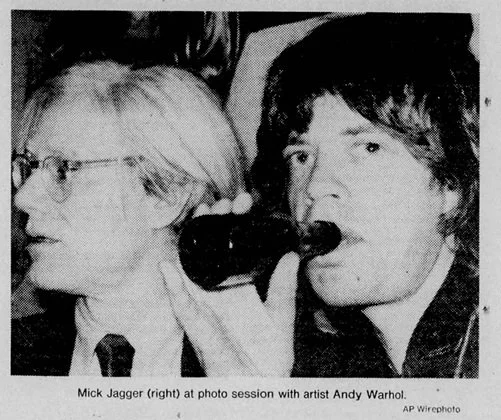
Even icons need a little relaxation. Andy Warhol and Mick Jagger on the town, Associated Press photo, October 17, 1977
Warhol and Jagger maintained a complex and occasionally difficult relationship to the end of Warhol's life, but at Warhol's death in 1987, it was Jagger who offered perhaps the most cogent commentary on the artist's unique appeal. "If you want to be reminded of a certain period," he said, "you can look at what Andy was doing then. He was very much in tune with what was going on." We invite you to rediscover the dynamic era of 1970s celebrity culture in our Autumn Majestic auction.
Be the First to Know
Sign up for emails here to be notified when the 2026 Autumn Majestic catalog goes live, including "Mick Jagger 138," Artist Proof 19/50, from the Mick Jagger Portfolio of 1975 by Andy Warhol.
For all other enquiries, please contact us.
Autumn Majestic
Date & Time: November 12th, 13th, 14th, and 15th - 11 AM
Location: Thomaston Place Auction Galleries, 51 Atlantic Highway, Thomaston, Maine
Bidding Options: In-person, by phone, or by absentee bid. Online bidding options are available at thomastonauction.com
Preview: November 7th — 12 PM - 5 PM and November 5th through 6th, November 9th through 11th — 10 AM - 5 PM
For details on how to participate, visit our How to Bid page or complete the Phone/Absentee Bid Form to register. With limited seating and phone lines available, collectors are encouraged to register early to secure participation.