
The City Of Everett Shinn
Whimsically Individual
Bold, yet delicate. Hard-edged, yet with a touch of sentiment. Realistic, yet ever so slightly romantic. How else can you describe the work of Everett Shinn?
At the turn of the twentieth century a leader in the rise in the "Ashcan School" of American art, with its focus on the honest depiction of everyday metropolitan life, but also a commercial illustrator who reveled in the make-believe glamour of the stage, Shinn's career was a web of apparent contradictions that nevertheless formed a fascinating and cohesive body of work.
Along with fellow "urban bohemians" Robert Henri, John Sloan, William Glackens, George Luks, Maurice Pendergast, Ernest Lawson, and Arthur Davies, Shinn gained fame as one of "The Eight," artists varying in their personal technique but united in their idea that art should depict the world people live in as it is, and who, following a landmark New York exhibition in 1908, triggered a national debate over the very nature of art. But Everett Shinn was no artistic radical. He remained, even at the peak of the Ashcan movement, an illustrator at heart, with an uncanny sense of capturing the spirit of the moment in the scenes he portrayed.
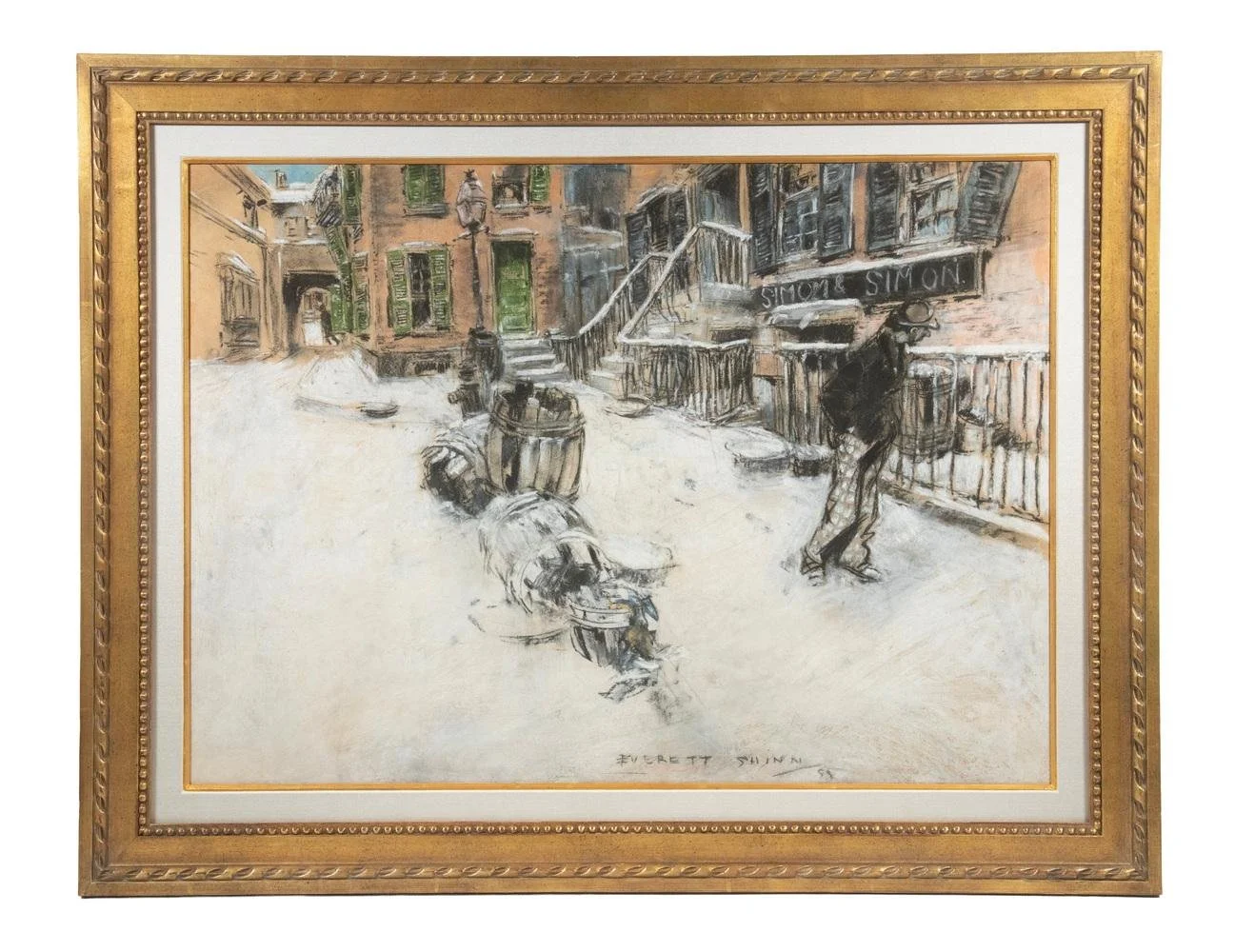
EVERETT SHINN (NY/PA, 1876-1953)
Lot 2195| June 27th, 2026
Everett Shinn’s “It Still Remains Whimsically Individual and Village Like", pastel and gouache on paper, signed lower center and dated '99, in gilt neo-classical frame, linen mat, under UV glass. Formerly on loan to the Farnsworth Museum in Rockland, Maine.
An outstanding example of this skill can be found in the work offered as Lot 2195 during Day Three of our upcoming Summer Splendor Auction Created by Shinn in 1899, early in the artist's career as an illustrator for the popular magazines of the day, this work in pastel and gouache carries the unusual title "It Still Remains Whimsically Individual and Village Like." While it may be tempting to presume from this real-estate-agent-hard-sell pronouncement that Shinn was here offering a sardonic comment on the real-life grittiness of the scene, the title was in fact drawn from an article by journalist and future Pulitzer Prize-winning playwright Jesse Lynch Williams entitled "The Cross Streets of New York," appearing in the November 1900 issue of Scribner's Magazine.
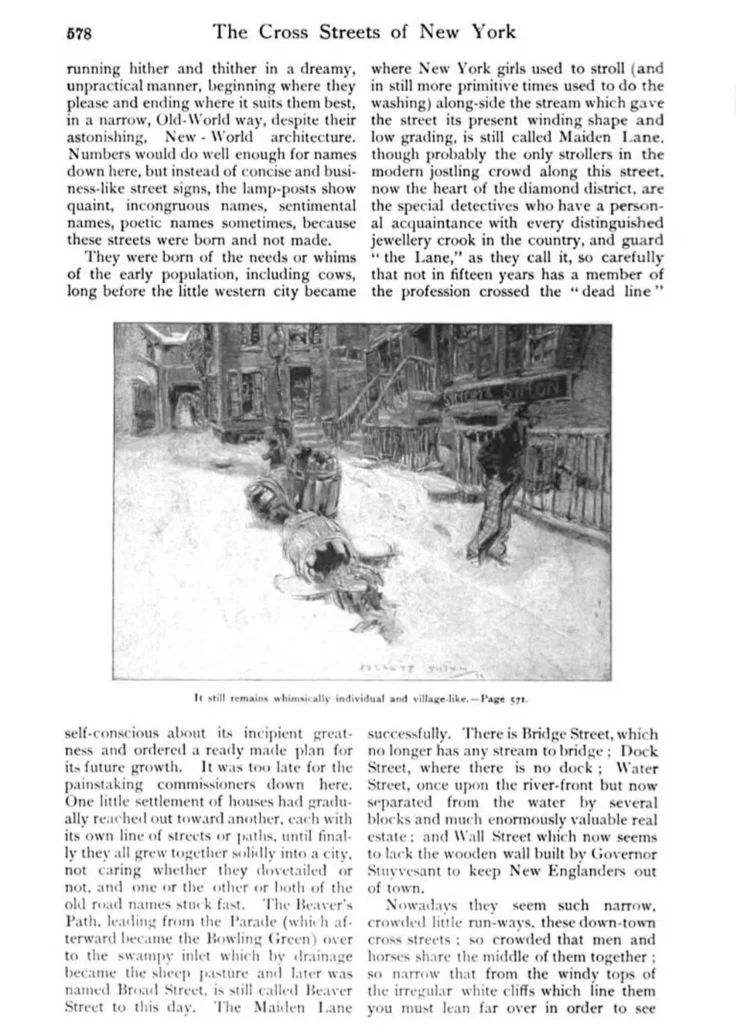
Page 578, Scribner's Magazine, November 1900. "Whimsically Individual" in situ, as originally published as a black-and-white halftone reduction.
Shinn's painting was one of several works used to illustrate this article, and depicts a typical scene in Greenwich Village — a section of the city which, Williams approvingly states in the article, remains "whimsically individual and village-like despite the attempts to swallow it whole by the 'new' city system." It was a section of Manhattan Shinn himself knew well, and furnished endless inspiration for his work in the bustle of its daily life. The reduced-size version of this work as published in Scribner's lost its moody colors and much of its fine detail. Seen at full size in the 20 1/2" x 28 1/2" original, with none of the subtleties of hue and shadow sacrificed to the exigencies of the printing process, Shinn's mastery not only of light and form but also of texture all come to the fore, drawing the viewer's eye along the row of soot-smeared salmon-colored brick houses with their stone stoops, weathered doors, and twisted iron rails, to the row of shattered barrels at the center of the image, and from there directly to the right, where an enigmatic figure in a battered hat, dark jacket and checked trousers pauses in mid-stroll to gaze out of the frame at — what? Or — whom? We will never know. We are simultaneously within the scene, yet forever isolated from it, much as any city resident moves daily through a world isolated from innumerable human dramas that unfold just out of view.
Everett Shinn did not mesh well with his fellow members of The Eight, most of whom were firmly, if perhaps self-consciously, committed to the idea of art-as-social-commentary. Shinn had no taste for politics, he had no interest in standing in the vanguard of an artistic revolution. His increasing focus on theatrical scenes, in a style more Degas-like than ever, only served to emphasize his repudiation of "message art." He cared little for the public recognition that goes with artistic fame, and as the twentieth century wore on, he exhibited only rarely. But late in the 1930s, with the Depression-era resurgence of interest in Social Realism at its height, he received his due acknowledgement as a vital figure in the origins of that movement, recognition which renewed his artistic career, and kept him in demand for murals and illustrations alike up to his death in 1953. His finest works still impress with their breathtaking technique and their surprising yet subtle emotional power.
Today, collectors and admirers alike have the rare chance to experience that same power firsthand. Works by Shinn and his contemporaries come to auction only occasionally, and this landmark event offers a unique opportunity to engage directly with the art and history that shaped Social Realism.
Summer Splendor
Date & Time: June 26th, 27th, and 28th - 11 AM EDT
Location: Thomaston Place Auction Galleries, 51 Atlantic Highway, Thomaston, Maine
Bidding Options: In-person, by phone, or by absentee bid. Online bidding options are available at thomastonauction.com
Preview: June 13th, June 20th — 12 PM-5 PM and June 15th through 19th, June 22nd through 25th — 10 AM-5 PM
For details on how to participate, visit our How to Bid page or complete the Phone/Absentee Bid Form to register. With limited seating and phone lines available, collectors are encouraged to register early to secure participation.
References
Zurier, Rebecca. Picturing the City: Urban Vision and the Ashcan School. Berkeley, Los Angeles, London: University of California Press, 2006
Williams, Jesse Lynch, illus. by Everett Shinn, et al. "The Cross Streets Of New York. Scribner's Magazine, November 1900.