
Discover Duncanson
Master of American Landscape Art
How did the son of a family once enslaved rise to the pinnacle of 19th-century global acclaim as a painter of compelling landscapes? Was there more to his work than meets the eye? Discover the life and career of Robert S. Duncanson!
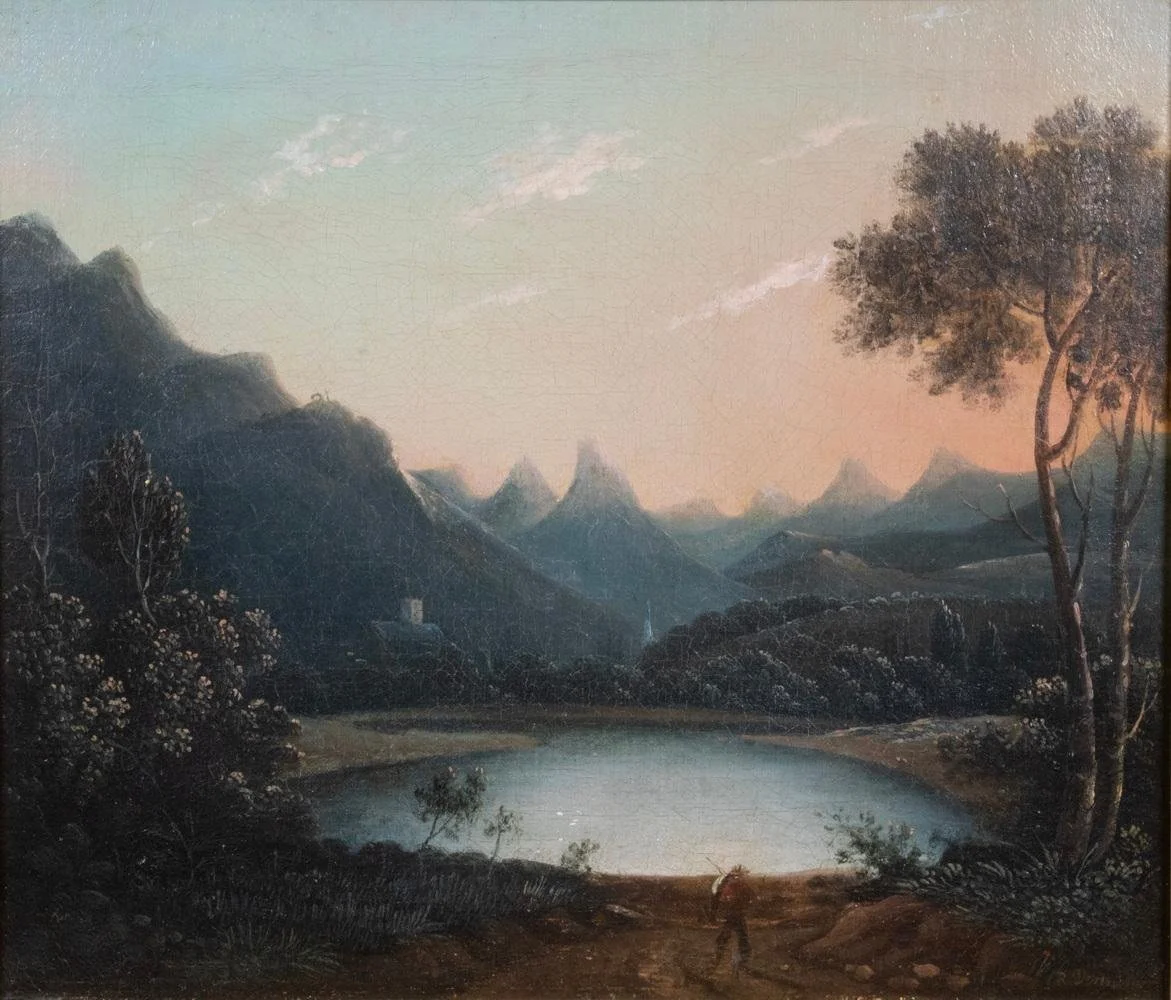
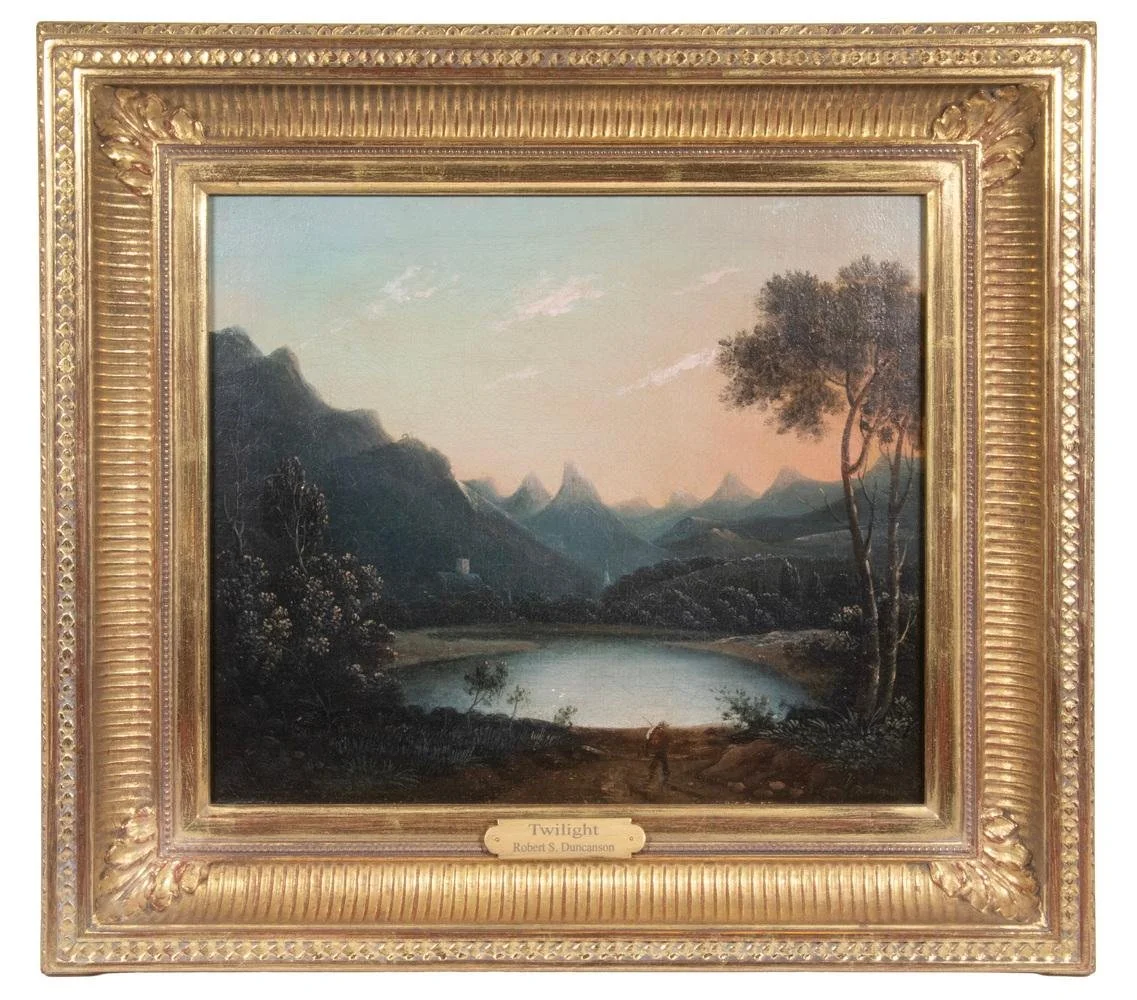
“Twilight” by Robert S. Duncanson. An evocative landscape is among the artist's earliest known works, circa 1849.
He was celebrated during his lifetime, but overlooked for nearly a hundred years after his death. But more than two hundred years after his birth, Robert Seward Duncanson stands as a towering figure in 19th-century American art. A landscape artist of refined skill and distinctive vision, Duncanson rose from obscurity to global renown over the span of twenty years as the first African American to achieve international fame as a painter, and as a figure admired and promoted by the Abolitionist movement in the years before and during the Civil War.
A JOURNEY BEGINS
Born in western New York around the turn of the 1820s to descendants of formerly enslaved people from Virginia, Robert Duncanson was the son of a carpenter and house painter, and as a youth learned those trades from his father. Something about brush and paint appealed to the young man, and after establishing himself with his own house painting business, he experimented with using the tools of his trade for a more artistic purpose. Copying existing works at first, he soon taught himself to draw and paint from life, moving from still lifes to portraits. By the time he was twenty years old, Duncanson began painting portraits for hire, moving from town to town around portions of Michigan and Ohio. By the time he was twenty-two, his works were exhibited by the Cincinnati Academy of Fine Arts. But the reality of the times in which he lived blunted his pride in this accomplishment: his family was denied admission to the exhibit hall because of their race.
Duncanson settled briefly in Detroit, where in late 1845 he rented a studio and advertised his services as a portrait artist, guaranteeing that his clients would find his work satisfactory or they would owe nothing. His advertisements, running steadily in the Detroit newspapers through the spring of 1846, produced a steady flow of commissions, and his work began to attract favorable notice in the press. He began also to move beyond the strictures of formal portraiture, experimenting with genre art and, after returning to Cincinnati by the end of 1846, with landscapes.
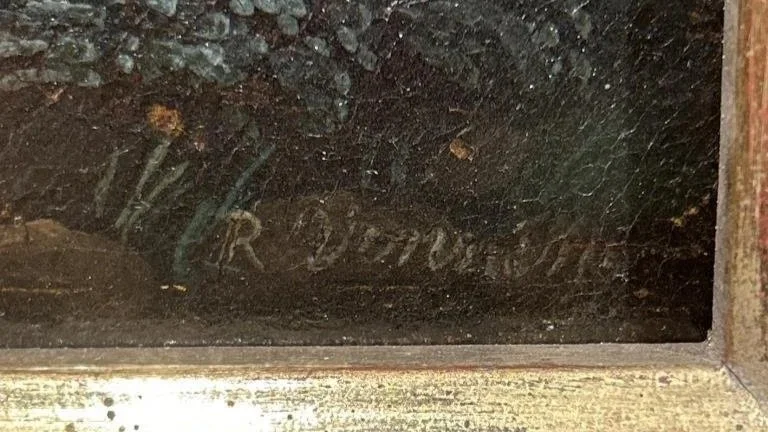
“Twilight” by Robert S. Duncanson. Signed in the lower right corner by the artist.
A VISION DISCOVERED
Duncanson's interest in landscape painting was very much a product of a creative current washing across the American artistic consciousness of the 1840s. The growing influence of Thomas Cole, Asher Brown Durand, Frederic Edwin Church, and other disciples of the Hudson River School moved the discipline well beyond the mere recording of a scene toward works deliberately layered with spiritual meaning and subject to broad interpretation of the significance of each element shown. Duncanson first studied published prints for inspiration before moving on to studies from nature along the Ohio River Valley. It was during this early landscape period that he received the commission that would change his life.
Charles Avery was a man of many vocations. He was a merchant, a manufacturer, and a Methodist minister, a devout Wesleyan who believed passionately that human slavery as practiced in the American South stood as the fundamental evil of his time. Based for most of his life in Pittsburgh, the Rev. Avery opened a school there to train free African Americans in the skilled trades -- and may also have used that school as a way station along the Underground Railroad by which people escaping from slavery might find their way to freedom. In 1848, Avery commissioned Duncanson to paint a scene depicting the Cliff Mine, a thriving copper site in Clifton, Michigan, that employed a number of free African American workers.
Duncanson traveled to Keweenaw County, Michigan, to complete the commission, creating a dramatic scene depicting in meticulous detail the mining camp dwarfed by the majestic rocky cliff that gave the mine its name. Although the actual cliff was composed of greenstone, the artist selected rich shades of red, gold, and brown to depict the formation, edged with deep green spruce trees, as the sun glows just below the top of the bluff. In the close foreground, jagged stumps and a single remaining scraggly tree suggest an undisciplined haphazardness in the clearing of the site, reinforcing a sense of human industry forcing itself upon unwilling nature. This haunting, moody work was characteristic of Duncanson's approach to landscape art, where deeper meaning always lingers just below the surface beauty.
A REPUTATION GROWS
The Cliff Mine painting attracted the notice of other important leaders in the Abolitionist movement, leading to further lucrative commissions, and in gratitude for Avery's encouragement and support, Duncanson presented his patron with a unique depiction of the Garden of Eden, transposing that Biblical setting to a depiction of a lush semi-tropical American wilderness opening upon an impressive, but distant, mountain peak. In presenting the piece to Avery, Duncanson explained his intended interpretation of each symbolic element, but newspaper accounts conspicuously omitted the specifics of his explanation. The work was clearly inspired by Thomas Cole's depiction of the same subject but differs sharply in its muted palette and the darker skin tones of its two small human figures.
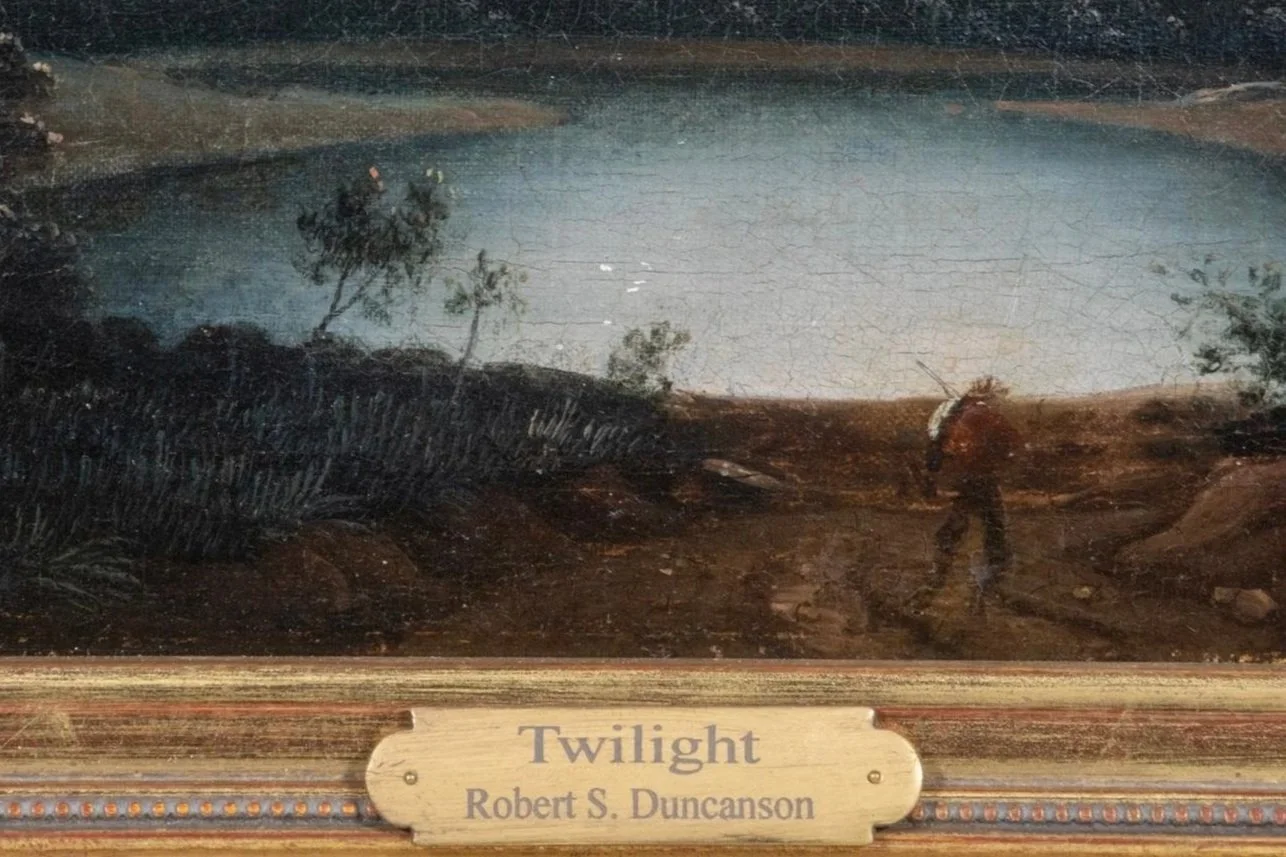
“Twilight” by Robert S. Duncanson. A man walks through the lush landscape, carrying what appear to be his personal belongings across his left shoulder.
It was during this early period of his success as a landscape artist that Robert Duncanson created a small painting entitled "Twilight," offered by Thomaston Place Auction Galleries as Lot 2190 in its 2026 Summer Splendor Auction. Again featuring the motif of a lush clearing opening onto a rugged horizon, a small pond reflects the light of a sunset just out of view, while a single figure crosses in the foreground, carrying an implement and a bag across his left shoulder. On the opposite edge of the pond, the roof and chimney of a house are visible, and the man directs his gaze away from that structure. Like the figures shown in "The Garden of Eden," this man appears dark-complexioned. He may be a fisherman, a hunter, or a traveler. Is he approaching the house, or is he leaving it behind? Is he, possibly, even escaping from that house? But whatever his purpose, he walks in isolation as he faces the oncoming night.
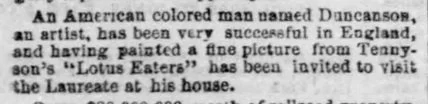
Pittsburgh Post-Gazette, November 28, 1865. Duncanson's visit to Alfred, Lord Tennyson garnered international notice.
Duncanson's career as an artist blossomed in the 1850s. In 1853, leading Abolitionists financed his participation in a Grand Tour of Europe, where he studied the work of the Continental masters as he traveled through France, Italy, Germany, and England. He was the first African American artist to make this journey, and the inspiration he received on the tour would carry through his work for the rest of his life, producing dreamlike, idyllic scenes of Italian landscapes. He would travel to Europe again in the 1860s, when he befriended British poet Alfred, Lord Tennyson, and exhibited his monumental work "Land of the Lotus Eaters," inspired by Tennyson's poetic description of the mythological paradise that seduced the forces of Odysseus. In Duncanson's vision, that Land is clearly a scene of an unspoiled New World, but whether the image depicts the pre-European past or a conjectural future is left to the viewer.
As is the case across the entire body of Duncanson's work, the ultimate interpretation of his meaning in "Lotus Eaters" is both subjective and suggestive. While he painted only a single known work with an overtly racial theme -- an 1853 elaboration of an engraving from "Uncle Tom's Cabin" depicting Uncle Tom and Little Eva -- the question of racial consciousness looms as the dominant subtext in most 21st century considerations of Duncanson's art, and the academic debate over his intended interpretation continues.
Duncanson spent the Civil War years based primarily in Canada, but he returned to the United States and to the Ohio River Valley in 1866. He continued to paint landscapes inspired by his travels, and by works of literature, such as his impressive "Ellen's Isle, Loch Katrine." This image, drawn from Sir Walter Scott's "Lady of the Lake," is often considered the ultimate realization of Duncanson's style and vision, in its romanticized yet ambiguous depiction of a lush Scottish lakeside under a brilliant setting sun.
A LEGEND FADES
But as he entered his fifties, Duncanson's personal behavior grew erratic. Possibly years of exposure to toxic lead pigments, first as a housepainter and then as a fine artist accustomed to preparing his own oil paints, was taking its toll on his mind. When hanging an exhibition in Detroit in the fall of 1872, he collapsed from a seizure and was placed in the care of The Michigan Retreat for the Insane. He died there on December 21, 1872.
Despite his prolific output, Robert S. Duncanson's reputation faded by the end of the 19th century, but there were periodic attempts to revive interest in the artist and his work. Cincinnati's largest newspaper commemorated the 50th anniversary of his passing in 1924 with a detailed biographic sketch and a critical appreciation of his art. In 1949, the Detroit Institute of Art included three Duncansons in an exhibition of "Detroit Painters before 1900." And in October 1951, Art in America magazine called for a full-scale reappraisal of Duncanson's work in James A. Porter's landmark study "Robert S. Duncanson, Midwestern Romantic Realist." At the time of that publication, only 24 of 54 then-cataloged works by Duncanson were known to survive in museums and private collections. Three years later, the Cincinnati Art Museum included Duncanson in an important exhibition entitled "Rediscoveries in American Painting."
A LEGACY REBORN
But it remained for the centennial of Duncanson's death in 1972 to spark a nationwide revival of the artist's reputation and a new appreciation of the work. Forty Duncansons from museums across the United States were assembled that spring in Cincinnati for the first comprehensive exhibition of his work in over a century, attracting strong notice both by art historians and the general public. In 1984, an exhibition of Duncanson's work in Durham, North Carolina -- touted as the first exhibition of his paintings in the South -- was described in a newspaper account as proof that Duncanson's art stands on its own merits quite apart from its historical significance. "But Duncanson is left out," wrote reviewer Blue Greenberg in the Durham Herald-Sun, "when others of similar ability are remembered. The idea that history is written by and about white middle-class males continues to nag."
Greenberg concluded her review of the 1984 exhibition with a firm assessment. "Duncanson's work," she declared, "stands well above the medium of 19th-century American painters. He deserves a permanent place in the history of American art." A national touring exhibition of Duncanson's work in 1995-96 further reinforced that argument. "Lifting the Veil: Robert S. Duncanson and the Emergence of the African American Artist" featured a selection of fifty works loaned from collections worldwide, along with an impressive archive of documentary information. A catalog raissone for Duncanson's work, prepared by scholars Michael F. and Julie E. Meyer, continues to expand as new discoveries are documented. The "permanent place in American Art" for Robert S. Duncanson's work seems well assured. We at Thomaston Place Auction Galleries are proud to play a role in helping to ensure the preservation of that legacy.
ROBERT S. DUNCANSON (NY/OH/MI, 1821-1872)
Lot 2190 | June 27th, 2026
"Twilight," circa 1849, oil on canvas, signed lower right. An evocative landscape by Robert Seldon Duncanson, this twilight painting is among the artist's earliest known works and reflects his engagement with the Hudson River School. In a custom 22K gold match corner ribbed cove frame.
Conservation treatment was carried out by a leading professional conservation studio. The surface has been cleaned to remove accumulated dirt, soot, a discolored soft resin varnish, and old overpaint. Minor scattered stains, small historic losses, and limited frame-related abrasions were addressed with precise inpainting. The work was subsequently finished with multiple layers of UV-protective varnish, including a final matte application, resulting in a beautiful satin surface.
Dating to circa 1849, the work belongs to a formative period in Duncanson's career, displaying his emerging lyrical approach to landscape painting. Born in Fayette, New York, Duncanson was among the most important nineteenth-century American landscape painters and one of the first African American artists to achieve international recognition. Accompanied by the definitive reference on the artist, "Robert S. Duncanson and His Courageous Southern Travels," in which this work is included by leading scholars Michael F. Meyer and Julie E. Meyer. According to a previous owner, the work was first discovered on an island in the Caribbean.
Provenance: Lawrence W. Cramer, Secretary General of the Caribbean Commission, U.S. Virgin Islands; Private Collection, North Carolina; acquired by the present owner.
Summer Splendor
Date & Time: June 26th, 27th, and 28th - 11 AM EDT
Location: Thomaston Place Auction Galleries, 51 Atlantic Highway, Thomaston, Maine
Bidding Options: In-person, by phone, or by absentee bid. Online bidding options are available at thomastonauction.com
Preview: June 13th, June 20th — 12 PM-5 PM and June 15th through 19th, June 22nd through 25th — 10 AM-5 PM
For details on how to participate, visit our How to Bid page or complete the Phone/Absentee Bid Form to register. With limited seating and phone lines available, collectors are encouraged to register early to secure participation.
References
Ketner, Joseph D., The Emergence of the African American Artist: Robert S. Duncanson, 1821-1872. Columbia, MO: University of Missouri Press, 1993
Moore, Lucinda, America's Forgotten Landscape Painter: Robert S. Duncanson. Smithsonian Magazine, Washington DC, October 18, 2011. Online at https://www.smithsonianmag.com/arts-culture/americas-forgotten-landscape-painter-robert-s-duncanson-112952174/
Pelto, Brendan, Black Americans in Michigan's Copper Mining Narrative. Unpublished Master's Thesis, Michigan Technological University, 2017. Online at https://scispace.com/pdf/black-americans-in-michigan-s-copper-mining-narrative-573uqw4v8w.pdf
"Conteur" (pseud. for Henderson, Edwin), Robert S. Duncanson, A Cincinnatian Who Became World Famous As An Artist. The Cincinnati Enquirer Sunday Magazine, Cincinnati OH, December 21, 1924.
Greenberg, Blue, Painter's Place In History Proven, Durham Morning Herald, Durham NC. June 15, 1984.