
The Art of Amphora
Fine Bohemian Art Pottery from the age of Art Nouveau
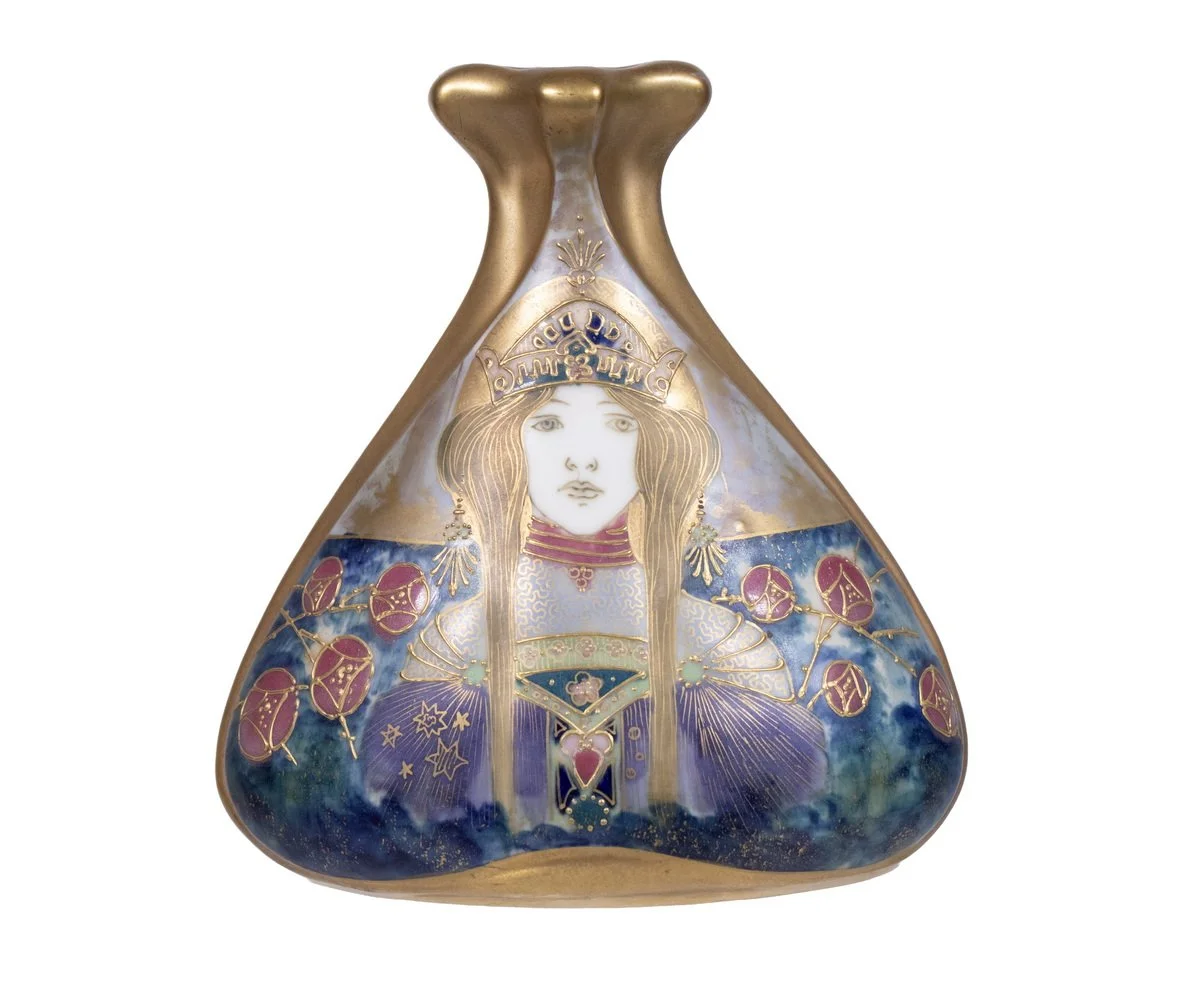
Austria Amphora Art Nouveau Portrait Vase. A fine specimen of a faux-cloissone effect skilfully created with enamels in a Russian motif.
There is a certain look, a certain style, that epitomizes a unique period in the history of the decorative arts, a style sinuous of curve and dynamic of form, and boldly innovative in its manipulation of everyday materials of construction and manufacture. The Art Nouveau movement reached its peak over a narrow twenty-year span, bridging the nineteenth and twentieth centuries, but it left behind a legacy that has far outlasted its original vogue. And very much at the center of that movement was the Bohemian pottery firm known as Amphora. Elaborate of design and coveted for well over a century by collectors, Amphora pieces stand today as a definitive symbol of their era.
Named for the traditional Greek wine vessel, and often considered of Austrian origin, Amphora pieces were never actually manufactured within the borders of Austria itself. The firm arose in the Bohemian region of Turn-Teplitz, then a part of the Austro-Hungarian Empire, and today located on the northwestern border of the Czech Republic. Shifting borders and changing political tides would bear heavily on the future of the Bohemian region, but when a Thuringian German named Alfred Stellmacher settled there in 1876, the region was a center of ceramics manufacture, the rich kaolin clay found in its soil producing pottery of a very high grade.
Stellmacher had a longstanding background in ceramics production, and when he arrived in Bohemia he achieved immediate success with a line of fine ivory-colored porcelain, fashioned into flowers and similar decorative objects. With his work recognized with high honors at the Paris World Exhibition in 1889, Stellmacher looked toward further expansion and diversification of his work. The result was a partnership with his son, Eduard, and his two sons-in-law, Hans Reissner and Rudolf Kessel, in the operation of a new and larger factory, with international ambitions both artistic and commercial.
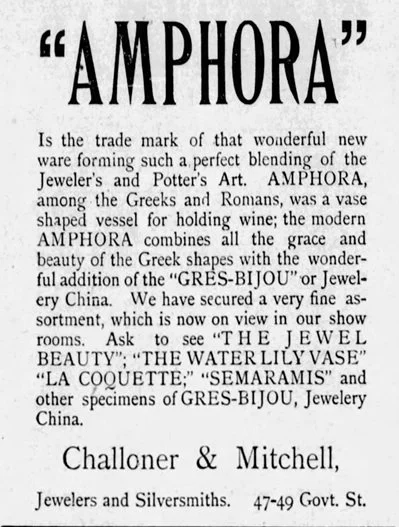
Advertisement, Victoria (B. C.) Daily Times, August 30, 1905, announcing the arrival of Amphora's Gres-Bijou Line. Amphora products were widely sold in fine department stores and specialty shops across much of North America.
The result was a line of dramatically-styled porcelain, ceramic, and faience earthenware pieces designed for the luxury export market. Eduard Stellmacher had studied at the Arts and Crafts Academy in his native Dresden, and with his brother-in-law Paul Dachsel as an artistic associate, supervised the creation of vases, jars, and figurines fully in keeping with the Art Nouveau trend then sweeping Belle-Epoque Europe, to be marketed under the "Amphora" label.
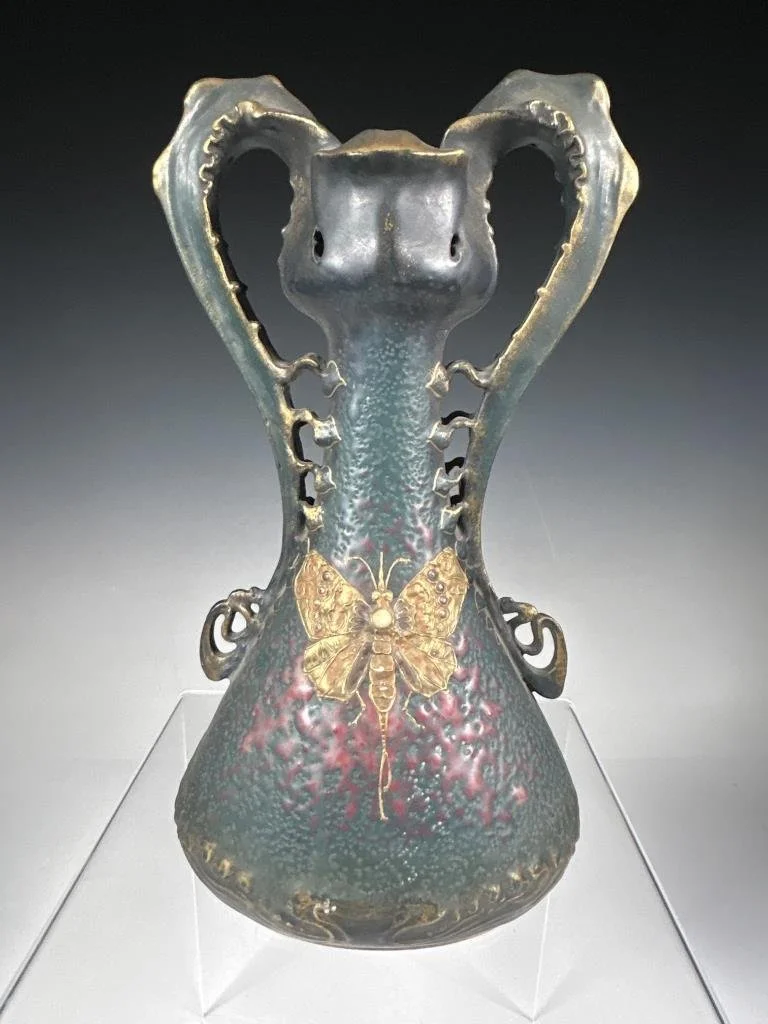
Austria Amphora Art Nouveau Jeweled Double-Handled Butterfly Vase. An early piece in the Gres-Bijou style, with the early maker's mark "RStK," for Reissner, Stellmacher, and Kessel, impressed in the base.
Amphora products made their international mark immediately. Exhibited at the World Columbian Exhibition in Chicago in 1893, the landmark World's Fair of its era, Amphora pieces were honored with a gold medal as Best In Show. A similar award followed at the San Francisco Exhibition in 1893. And when the pieces began to be imported into the United States in bulk at the turn of the 20th century, they arrived just in time for a national decorating trend. "L'art nouveau, that strange new art that has captured Paris," declared a Los Angeles department store advertisement in 1900, "comes in vases, jardinieres, and fancy pieces." Priced from a then-hefty $7 for a small shelf-sized vase to a monumental $50 for a floor-sized ornamental urn, at a time when the average American earned less than $38 per month, Amphora pottery found enthusiastic purchasers among the wealthy and the trend-conscious, due in no small part to the support of Louis Comfort Tiffany, who called the attention of his clientele to the pieces at his exclusive New York shop.
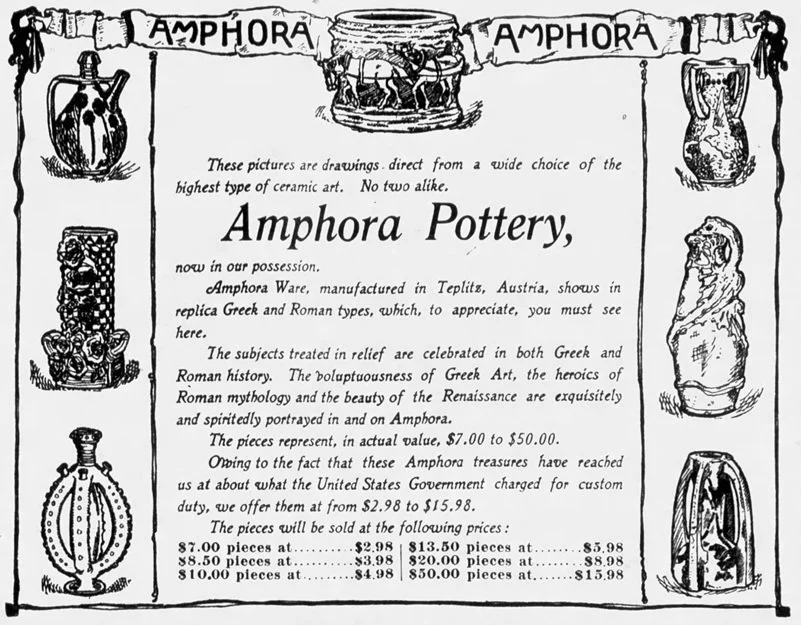
Advertisement, Brooklyn Times-Union, November 28, 1909. An enormous shipment of Amphora products arriving in New York aboard the liner SS Abraham Lincoln in the fall of 1909 led to dramatic reductions in retail prices, helping to bring the objects within reach of middle-class purchasers.
In American newspapers from coast to coast, breathless advertising copy from specialty shops and fine department stores alike touted the Amphora collection as combining "the voluptuousness of Greek art, the heroics of Roman mythology, and the beauty of the Renaissance," and the prose, though perhaps overheated in the manner of the time, does suggest the unmistakable visual impact of the pieces. Ornately formed and richly ornamented with shapes of fruits, flowers, and foliage, figures of women and of fantasy creatures, and thickly glazed with iridescent color, it could well be claimed that no two Amphora creations were exactly alike. With the advent of its Gres-Bijou, or "Jeweled Stoneware," line in 1904, Amphora reached its creative peak with designs featuring wildly imaginative insect and spiderweb motifs, studded with simulated cabochon jewels of glass and vitrified enamel in a lavish symphony of color, shape, and texture. The Gres-Bijou line brought Amphora to the pinnacle of its creative and commercial success, earning plaudits at the 1904 World's Fair in St. Louis. "From the melting heat of the glowing fire," announced the advertising, "a triumph of ceramics, a jeweled beauty of pottery." American firms hastened to imitate the style, but could not hope to capture the inspiration.
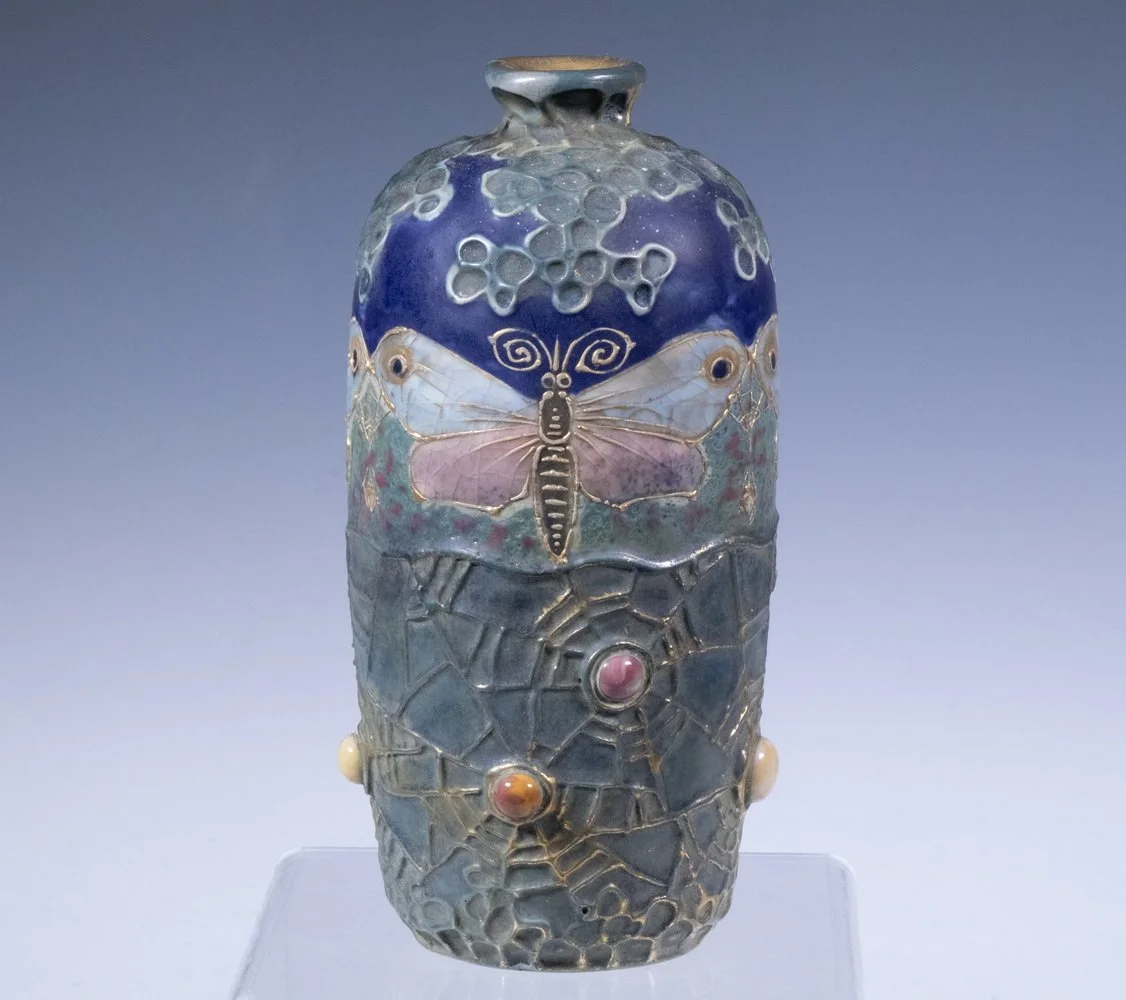
Austria Amphora Art Nouveau Jeweled Butterfly Vase. A choice example of the fully-realized Gres-Bijou style.
The introduction of the Gres-Bijou line roughly coincided with the end of the original firm of Reissner, Stellmacher, and Kessel. Edouard Stellmacher and Paul Dachsel had already left the firm by the time the new pieces reached the market to begin design studios of their own, but Hans Reissner remained to oversee continued development of new designs. American sales remained brisk through the 1910s, as innovative marketing brought selected pieces to a price point within reach of the striving upper middle class. But the eruption of the First World War in 1914 and its impact on the European export market brought the end of Amphora's golden era
The firm, now called "Amphora Werke Reissner" after the sole remaining original partner, continued on. With the fading of the Art Nouveau era, Reissner's designers explored new esthetics, creating pieces in styles evocative of ancient Egyptian, Roman, and Greek imagery, and of the bold new Art Deco movement. But the German occupation of what had been Czechoslovakia at the start of the Second World War put an abrupt end to this final period of Amphora art pottery production. The factory would reopen after the war under the operation of the Czechoslovakian government, producing ceramics of far more prosaic, everyday design.
Sturdy in form yet delicate in design, original Amphora creations survive today as prized collector pieces, having lost none of their power to dazzle, to impress, and to surprise. We are proud to offer an array of these distinctive works of ceramic art, from the collection of Richard Plunkett, in our April 17th Design & Decor Auction.
Design & Decor
Date & Time: Friday, April 17th - 11 AM EDT
Location: Thomaston Place Auction Galleries, 51 Atlantic Highway, Thomaston, Maine
Bidding Options: In-person, by phone, or by absentee bid. Online bidding options are available at thomastonauction.com
Preview: Open to the Public, Tuesday, April 14th through Thursday, April 16th, 11 AM to 5 PM EDT
For details on how to participate, visit our How to Bid page or complete the Phone/Absentee Bid Form to register. With limited seating and phone lines available, collectors are encouraged to register early to secure participation.
References
Amphora Collectors International, the worldwide association of all those fascinated by the beauty and the lore of Amphora art pottery, at https://amphoracollectors.org