
Elegance In Relief
The Enduring Popularity of Cameo Jewelry
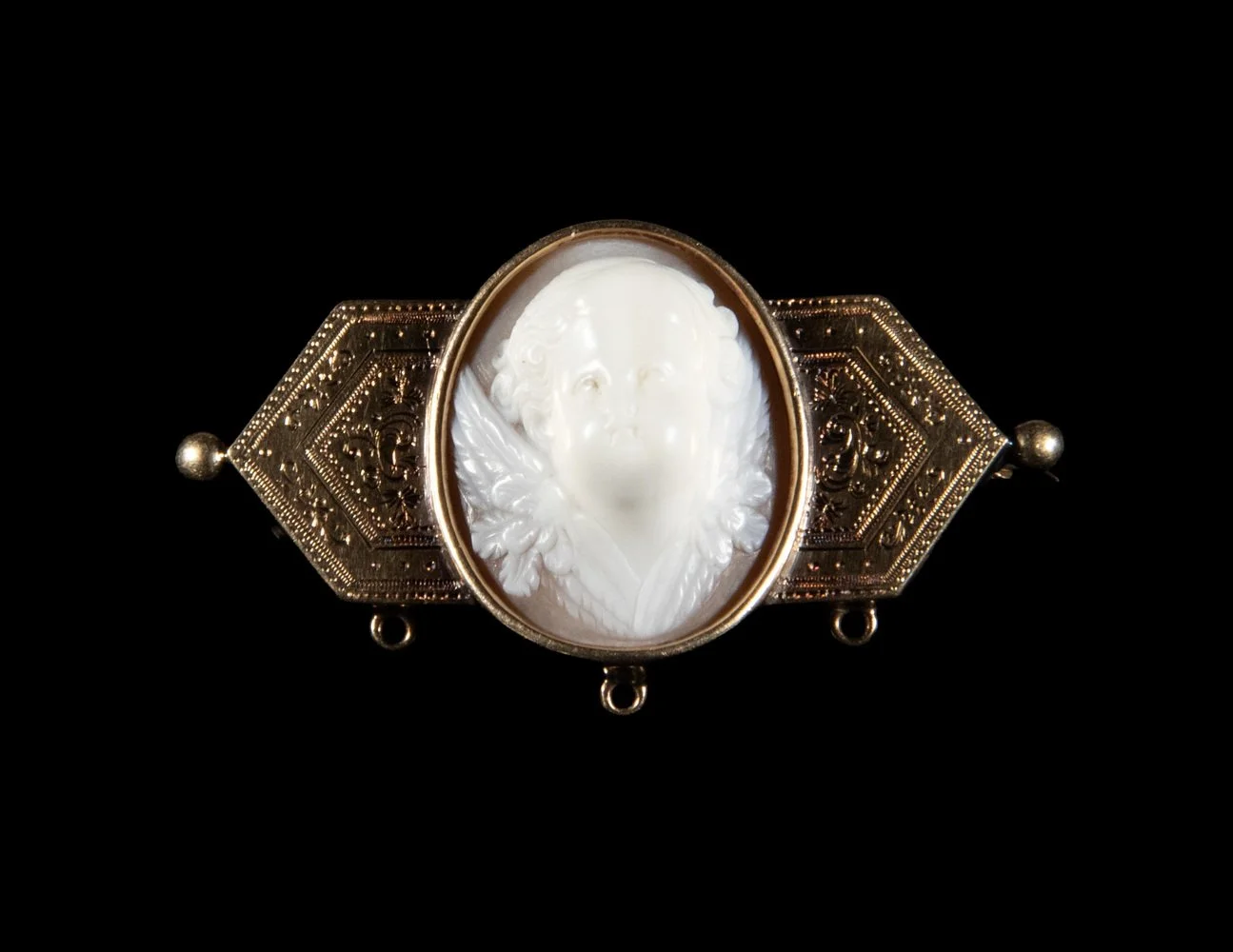
Victorian 14K Gold Cameo Brooch. A dramatic high-relief rendering of a Cupid figure in full-face view commands attention from within an elaborate gold frame.
Delicate, refined, and evocative of the past, yet with an appeal that transcends generations. Cameo jewelry is one of fashion's constants, its popularity rising and falling with the trends of the moment, yet never truly out of style. The subtle beauty of a classic cameo can easily be taken for granted, until you stop and consider the level of artisanship that went into its creation.
To be strictly technical, a cameo isn't an object at all, it's the process by which that object is brought into being. "Cameo," a word derived from Italian, Middle French, medieval Latin, Arabic, or some combination of each, depending on the theory you choose to embrace, was first used in 15th Century English to describe the process of carving a stone or gem by removing the outer layer of the source material so that the image stands out in relief, exposing the inner layer of the material to display in a contrasting color.
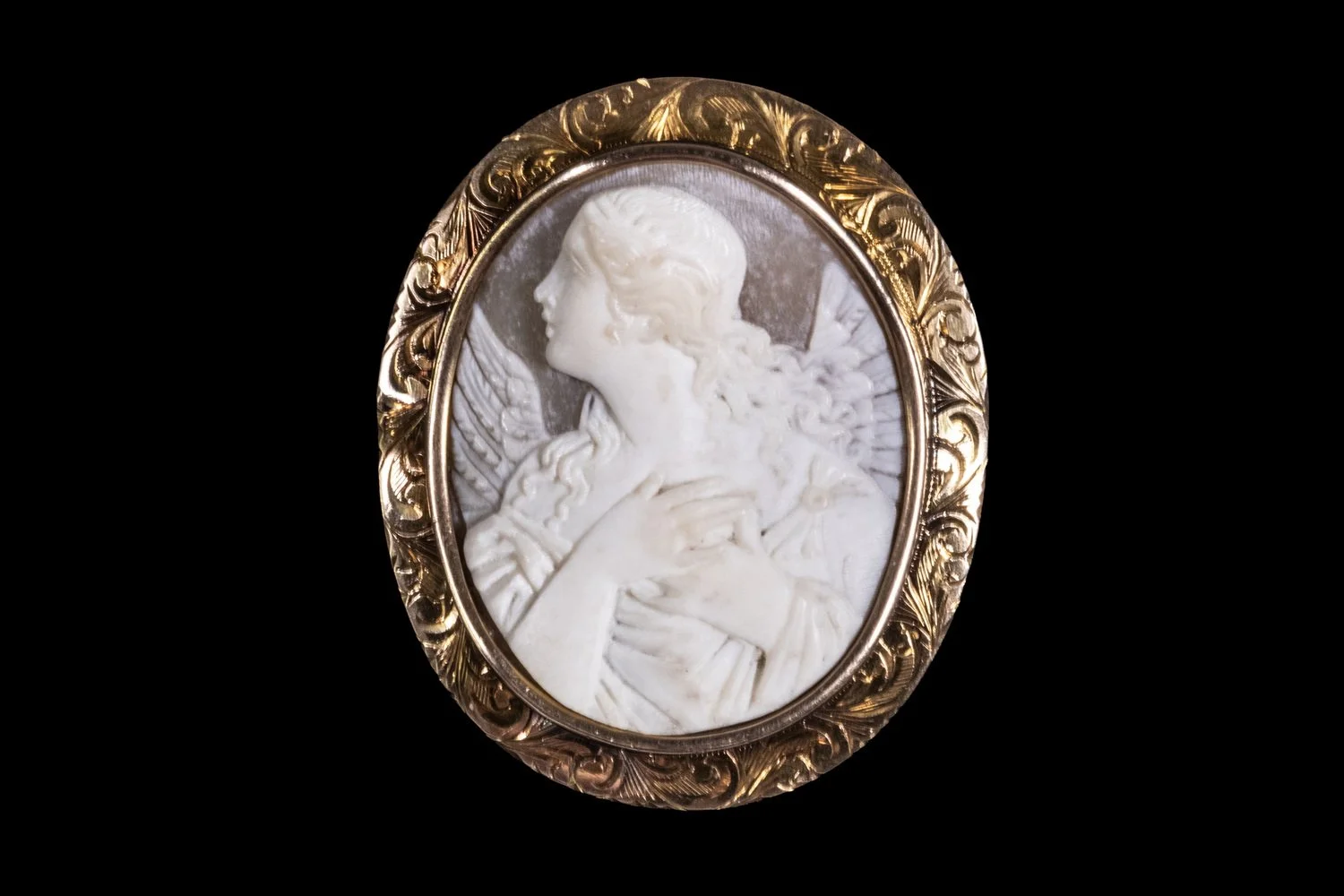
Victorian 14K Gold Cameo Brooch. A classic example of 19th century cameo workmanship, featuring a detailed yet delicately carved figure on shell, framed in an engraved golden bezel.
Creation of cameo imagery from hard, multi-layered stone was raised to a high art in the Roman world, and the objects thus created often had a practical application for use as official seals or signets. The more elaborately carved the cameo seal, the more impressive the dignitary who used it to affix his mark to documents of business or state. But Roman artisans also used the cameo technique to create objects of personal adornment or fine art, whether in precious stone or glass. Rings, brooches, earrings, and pendants displaying family portraits were items of prestige for the wealthy Roman, whose home might also display vases, jars, and bottles ornamented in cameo designs featuring elaborate scenes of nature, of worship, of military or political triumph, or of daily life.
The technique for creating cameo work survived the fall of Rome, and saw a powerful resurgence during the Renaissance, when cameo jewelry saw a new vogue among the nobility of Europe. Italy remained the center of the art form, where master carvers working in various types of gems, volcanic lava stone, coral, ivory, and mollusk shell achieved new heights of intricate beauty in their creations. Shells harvested from various types of sea creatures, selected for the distinctive color contrast between their dark or dappled outer layer and the creamy pink or white of their interior, offered precisely the right combination of durability and relative softness to yield extraordinarily detailed results. Expert cameo carvers working in shell were limited only by their imagination.
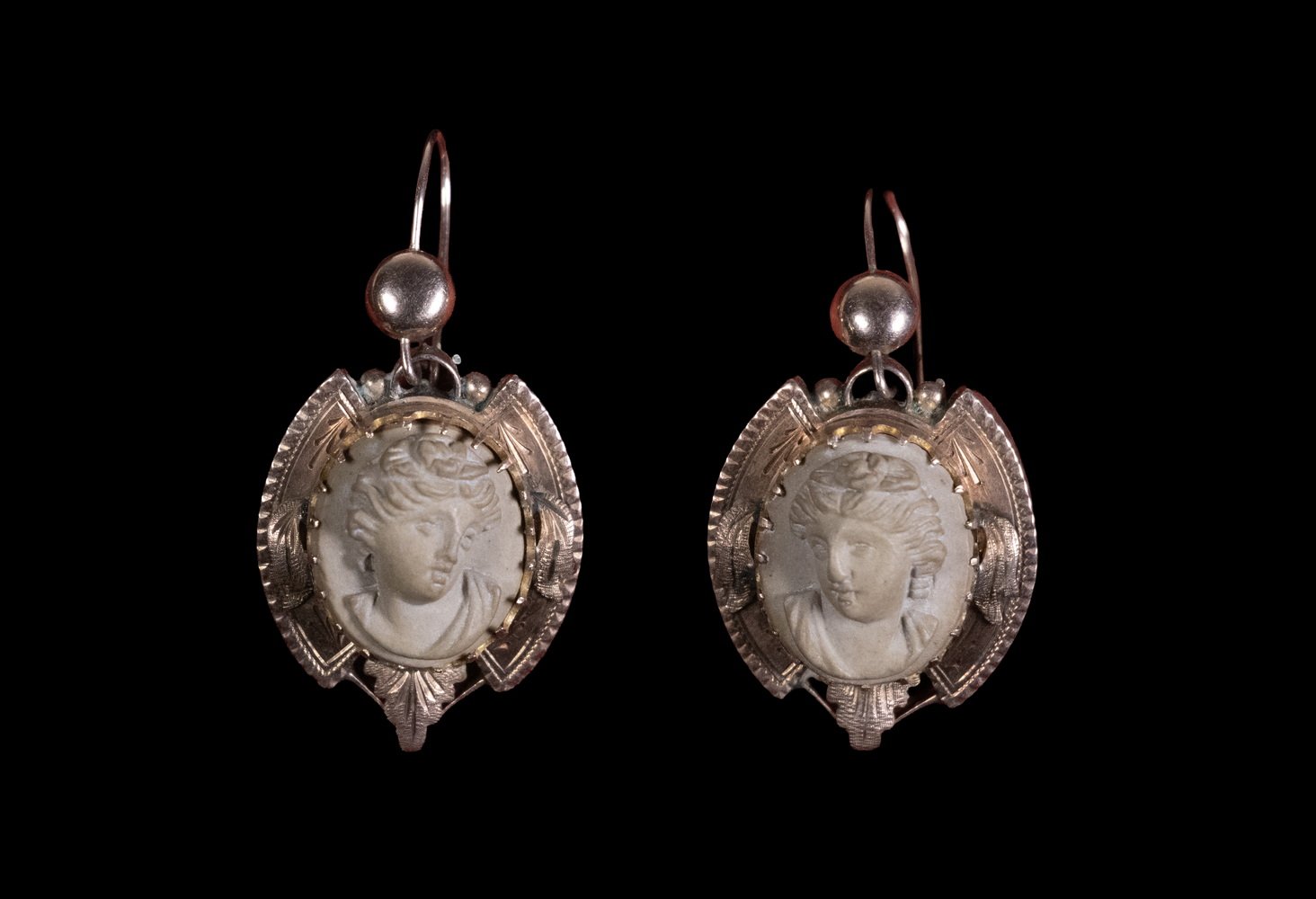
Pair of Victorian 14K Gold Carved Lava Cameo Earrings. Cameos carved from authentic volcanic stone were especially popular for Grand Tour vacationers visiting Italy in the 19th century.
It is the shell cameo that led to the most-collected era of cameo jewelry. Large quantities of shells imported into Europe from African and Caribbean colonies furnished ample working material for cameo artists, and the rise of the European Grand Tour as a status symbol for the middle classes offered a market of ready buyers for souvenirs. Attractive, plentiful, and available at nearly every price point, cameo jewelry swept the Continent during the middle years of the 19th Century, and on into North America. Queen Victoria herself embraced the vogue, forever linking her favored portrait-style brooches and bracelets with the image of Victorian cameo jewelry. Whether as portraits of actual people, or as, increasingly, profile views of idealized, dignified women, cameo jewelry became emblematic of the era.
That close identification with the Victorian period, and all that it culturally represented, caused the cameo to lose favor in the early years of the 20th century, but the style saw a powerful resurgence around the time of the first World War. "For a long time regarded as old fashioned," declared a 1918 advertisement for the Abraham & Straus department store in Brooklyn, "cameo jewelry has come back into favor -- and many a beautiful piece prized chiefly as an heirloom is now being worn again." The revival brought newly-created pieces to the market, with shell and coral again the favored material, mounted in delicate settings of gold.
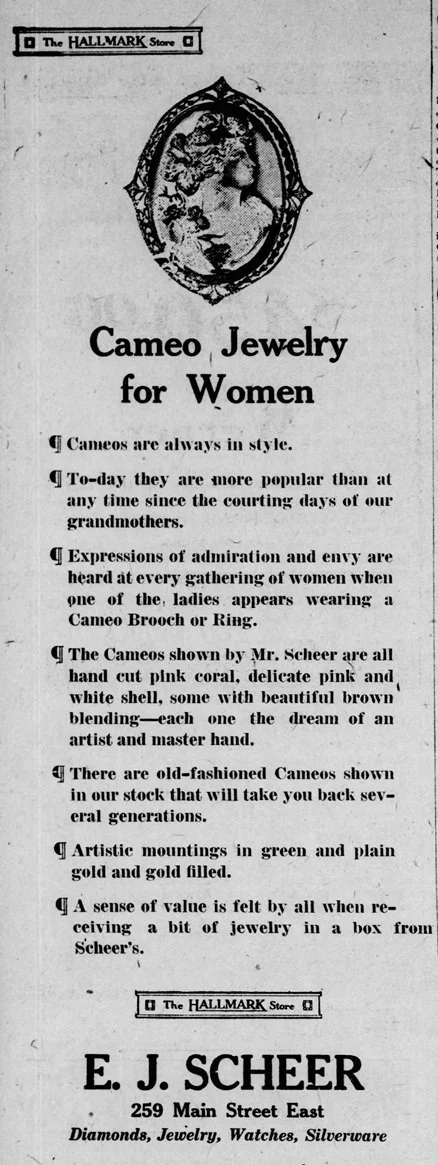
Advertisement from the Rochester (NY) Democrat and Chronicle, December 11, 1918. The World War I era resurgence of interest in cameo jewelry found the pieces an elegant accent to the simplified attire favored by women in wartime America.
Fashions proceed in cycles, and the late 1910s cameo revival ebbed again with the rise of the hard-edged modern styles of the 1920s, before resurfacing briefly at both the start and the end of the 1930s. But it wasn't until the nostalgia craze of the 1960s and 1970s that there would be a full-scale resurgence of interest in classic cameo jewelry, with vintage brooches, rings, and bracelets prominently displayed in the good-old-days imagery of that trend. Collector interest in original Victorian pieces soared, as quantities of heirloom pieces found their way out of attic trunks and onto the collectors' market, and newly-manufactured cameo jewelry, often machine-made in imitation of traditional styles, again filled jewelers' catalogues.
There have been further waves of cameo popularity over the past half-century, driven by television shows, by celebrities, and by social media, and today, a vigorous community of cameo collectors congregate on dedicated Facebook groups for the exchange of photos and information on the pieces they discover. For collectors of fine jewelry, for those who admire the work of fine artisans in an ancient tradition, the cameo is forever timeless. Consider adding to your collection with pieces from our Spring Jewelry Auction.
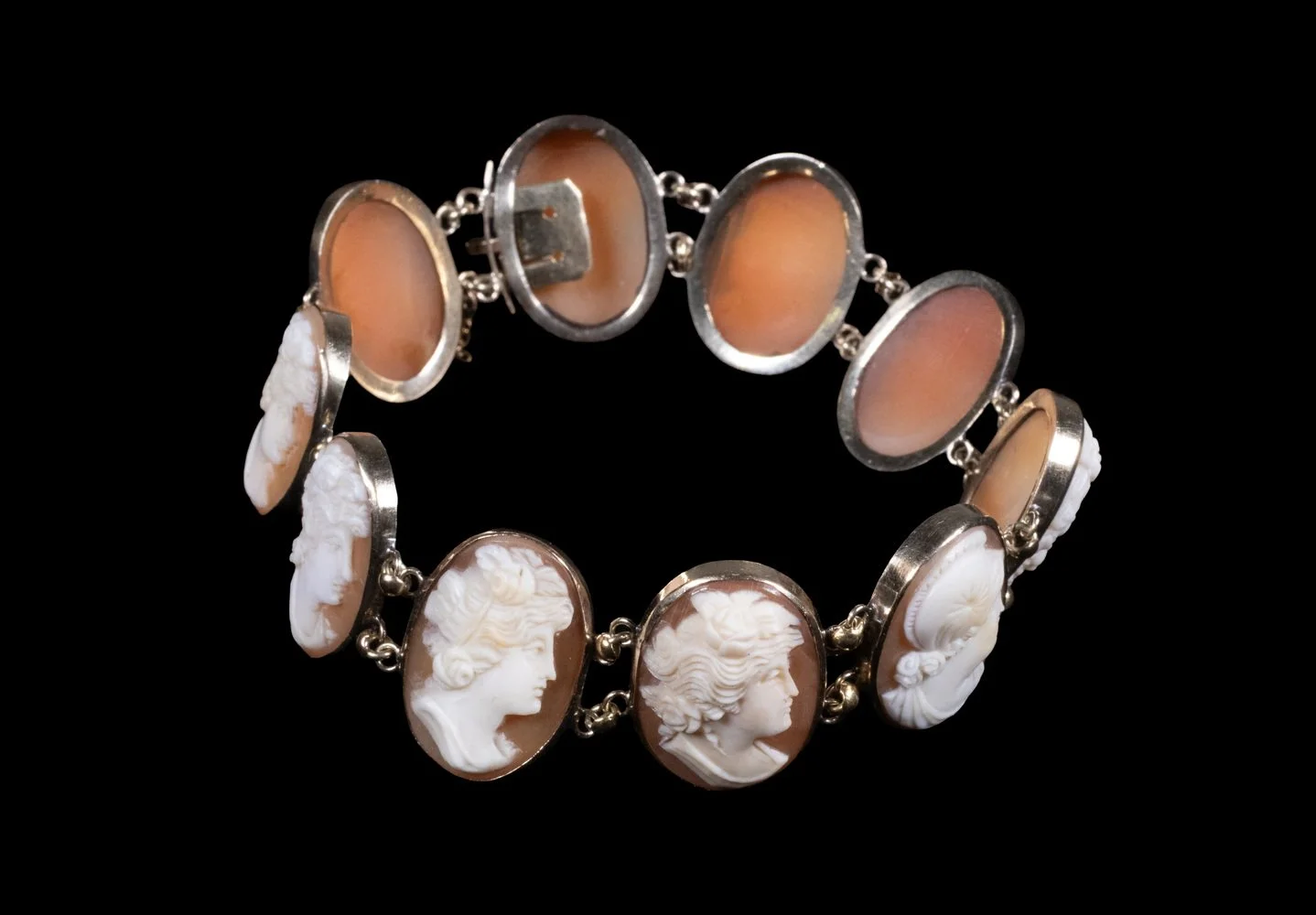
Vintage 14K Gold Multi-Cameo Bracelet. The elegance of a classical profile framed in gold epitomizes the traditional beauty of cameo jewelry.
Spring Jewelry Auction
Date & Time: Friday, April 24th - 11 AM EDT
Location: Thomaston Place Auction Galleries, 51 Atlantic Highway, Thomaston, Maine
Bidding Options: In-person, by phone, or by absentee bid. Online bidding options are available at thomastonauction.com
Preview: Open to the Public, Tuesday, April 21st through Thursday, April 23rd, 11 AM to 5 PM EDT
For details on how to participate, visit our How to Bid page or complete the Phone/Absentee Bid Form to register. With limited seating and phone lines available, collectors are encouraged to register early to secure participation.
References
Miller, Anne M. and Jarrett, Diana. Cameos Old & New, 4th Edition. Nashville: Turner Publishing Co., 2012