
Charmed, I’m Sure
The Life and Lore of the American Charm Bracelet
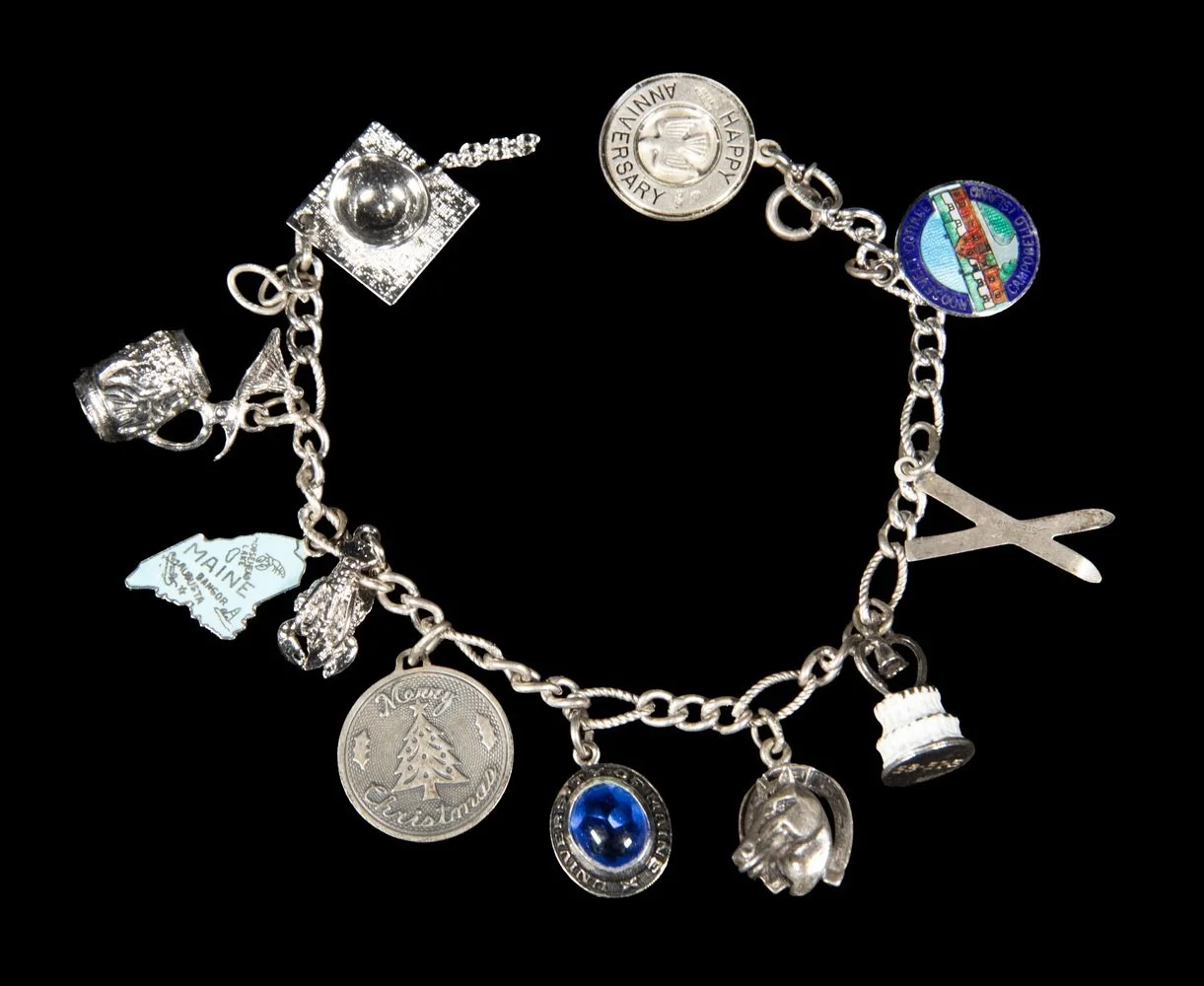
Vintage Sterling Silver Charm Bracelet. A mortarboard, the blue gem of the University of Maine, and the familiar Maine Stein symbolize the owner's college days, a Maine map and a glittering lobster pride in local heritage, and a wedding cake a hope for future happiness.
You can't keep a good trend down, and that's especially true when it comes to jewelry. Certain styles, certain fashions, certain ideas return again and again to the public consciousness. Sometimes it's because they're just distinctive enough that, after a period of temporary eclipse, their sudden revival makes them seem brand-new. But others reappear because they carry a continuing emotional connection that bridges generations. A prime example? The eternal popularity of the charm bracelet.
A chain of silver, links of gold, whatever the material used, the idea of using a simple bracelet as a means of representing high points in the wearer's life, displaying tokens symbolizing personal beliefs or interests, or to honor friends and loved ones, goes back to the very beginnings of human civilization. Early humans created intricate carvings of shell, bone, or rock intended for display on thongs of hide. Some are believed to have played a role in rituals of the hunt, some as a form of personal identification, some as a way of invoking divine protection, or to ward off evil. As civilizations rose and fell, and methods arose for fabricating metals, the concept of the charm bracelet carried forward. Whenever and wherever they appeared along the march of history, these highly personal bits of jewelry were cherished by their owners.
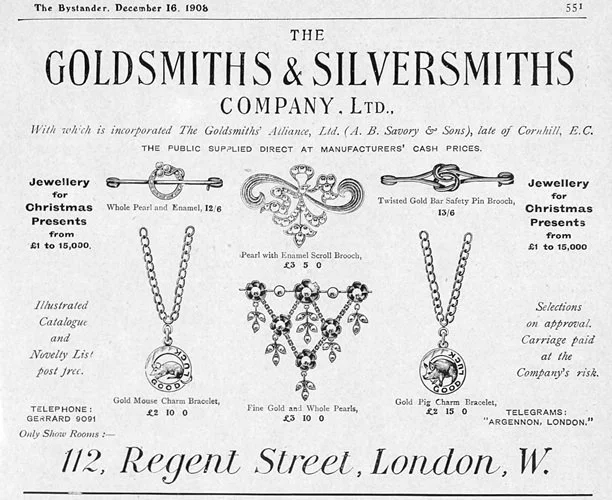
Advertisement from the London Bystander, December 16, 1908. The typical turn-of-the-century charm bracelet carried over the "good luck" associations common during the Victorian Era, and was the source of the term "charm." Also carrying over from the 19th century was the positioning of the bracelets as a luxury item: at a time when the average London factory worker earned about 10 pounds a year, 2 pounds 10 shillings for a trinket was an unimaginable expense.
Charm bracelets enjoyed a vogue among the upper classes of Europe toward the end of the 19th century, with Queen Victoria herself at the forefront of the trend. By the turn of the 20th century, the fad filtered down to the British middle classes, who adopted the bracelets as whimsical tokens of good luck, and spread across the Atlantic to the United States, where miniature locks and keys dangling from the wrist-chain were popular gifts exchanged as symbols of "the key to my heart."
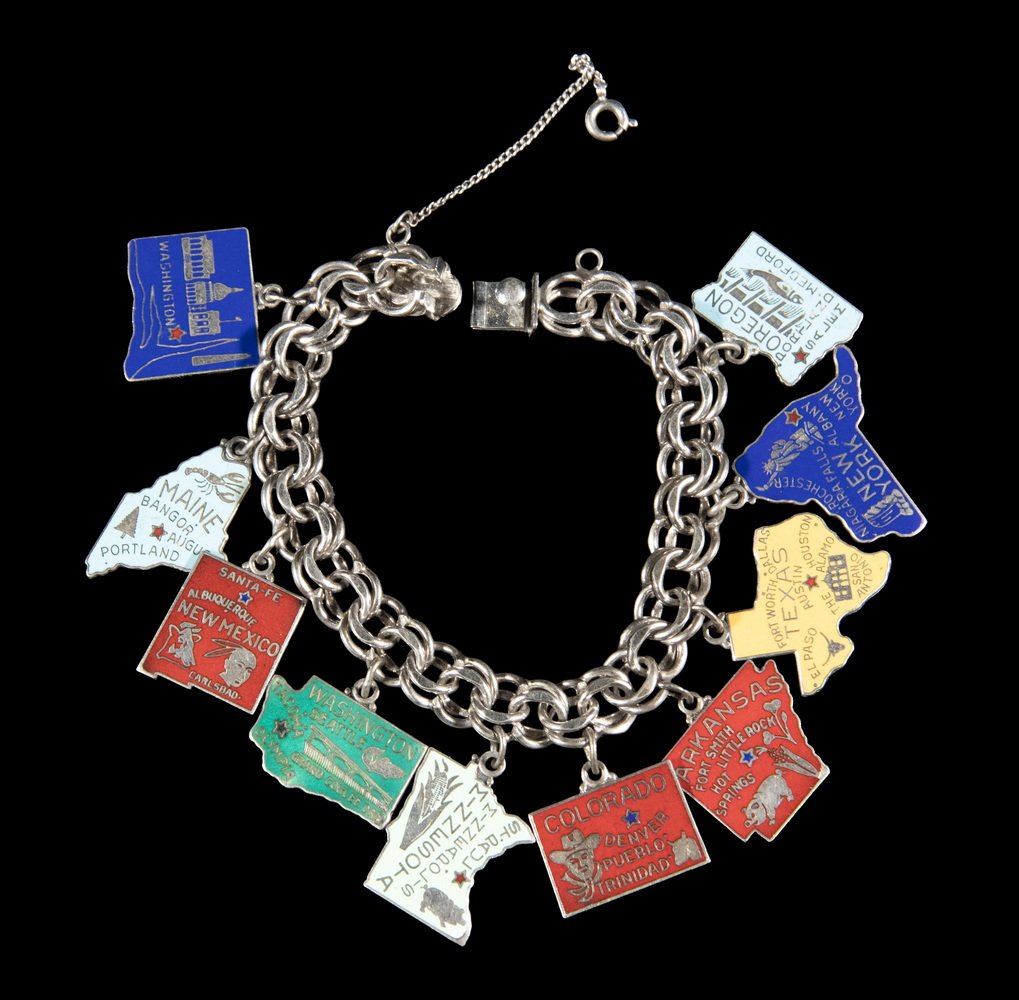
Vintage Sterling Silver Enamel State Charm Bracelet. Coast-to-coast adventures are symbolized by this bracelet, recording the owner's travels across ten states.
But it was in the latter half of the 1920s that the charm bracelet began to take on its recognizable modern form. They were marketed for the first time to children, specifically to school-age girls, in a variety of inexpensive styles, generally gold-filled, and often featuring small die-cast ornaments in the form of tiny zoo or circus animals, good-luck symbols, or similar tokens. The marketing was ingenious, with the "starter" bracelet and the charms sold separately to allow the owner to decorate her own bracelet exactly to her own taste. Bracelets and the accoutrements were available to suit any price point, from fine jewelers, from department stores, and even from the neighborhood five-and-ten, whether for giving as gifts, or for the young wearer to purchase for herself.
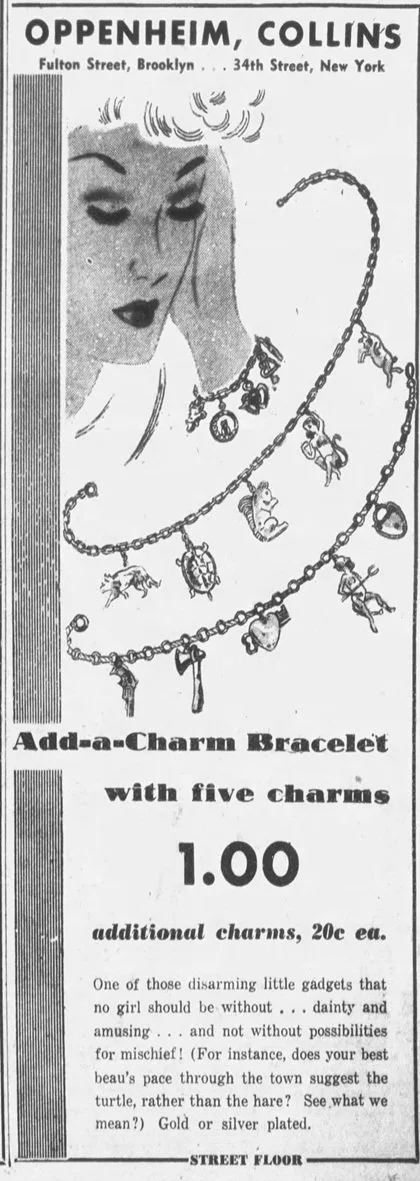
Advertisement from the Brooklyn Eagle, February 8, 1935. Upscale glamor and winking Hollywood sophistication drove the 1930s charm bracelet craze, exploding across the fashion scene during the winter of 1934-35. The idea of "lucky charms" gave way to a more whimsical expression of the wearer's personality.
The mid-1930s saw a dramatic shift in the perception of the charm bracelet, crossing childhood trinketry with ironic sophistication. This latest vogue bloomed first in California in the winter of 1934-35, as the tastemakers of Hollywood adopted the bracelets as their latest craze. With a knowing wink and a clever nudge, these new enthusiasts took up the glittering little figurines as a way to speak the unspoken, using them to symbolize romantic accomplishments, career achievements, and other decidedly adult interpretations. Newspaper and magazine fashion editors found the fad "too too precious for words," to use the argot of the time, and by the middle of 1935, the trend had swept the nation.
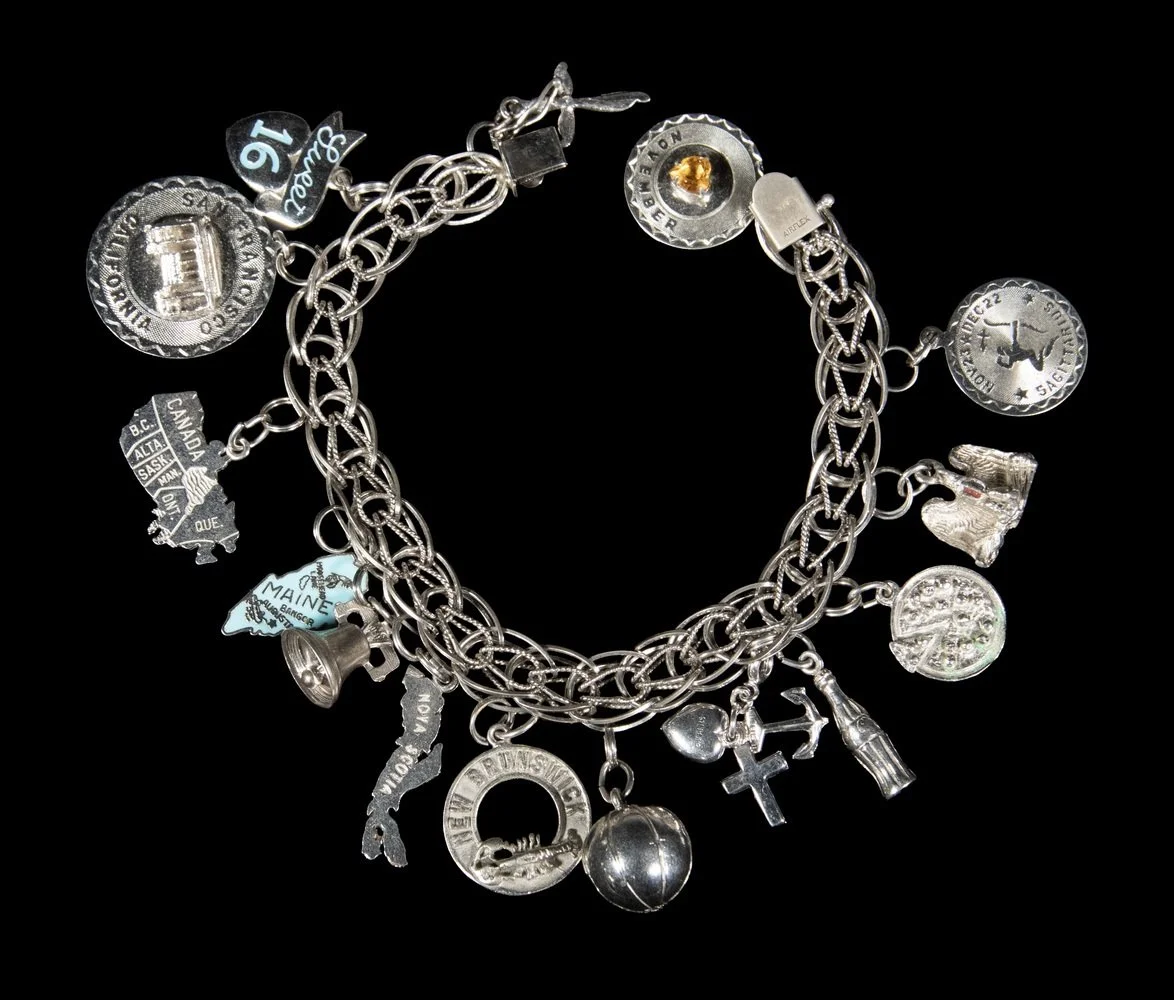
Vintage Sterling Silver Airflex Charm Bracelet. A traveling teenager assembled this bracelet, combining her journeys with her interests in those ever-popular distractions of high school youth, basketball, Coke, and pizza.
Fads come and go, but this one stuck around, particularly on 1930s college campuses, where the saddle-shoe set found charm bracelets ideally suited to the display of boyfriends' fraternity pins or football medals, their own hard-earned honor-society keys, and other glittery hallmarks of collegiate life. And what older sisters do, younger sisters follow. Among the 1940s "bobby-soxers," teenage girls vigorously carving out their own slice of American popular culture, charm bracelets became an icon of the times. From images of popular crooners, movie stars, and other celebrity crushes, insignia representing relatives or friends in wartime military service, and symbols of scholastic or sporting achievement, to tiny representations of favorite consumer products, any subject the wearer might want to represent could be found adorning any wrist in any American high-school hallway, tinkling from a sterling-silver chain.
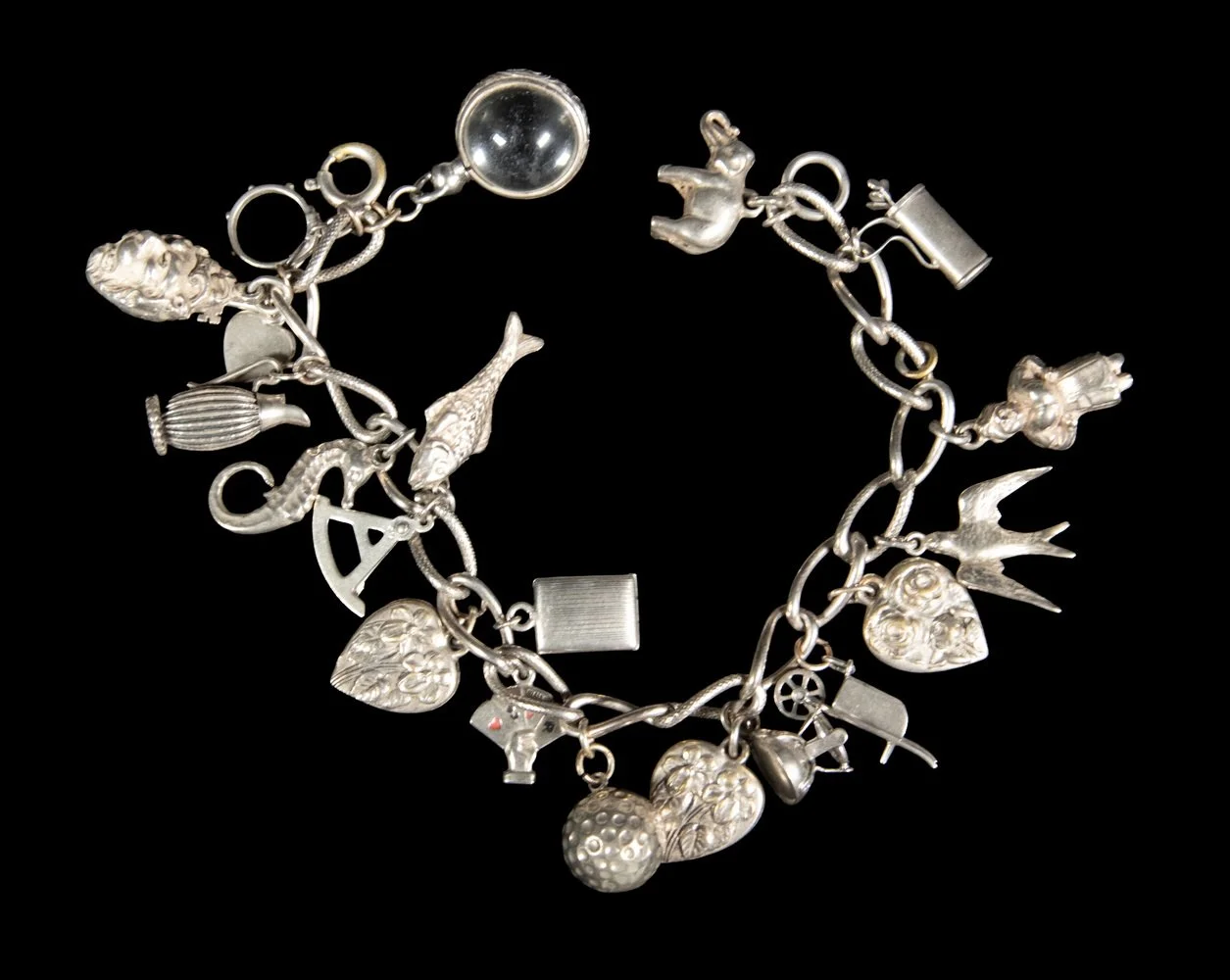
Vintage Sterling Silver Charm Bracelet. The most heavily populated of the bracelets offered in this auction shows us the record of an athletic, imaginative young woman who could take you on at golf or poker, and who also loves the sea.
Charm bracelets have survived into the present day, little changed since their mid-20th century heyday. Popular with teens and adults alike and as whimsical as ever, these uniquely personalized bits of jewelry jingle on the wrists and in the hearts of wearers everywhere. Don't miss your chance to own one of these original vintage charm bracelets offered in our Spring Jewelry Auction!
Spring Jewelry Auction
Date & Time: Friday, April 24th - 11 AM EDT
Location: Thomaston Place Auction Galleries, 51 Atlantic Highway, Thomaston, Maine
Bidding Options: In-person, by phone, or by absentee bid. Online bidding options are available at thomastonauction.com
Preview: Open to the Public, Tuesday, April 21st through Thursday, April 23rd, 11 AM to 5 PM EDT
For details on how to participate, visit our How to Bid page or complete the Phone/Absentee Bid Form to register. With limited seating and phone lines available, collectors are encouraged to register early to secure participation.
References
Alun-Jones, Deborah and Ayton, John. Charming: The Magic of Charm Jewelry. London: Thames & Hudson, 2005
Raulet, Sylvie. Jewelry of the 1940s and 1950s. New York: Rizzoli, 1988.
Schrum, Kelly. Some Wore Bobby Sox: The Emergence of Teenage Girls' Culture, 1920-1945. New York: Palgrave-Macmillan, 2004