
The Art and Science of Creative Glassware
Through a Glass, Brightly
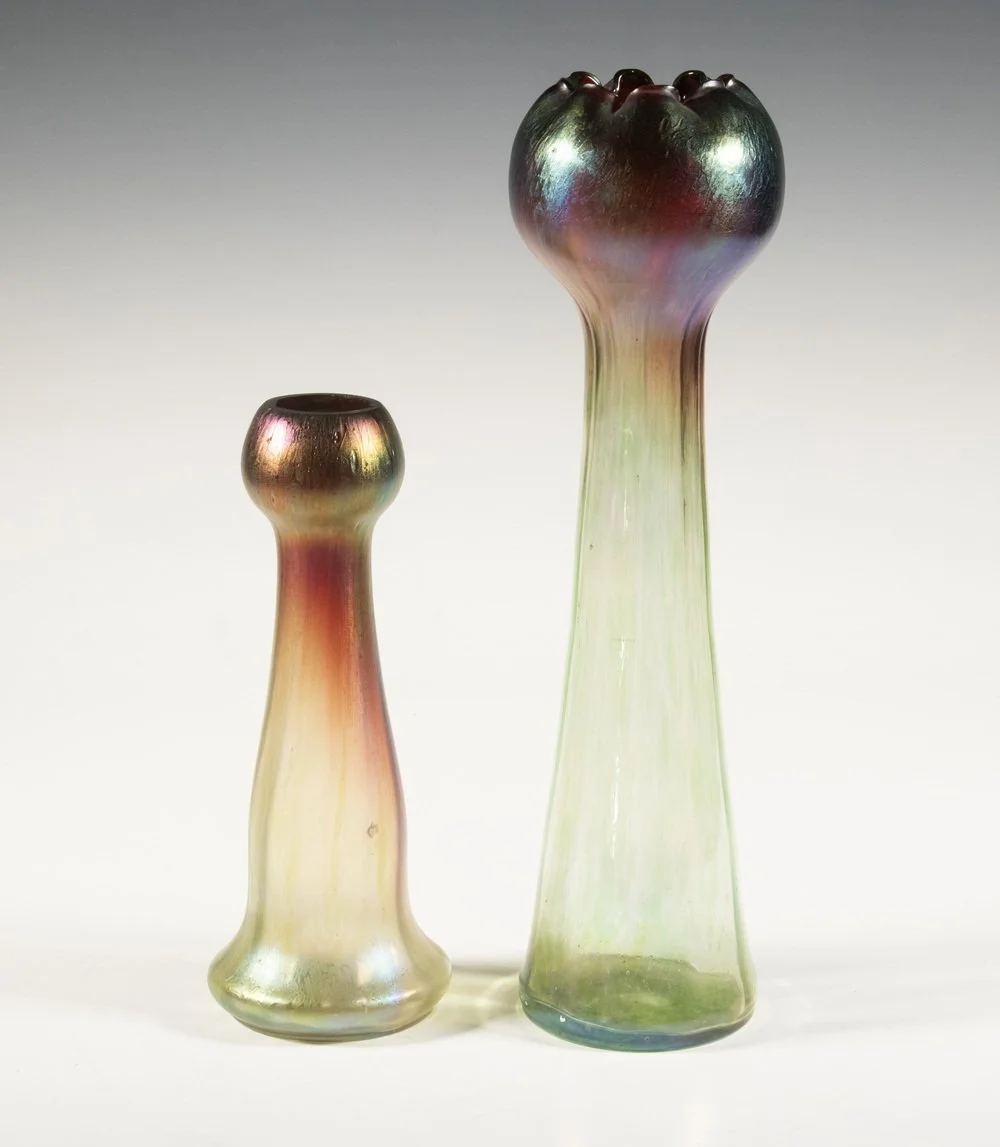
Two Loetz Iridescent Art Glass Vases, c. 1900-1910. From the Golden Age of European Art Glass, this exquisite pairing displays the delicate shadings that characterized Loetz's finest work. The taller vase is 13 1/2 inches high and bears Loetz - Austria markings on the base. The smaller vase, at 9 inches high, carries a period applied label from a Connecticut jeweler.
It's an art nearly as old as human civilization itself -- the transformation by blazing heat of simple mineral dust into works of beauty and utility. Emerging from the sands of Egypt and Mesopotamia more than 3600 years ago, the manufacture of glass has yielded objects of everyday use and of stunning artistic merit, often combining both qualities in a single object. Few raw materials worked by the hands of humanity offer such versatility.
Fine glassmaking begins with the careful selection of those materials. Although all fine glass is made from silica sand, not all sand is suitable for the creation of fine glass -- the sand must contain at least 95 percent finely-ground silica quartz. Nor is sand the sole determinant of the quality of the finished product. Sodium carbonate, which you might have on your kitchen shelf as "washing soda," reduces the melting point of silica to a manageable temperature. Powdered limestone gives the glass its permanence, making it hard and insoluble in water.
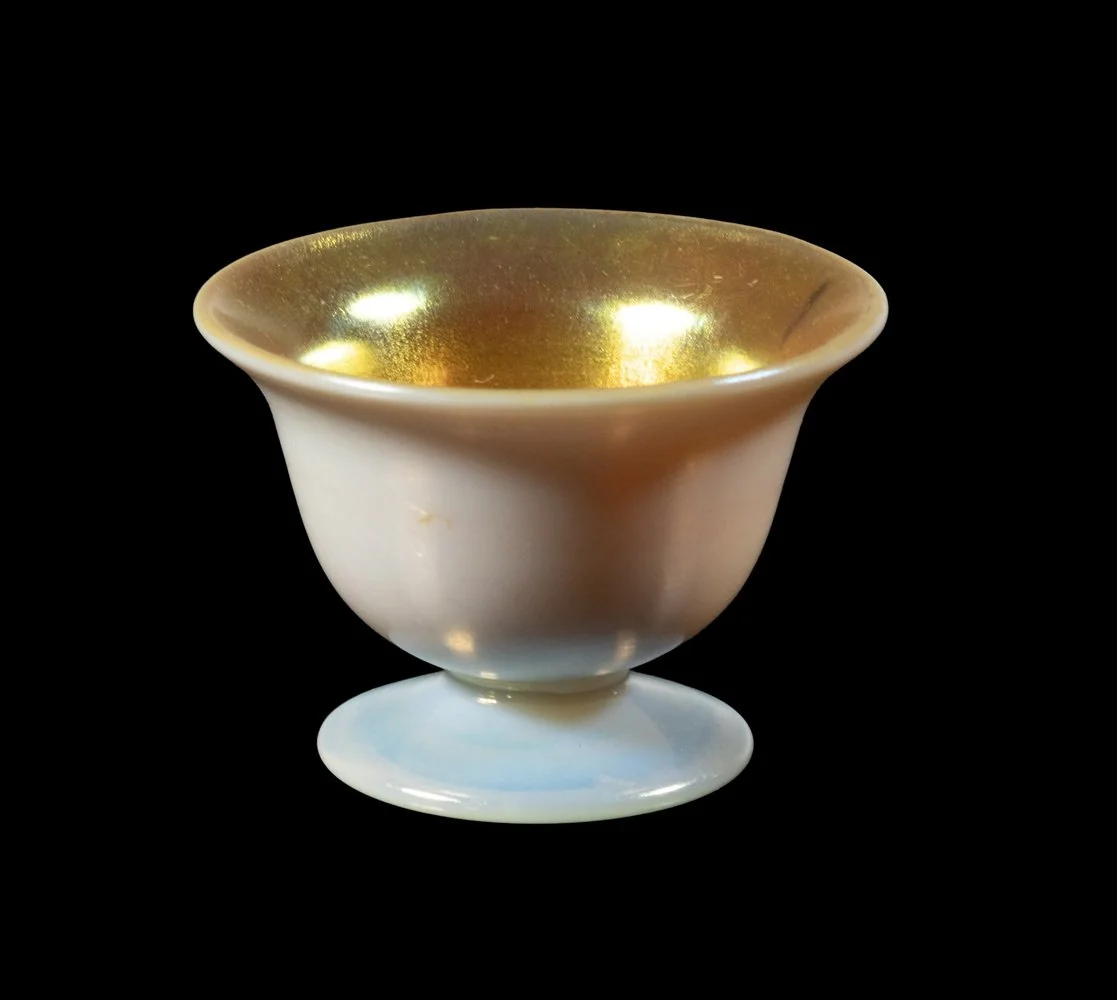
Steuben Calcite and Gold Aurene Open Salt, c. 1920. An interesting specimen of the selective use of the Aurene technique as an interior contrast against a solid exterior. The style reflects Steuben’s shift to less fanciful shapes in the post-WWI era.
It is impurities in the sand, natural or deliberately introduced, that give glass its rainbow of colors. Minute quantities of gold yield glass in shades of red ranging from dark ruby to a delicate cranberry pink. Traces of cobalt produce a deep, bottomless blue used for objects as extraordinary as ancient Egyptian statuary and as prosaic as milk-of-magnesia bottles. Iron oxides, or rust, will produce a bluish-green, which when combined with traces of chromium, yields a dark wine-bottle green. Manganese produces a light tint of amethyst. Cadmium and sulfur combine to produce a deep yellow, which, with selenium added, shifts the shade toward red, orange, or amber. And the radioactive properties of uranium create glass in distinctive shades of fluorescent yellow or green. Additional subtleties of shade may be achieved by the addition of broken scraps of previously manufactured glass, which not only contribute their own coloration to the new batch but also further lower the melting temperature of the mixture. Such additions also allow the glassmaker to create decorative shapes and patterns in the finished product, a process limited only by the skill and imagination of the artist.
Once melted, the glass batch is ready to be formed, and it is this stage that art glass and ordinary manufactured glass diverge in their methods of production. The spread of steam-powered glass-pressing equipment over the first half of the 19th Century made it possible for glassworks to produce a high grade of attractive and functional glassware in a fraction of the time and cost of craft-based forming techniques. But the traditional image of the glassblower, skilfully manipulating bubbles of molten glass at the end of his pipe, endured in the production of specialty goods produced as much for their beauty as their utility.
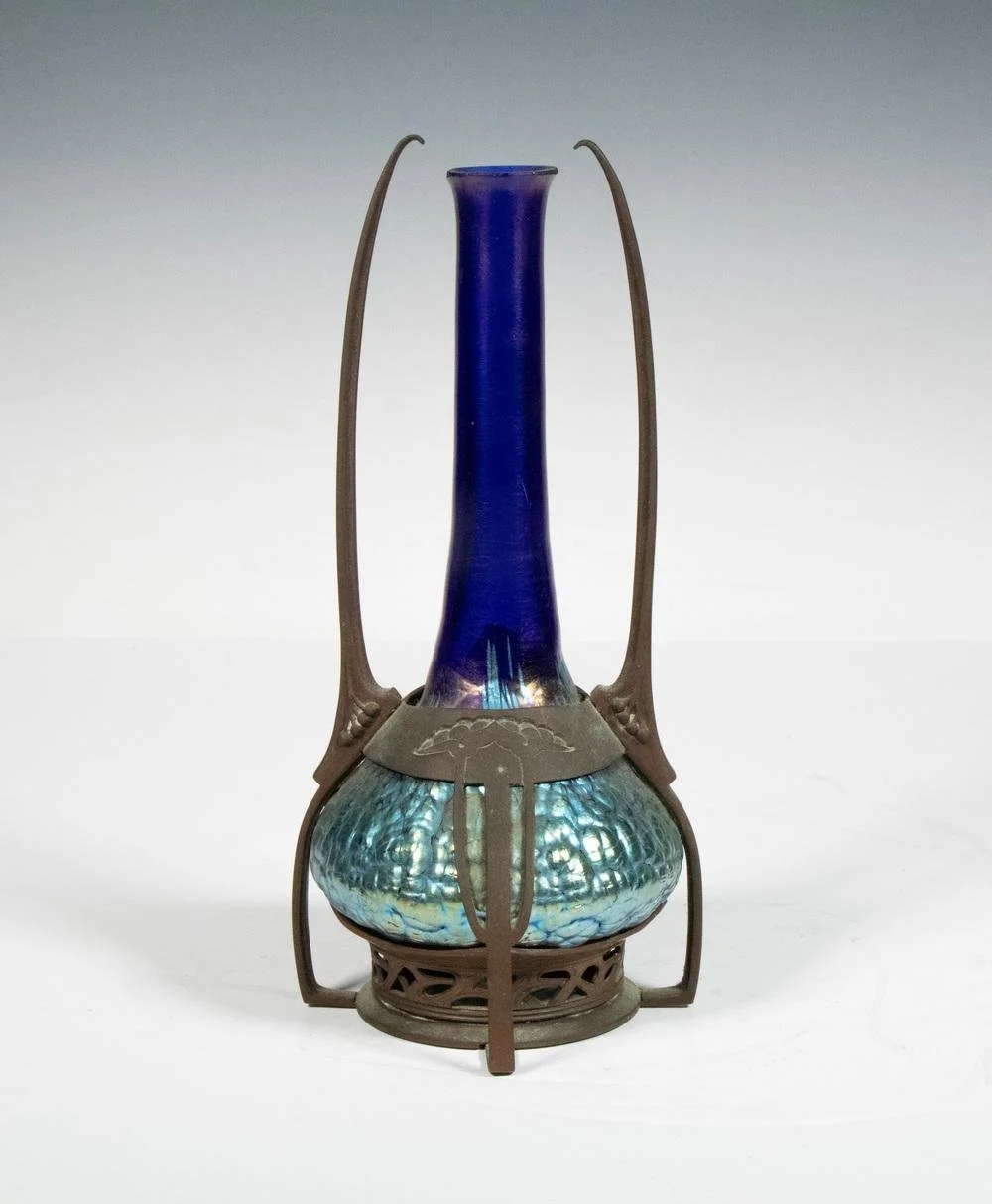
Loetz Iridescent Art Glass Vase in Jugendstil Mount. The Loetz artisans drew from many inspirations in the creation of their pieces. Here we see the influence of the German “Youth Style” movement, a decorative trend drawing heavily from the French Art Nouveau while adding elements distinctive to Central European tastes. Shaped metal mountings designed to accent the curves of the glassware were frequently seen in Loetz’s reflection of this trend.
The primary tool of the artisanal glassblower is that pipe, made of iron or steel, with thick walls and a small barrel for the passage of air, long enough to isolate the blower from the heat of the furnace, but short enough to easily manipulate. As molten glass is a very poor conductor of heat, little of the blazing temperature of the material transfers to the tube as the blower gathers it around the tip as an amorphous blob.
Before blowing, the glassworker rolls the blob on a clean slab-topped table, traditionally of marble, to cool the glass just enough to form a protective skin. A series of breaths through the pipe then inflates the glass to a bubble of the desired size, which may then be worked with specialized tools to form the shape required. The glass blob may also be blown into a prepared metal or wooden mold to create as many copies of a specific form as needed. Whether formed by free-blowing or mold-blowing, the pieces may be finished as they come from the pipe or may be used as elements in the creation of a more elaborate piece.
Once shaped, the piece may then be finished by a variety of specialized methods. Enamel paints containing finely-ground glass in various colors may be applied by hand, and then fired in a kiln to create a hard, permanent, jewel-like finish. Gilding with gold leaf or foil may be applied and fired in the same manner. But it is the unique iridescent glass produced in Europe over the latter years of the 19th Century that today captures the imagination of collectors worldwide.
Shining with opalescent colors that shift and change as the object is moved under light, the true beauty of iridescent art glass cannot be captured in mere pictures, and this is particularly true of the pieces created by a firm founded in Southern Bohemia in 1836. Glassmaker Johann Eisner began the company, but operated it for only a brief time before his death. It passed through a succession of owners of no particular distinction until it came under the control of Susanne Gertsner, a strong-minded woman who had once been married to a glassmaker named Johann Loetz. Loetz himself made no particular mark in the field, but Suzanne Gertnsner's decision to give the company his name would grant him a sort of unearned immortality.

Advertisement from the Montreal Gazette, January 8, 1901. Fine jewelers were a natural outlet for Loetz products as they made their mark on the North American market.
The iridescent finish of the finest Loetz pieces was created by a process patented by the firm in 1895, at the height of the European Art Nouveau movement. Hot from the furnace, the blank, consisting of basic soda-lime glass overlaid with a second layer containing lead, silver, or other elements specific to the design, was rolled in splintered glass containing lead or silver. The piece was then reheated and blown into the desired shape, leaving the splinters embedded in the surface of the piece. After cooling, the piece was sprayed with chemical solutions consisting of tin chloride or other metallic salts. When again reheated, the solution produced a thin, opalescent layer of metallic oxide, bonded into the glass itself, accented by a unique pattern created by the embedded splinters. The process, created by a repeatable method suitable for factory production, pieces of which no two were exactly alike.
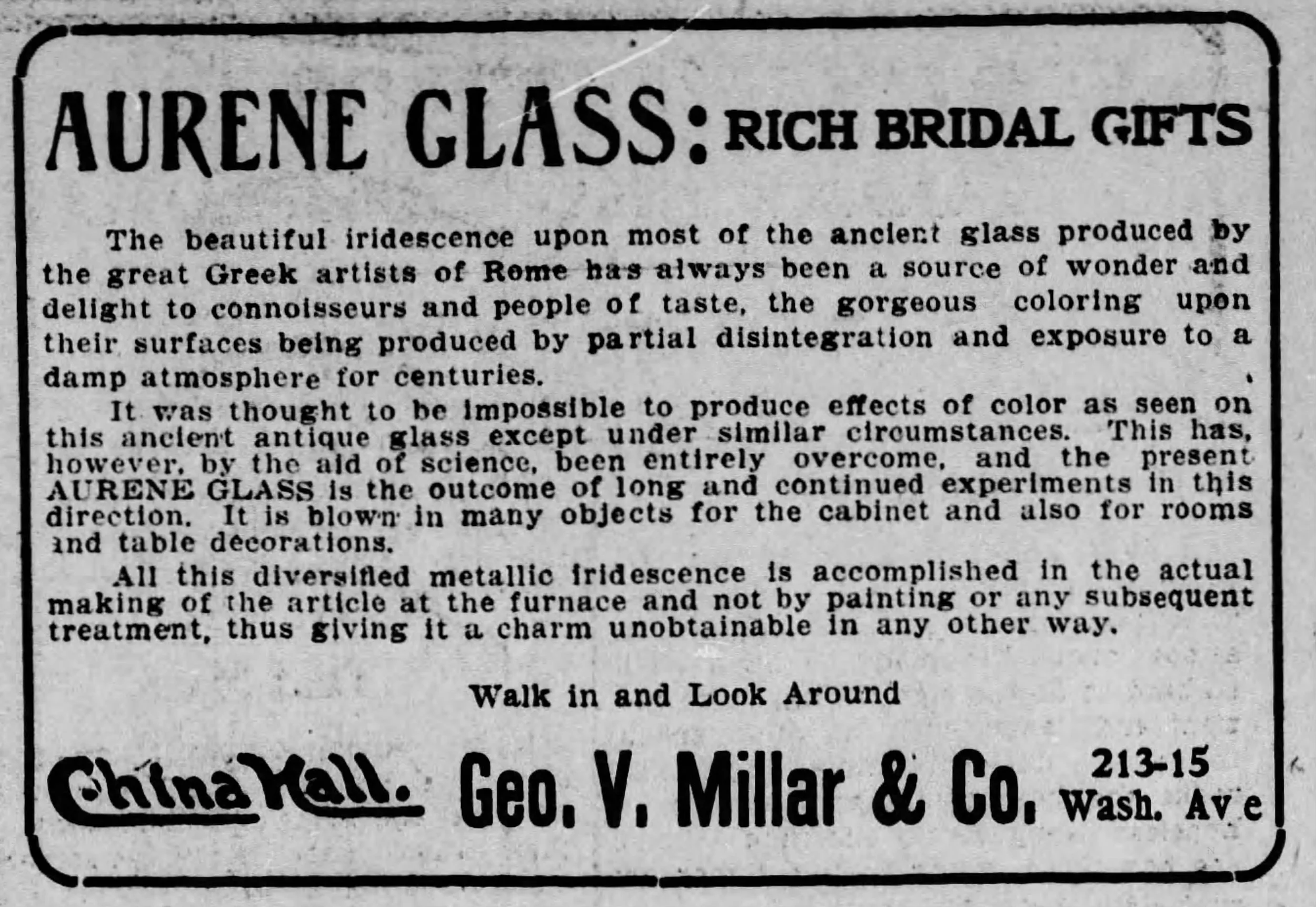
Advertisement from the Scranton (Pa.) Tribune, June 1, 1905. The Steuben Glass Works positioned its line of Aurene glassware both as a connection to the ancient artistic creations of the classical era and to the progressive world of modern science.
Although the Loetz process was proprietary, other firms producing fine art glass developed their own individual variations on the basic technique. At Corning, New York in 1903, British-born glass artist Frederick Carder joined the newly-founded Steuben Glass Works, and the following year introduced the "Aurene" line of iridescent art glass. Similar to the Loetz method, the Aurene process used a chemical spray applied to the glass, which was then reheated to create the metallic finish. Steuben pieces favored clean, graceful shapes and delicate petal-like forms finished in shimmering shades of gold, blue, and green. The result is a product line worthy of comparison to the iridescent Favrile glass produced by the studios of Louis Comfort Tiffany. So worthy, in fact, that in 1913, Tiffany threatened to sue the Steuben Glass Works until it was concluded that the two processes, though producing a similar product, were sufficiently different in method.
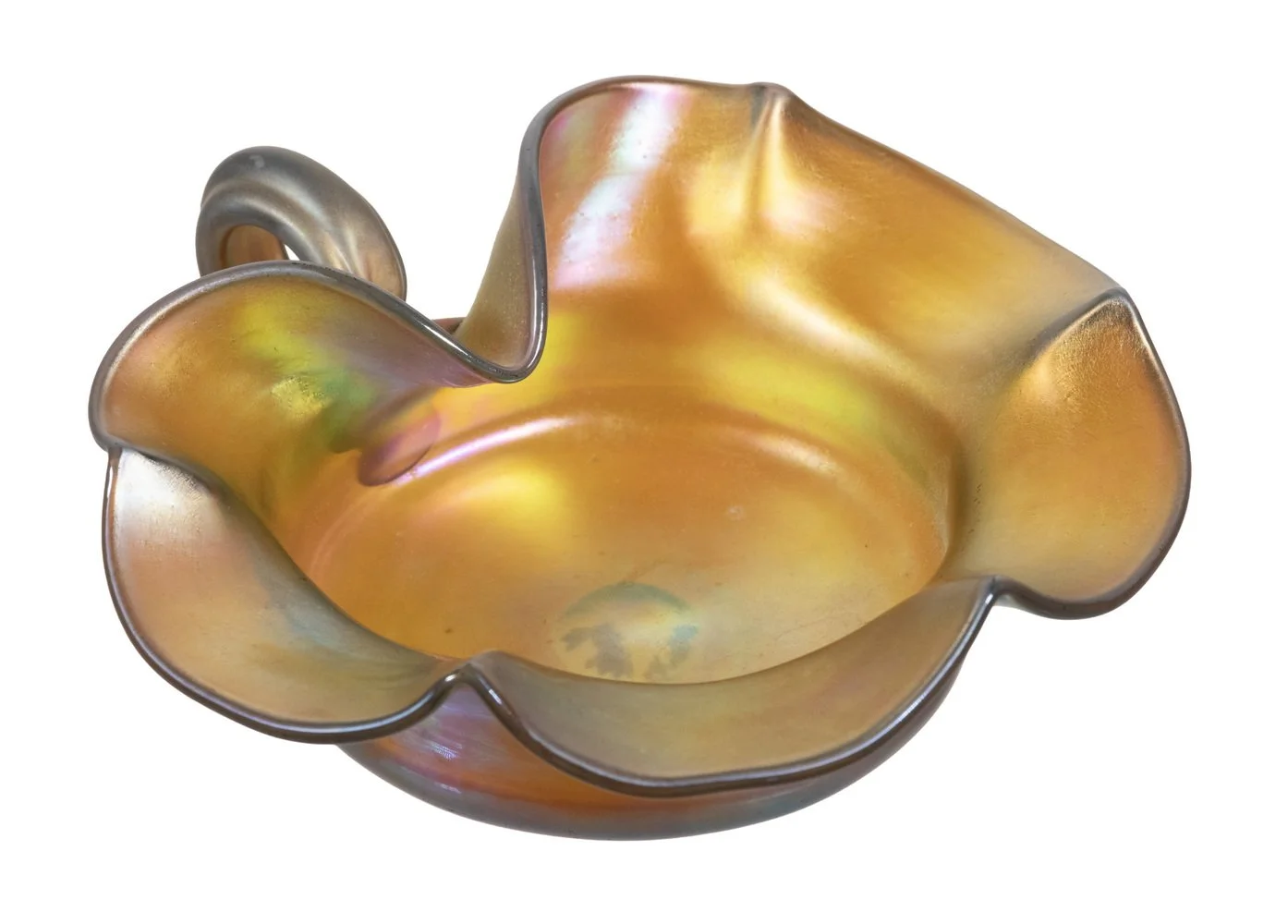
Vintage Steuben Gold Aurene Nappy, c. 1910. A quintessential example of the early Steuben style and its graceful petal-like forms. The piece displays an Aurene signature and shape number on the base.
The coming of the First World War brought an end both to the Art Nouveau movement and to the Golden Age of art glass. But fine glassmaking carried on, adapting and adjusting to each new trend in modern decor. The 1920s found glassworkers exploring the bold geometry of Art Deco, the 1930s the mechanistic elegance of Streamline Moderne, until the Second World War again disrupted production. The Loetz works, by then a part of Czechoslovakia, fell to the German invasion. Steuben came under corporate ownership as a subsidiary of the Corning Glass Works, and while the Steuben plant continued to produce pieces of distinctive beauty, they were never again quite so inspired as they had been in earlier times.
Today, fine artists continue to work in glass, creating works of unique inspiration, while the masterpieces of the Golden Era of Art Glass grace museum shelves, collections of distinction -- and the auction platform. Discover this fascinating world for yourself at our Design and Decor Auction.
Design & Decor
Date & Time: Friday, April 17th - 11 AM EDT
Location: Thomaston Place Auction Galleries, 51 Atlantic Highway, Thomaston, Maine
Bidding Options: In-person, by phone, or by absentee bid. Online bidding options are available at thomastonauction.com
Preview: Open to the Public, Tuesday, April 14th through Thursday, April 16th, 11 AM to 5 PM EDT
For details on how to participate, visit our How to Bid page or complete the Phone/Absentee Bid Form to register. With limited seating and phone lines available, collectors are encouraged to register early to secure participation.
References
The World of Loetz. A non-profit resource for admirers and collectors of Loetz art glass worldwide, including an extensive library of images of authentic Loetz pieces.
The Carder Steuben Glass Association. An invaluable reference for the beginning or advanced Steuben collector, containing verified shape number references for hundreds of specific Steuben pieces created over the era in which Frederick Carder supervised the firm's designs.