
Meet the Beechers
Recent Acquisitions
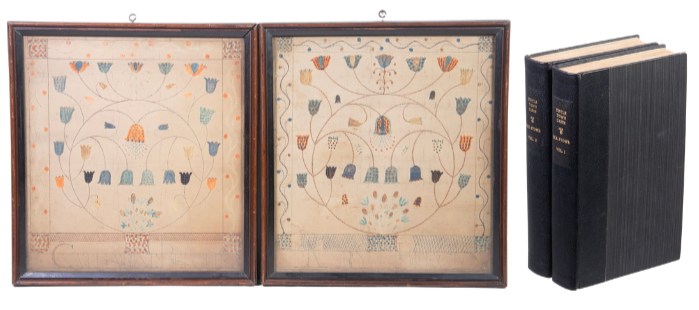
Two works of art, a legendary book -- and the family tie that binds them!
Three sisters, each making their own way through the tumult of the 19th century. One a teacher, who stressed the vital role of women in the field of education. One a novelist, whose searing depiction of Southern slavery galvanized the nation. One provided quiet but essential support to the powerful lives of her siblings. And all three are represented in Thomaston Place Auction Galleries' 2026 Autumn Majestic Auction.
Catharine, Mary, and Harriet Beecher were daughters of a fiery Presbyterian minister from Connecticut, Lyman Beecher, and the first of his three wives, Roxana Foote. The Rev. Beecher preached a stern, uncompromising Calvinism that led him into frequent social and political controversy over the course of his career, and growing up in such an environment, his daughters emerged into adulthood sharply aware of the issues forming the world in which they lived.
Catharine Esther Beecher, born in 1800 as the oldest of the daughters, was unsatisfied with the educational opportunities open to her as a girl growing up at the turn of the 19th century. While learning the domestic subjects thought proper for well-bred young women of her time, she forged ahead on her own to master Latin, philosophy, and mathematics. Completing that education, she determined to offer a similar course of study to other young women, establishing in 1823 with her sister Mary, in a second-floor classroom above a harness shop, the Hartford Female Seminary. The school placed a strong emphasis on training women to take a leading role in the formal education of the young, and Catharine Beecher's views had much to do with entrenching the idea of women-as-schoolteachers that would come to dominate American elementary education well into the 20th century.
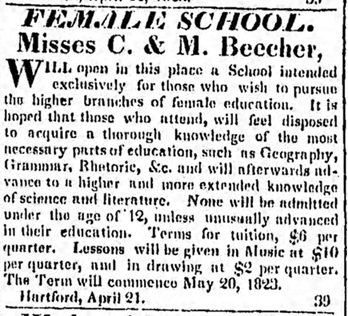
First public announcement of the school that became the Hartford Female Seminary, Hartford Courant, April 22, 1823.
Mary Foote Beecher was in many ways Catharine's polar opposite, quiet and mild where her sister was bold and forceful. She took no strong public stands on the issues of her day, and much of her life was spent providing backline support for her older sister's activities. She handled many of the administrative tasks for the Hartford Female Seminary, she taught classes, and she kept house for Catharine until the excessive workload carried her to the point of a physical collapse. Mary would recover, shifting away from the school to take on another domestic duty in helping to raise her young stepsister Isabella and serving as a calm counterpoint to the flurry of activity that surrounded the rest of the family.
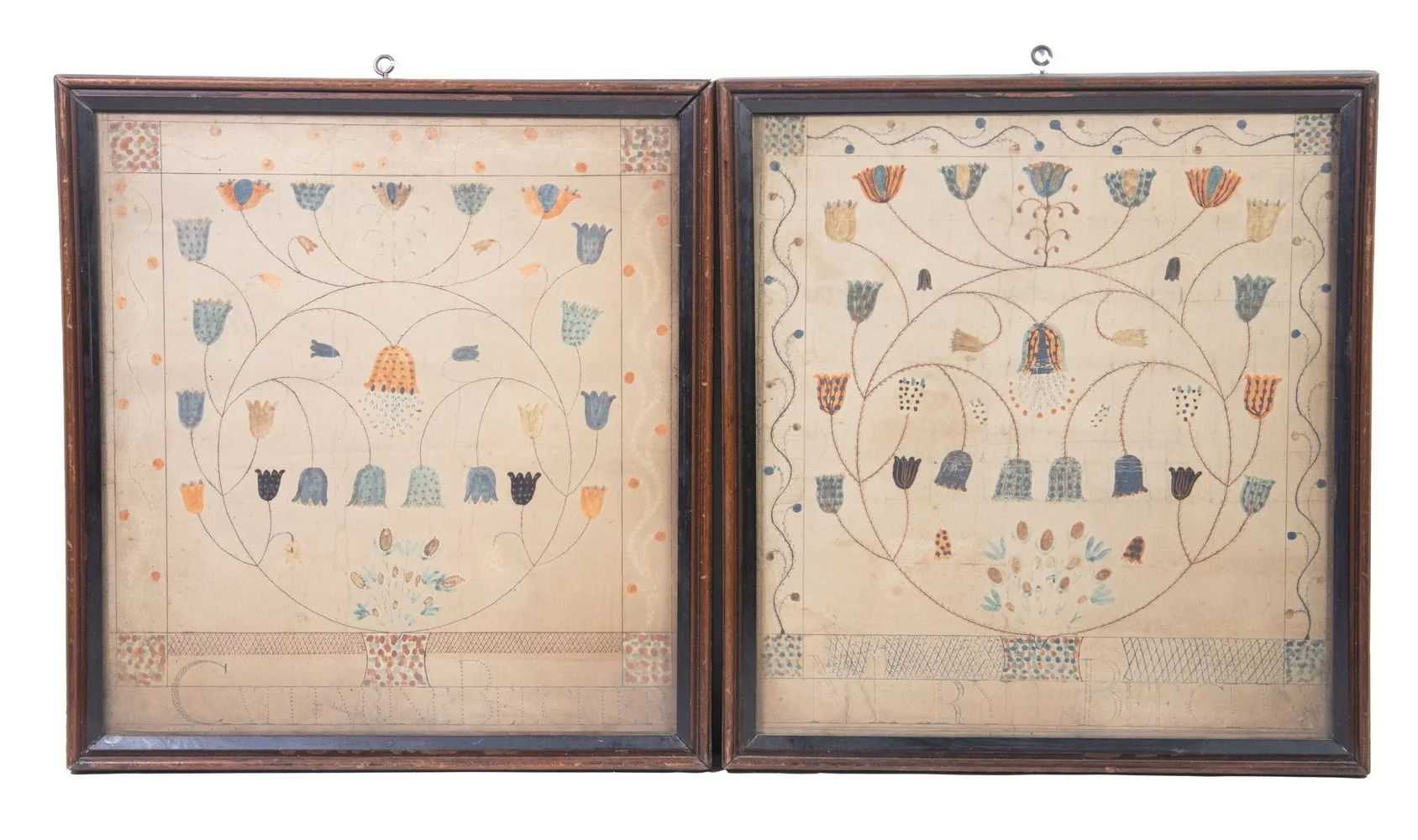
PAIR OF HISTORICALLY IMPORTANT EARLY 19TH C. BEECHER FAMILY WATERCOLORS
Thomaston Place Auction Galleries' 2026 Autumn Majestic Auction offers rare artifacts from Catharine and Mary Beecher's early lives - two matched watercolor theorem paintings by the two sisters, each depicting a traditional Tree of Life in the Enfield Shaker style, executed around 1820. While the linework is nearly identical, the choice of color and ornamentation reflects each sister's personal interpretation of the image.
Harriet Elisabeth Beecher was the youngest of Lyman and Roxanne Beecher's daughters. Eleven years younger than Catharine, she was herself a student at Hartford Female Seminary, following the rigorous curriculum established by her older sister, and received a thorough training in classical literature, language, and mathematics. Upon graduation, she joined her father in Ohio, where he had taken the presidency of a theological seminary, and it was there that she took an interest in the growing movement for the abolition of slavery. Following her marriage to the Rev. Calvin Ellis Stowe, she moved with her husband to Maine, where he had taken a teaching position at Bowdoin College. Together, the Stowes not only participated in the abolitionist movement through words, but also by deeds, aiding several fugitive slaves to escape along the Underground Railroad to Canada. In 1850, she began the work that would define the rest of her life, with the first installment of "Uncle Tom's Cabin" appearing in the "National Era" newspaper the following year. The novel, a harrowing exploration of the plight of a middle-aged enslaved man and his family, and of the fundamental evil of the institution of slavery itself, ran in newspaper serial form for nearly a year.
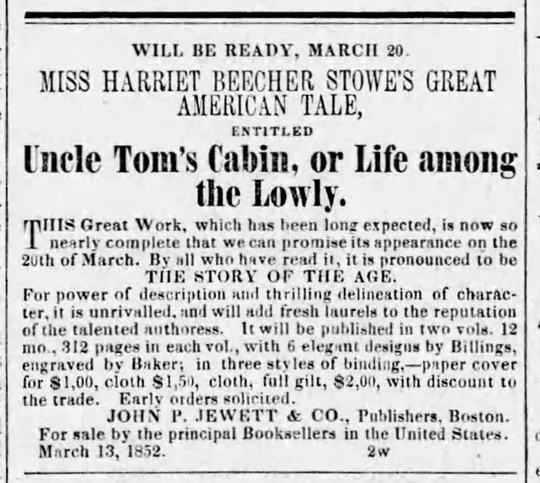
Advertisement for the release of the first edition, first printing of "Uncle Tom's Cabin," The New England Farmer, March 20, 1852.
In March of 1852, the Boston publisher John P. Jewett issued the full novel in two volumes, in a first press run of five thousand copies. This first issue appeared in three different bindings -- printed paper wraps for $1, gold-stamped cloth for $1.50, and a deluxe "gift" cloth binding with elaborate gold stamping and gilt page edges for $2.00. This edition sold out immediately with a second press run of 5000 copies prepared the same week. This second run, which reached booksellers in early April, added the phrase "TEN THOUSANDTH" above the publisher's imprint on the title page, and corrected various typographical errors in the text.
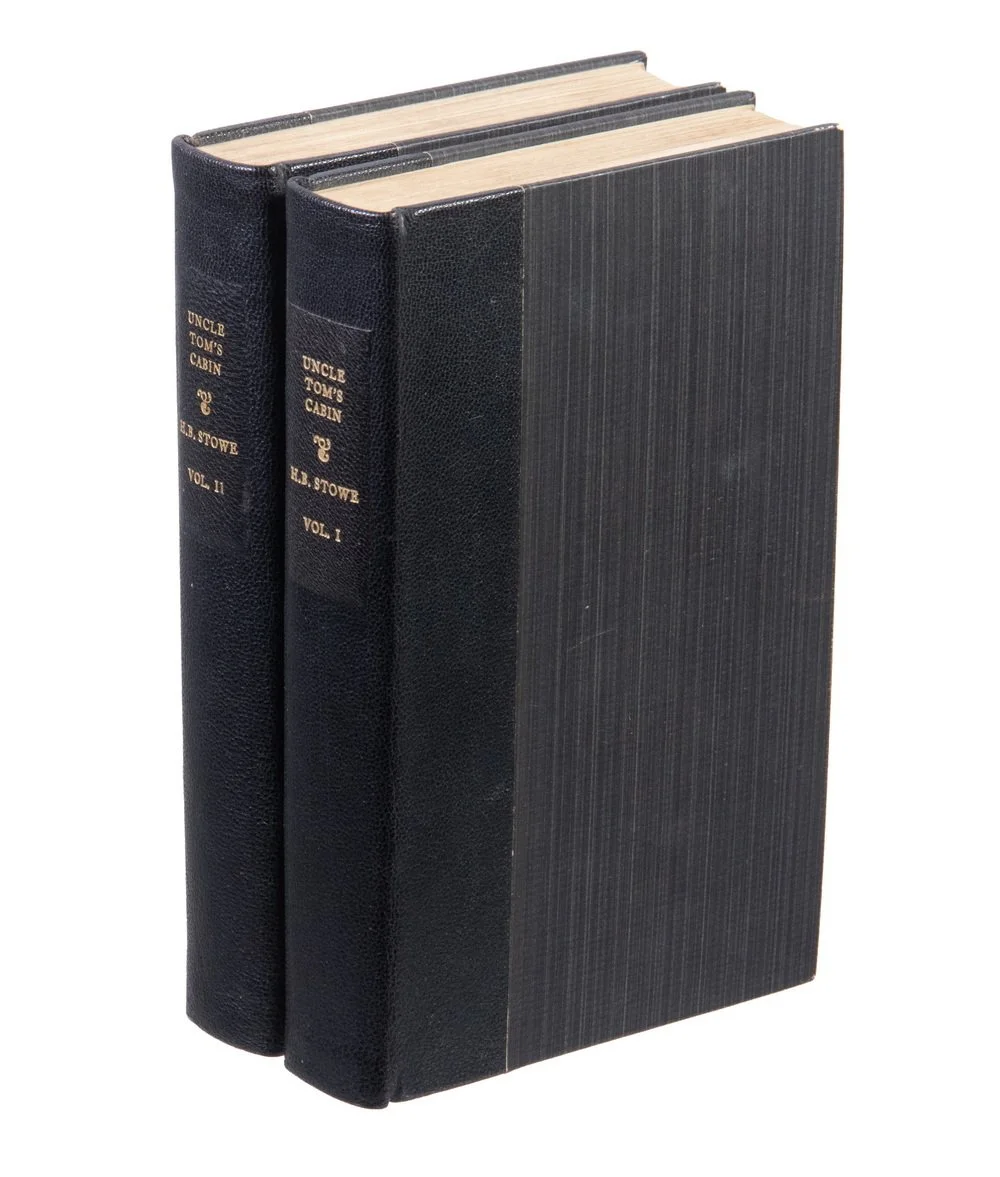
"UNCLE TOM'S CABIN" FIRST EDITION, FIRST ISSUE
We offer in our 2026 Autumn Majestic Auction a rare copy of Harriet Beecher Stowe's famed novel, from the first run of five thousand, in a later preservation binding, bearing the characteristic first edition/first issue identification points. The text is complete, as are the six unattributed boxwood engravings prepared for this edition by Hammatt Billings.
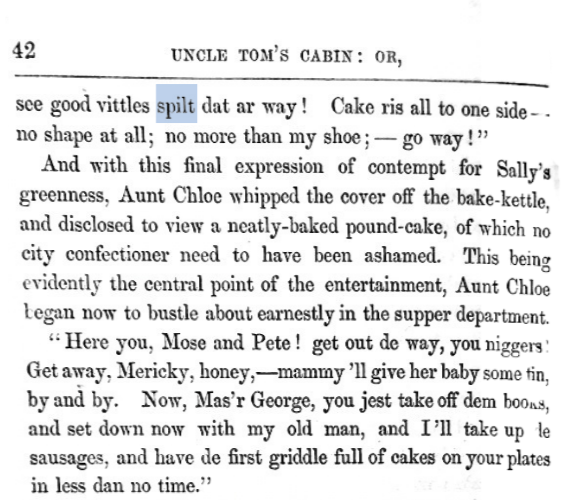
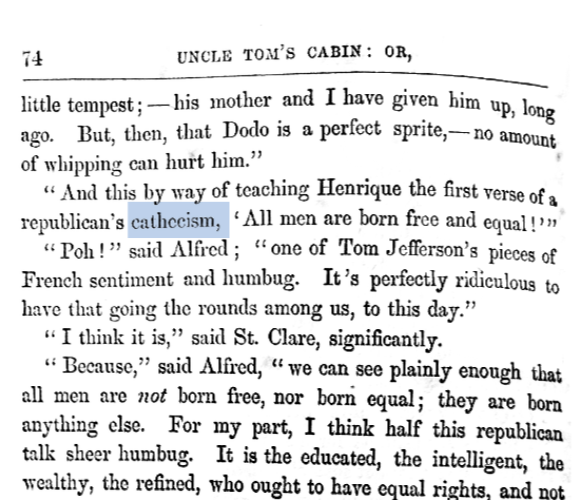
Typographical errors on page 42 of Volume I -- "spilt" instead of "spiled," and page 74 of Volume II -- "cathecism" instead of "catechism" -- are among the key points of identification for a true First Edition, First Issue copy.
"Uncle Tom's Cabin" sold about 300,000 copies, all printings combined, in its first year, a spectacular sale by the standards of that era, and an additional 200,000 copies in Great Britain, where both authorized and unauthorized copies flooded the market. The book's success made Harriet Beecher Stowe an author of world renown and a prominent figure in the abolitionist movement. Through multiple editions from multiple publishers, her landmark novel became, aside from the Bible, the best-selling book of the 19th Century. She was one of the founders of the still-published Atlantic Monthly, and until falling ill in the 1880s, she continued to write and publish.
Harriet died in 1896, eighteen years after the passing of her older sister. Catharine Beecher's later years were a time of contradiction, in which this early crusader for the educational rights of women crusaded just as forcefully against women's suffrage, a position which placed her in strong opposition to her younger half-sister Isabella, and their brother, the prominent Protestant clergyman Henry Ward Beecher, both of whom were active and prominent leaders in the movement to secure votes for women. Harriet Beecher Stowe was claimed at various times by both sides of that epochal debate, while Mary Foote Beecher Perkins remained aloof from the roiling political questions of her time. She was the last surviving Beecher sister when she died in 1900 at the age of 94.
Three sisters, navigating a momentous century, each in their own way. Enter their world with two unusual lots in our 2026 Autumn Majestic Auction.
Be the First to Know
Sign up for emails here to be notified when the 2026 Autumn Majestic catalog goes live, including both Beecher Watercolors by Catharine and Mary Beecher, as well as the rare first edition of “Uncle Tom’s Cabin” by Harriet Elisabeth Beecher Stowe.
For all other enquiries, please contact us.
Autumn Majestic
Date & Time: November 12th, 13th, 14th, and 15th - 11 AM
Location: Thomaston Place Auction Galleries, 51 Atlantic Highway, Thomaston, Maine
Bidding Options: In-person, by phone, or by absentee bid. Online bidding options are available at thomastonauction.com
Preview: November 7th — 12 PM - 5 PM and November 5th through 6th, November 9th through 11th — 10 AM - 5 PM
For details on how to participate, visit our How to Bid page or complete the Phone/Absentee Bid Form to register. With limited seating and phone lines available, collectors are encouraged to register early to secure participation.