
Pages of History: A Sixteenth Century Landmark of The Printers' Art
We live, it is claimed, in the post-print age. But half a millennium of publishing history says otherwise. While technology might alter the methods by which texts are distributed, there will always be a place for the printed book. Since the arrival of movable type in Europe at the end of the fifteenth century, the book has survived social, cultural, and technological upheavals to stand as the preeminent, enduring monument to human knowledge. While a computer might be obsolete within five years of its manufacture, while forgotten storage formats linger useless in the junk drawers of their "early adopters," a printed book yields its contents to any reader in any epoch.
And not just "the book" as a general description of the form. Individual volumes, specific artifacts of the early press, survive down to the present day not merely to convey the words stamped upon their leaves, but to tell the stories inherent in those books as books themselves. Early volumes carry with them the imprint of the society that produced them, with all its cultural preoccupations and shifting political tides. We are proud to offer such a book for your consideration as Lot 3483 in our 2026 Winter Enchantment Auction.
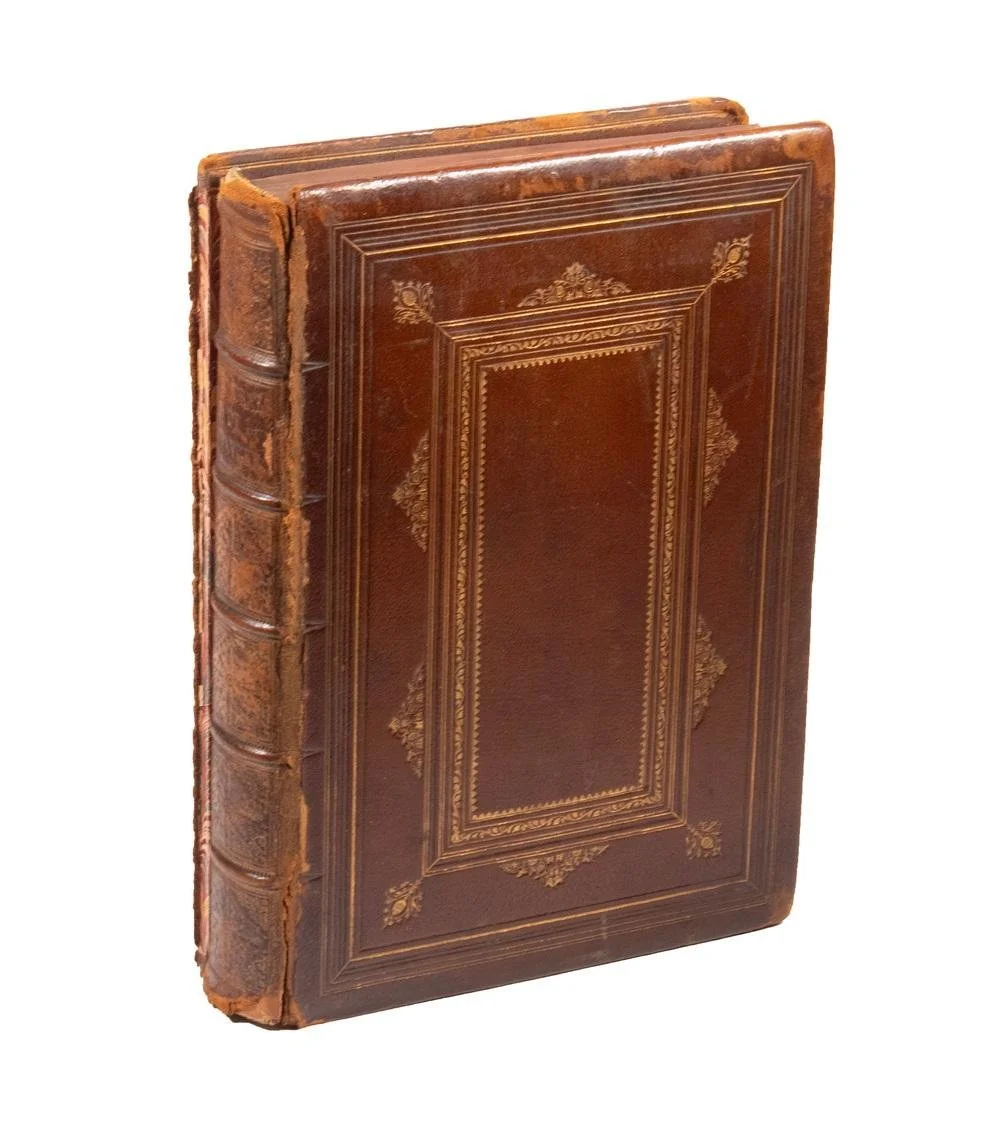
Lot 3483
Geoffrey Chaucer, Works (1561)
Fourth Collected Edition, Second Issue.
A cornerstone of English literary history, printed at the height of the Tudor press.
The works of Geoffrey Chaucer (c. 1343-1400) are a foundation of English literature, defining the evolution of the language itself in the post-Norman era, and bridging the gap between the Old English of the Anglo-Saxon age, and the post-Renaissance English still recognizable to speakers of the modern tongue. As the Middle Ages eased their grip on the intellect of Europe, the writings of this remarkable polymath, this civil servant turned poet turned legend, captured the imagination of scholars, editors, and publishers while the man himself remained yet within living memory. His definitive work, "The Canterbury Tales," spans all boundaries of style and genre as they existed in the literature of the Middle Ages in its presentation of the stories told by a group of pilgrims on a journey to Canterbury Cathedral, stories exploring every facet of contemporary life, from social, cultural, and sexual mores to the religious and political turbulence of the era, and all of them reveling in the rich, colorful vernacular of Middle English. "The first finder of our fair language," as poet Thomas Hoccleve, a contemporary, called him. "The lodestar of our language," agreed the poet/monk John Lydgate, whose impact on the Chaucer legacy would prove monumental.
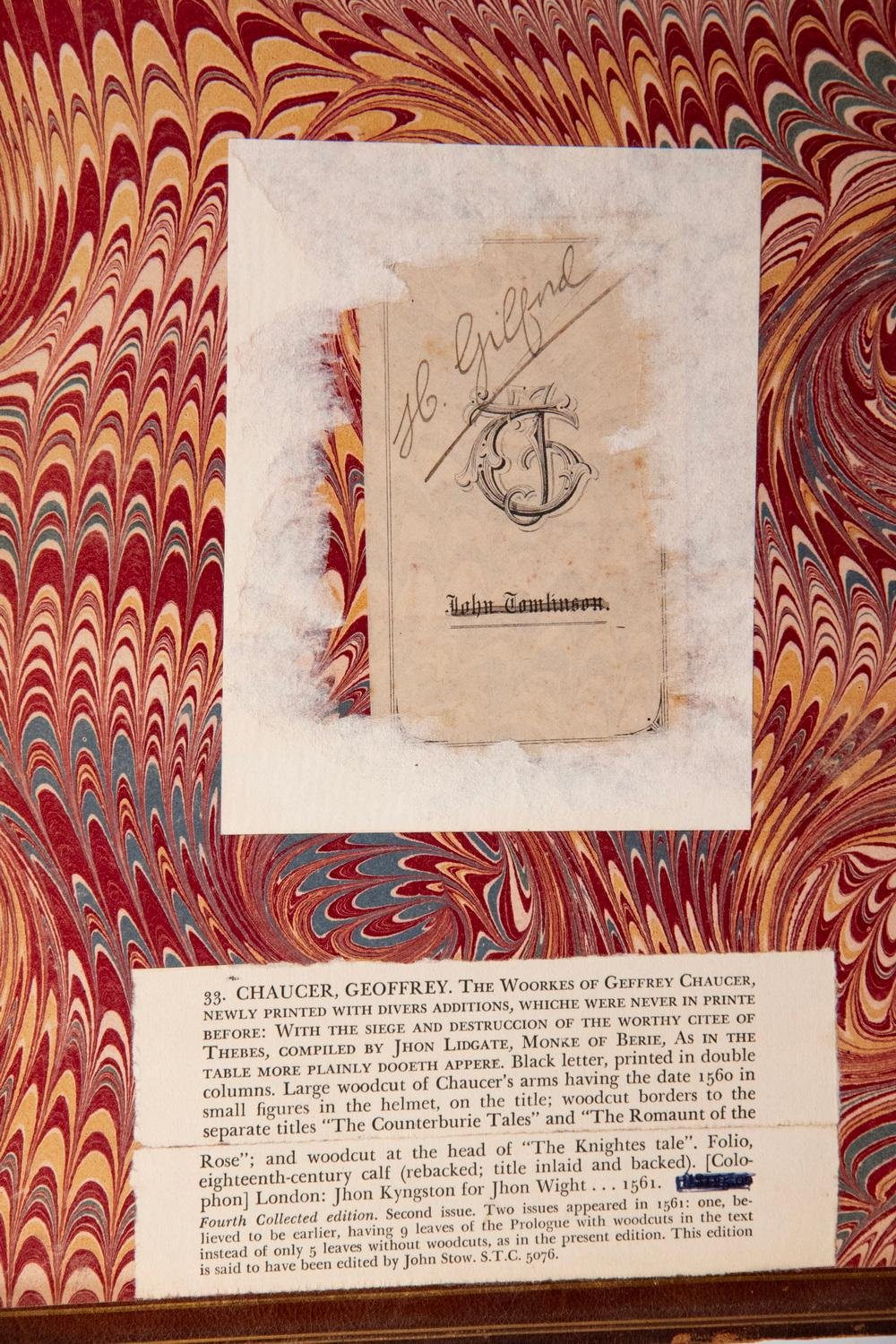
Lot 3483
The Woorkes of Geffrey Chaucer (1561)
Printed by Ihon Kyngston for Ihon Wight, St. Paul’s Churchyard.
The celebrated fourth collected edition, incorporating John Lydgate’s Siege of Thebes and additions attributed to John Stow.
Lydgate, born around 1370 in Suffolk, England, never knew Geoffrey Chaucer in person, but knew the poet's son Thomas quite well. He became the outstanding Chaucerian of his age, compiling writings Chaucer had left unfinished at his death, and writing himself in the Chaucer vein, with his manuscript "The Siege of Thebes" appearing around 142 as a work proposing to expand upon characters and incidents in "The Canterbury Tales" itself as both a supplement and a coda to elements of the original work.
Manuscripts of the tales copied by scribes likely circulated among Chaucer's friends and followers by the end of the Fourteenth Century, but it was the dawn of moveable type printing in the mid-Fifteenth Century that firmly embedded Chaucer and his work in English culture. When merchant/author William Caxton brought to England from Belgium Britain's first known printing press, "The Canterbury Tales" emerged from that press in 1477 as the first book ever printed in England. Following Caxton's death around 1492, his successor Wynkyn de Worde used the same press to produce his own Chaucer edition.
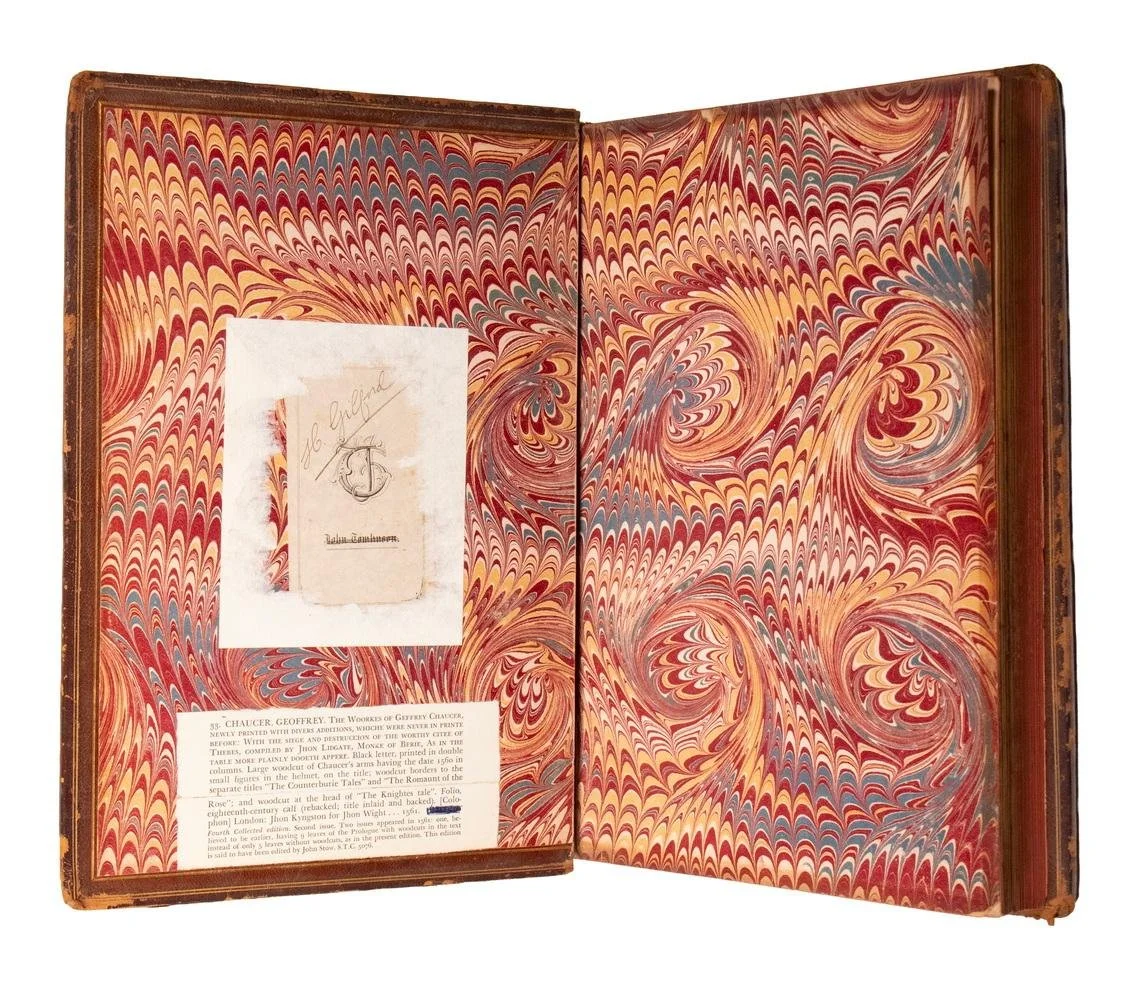
Lot 3483
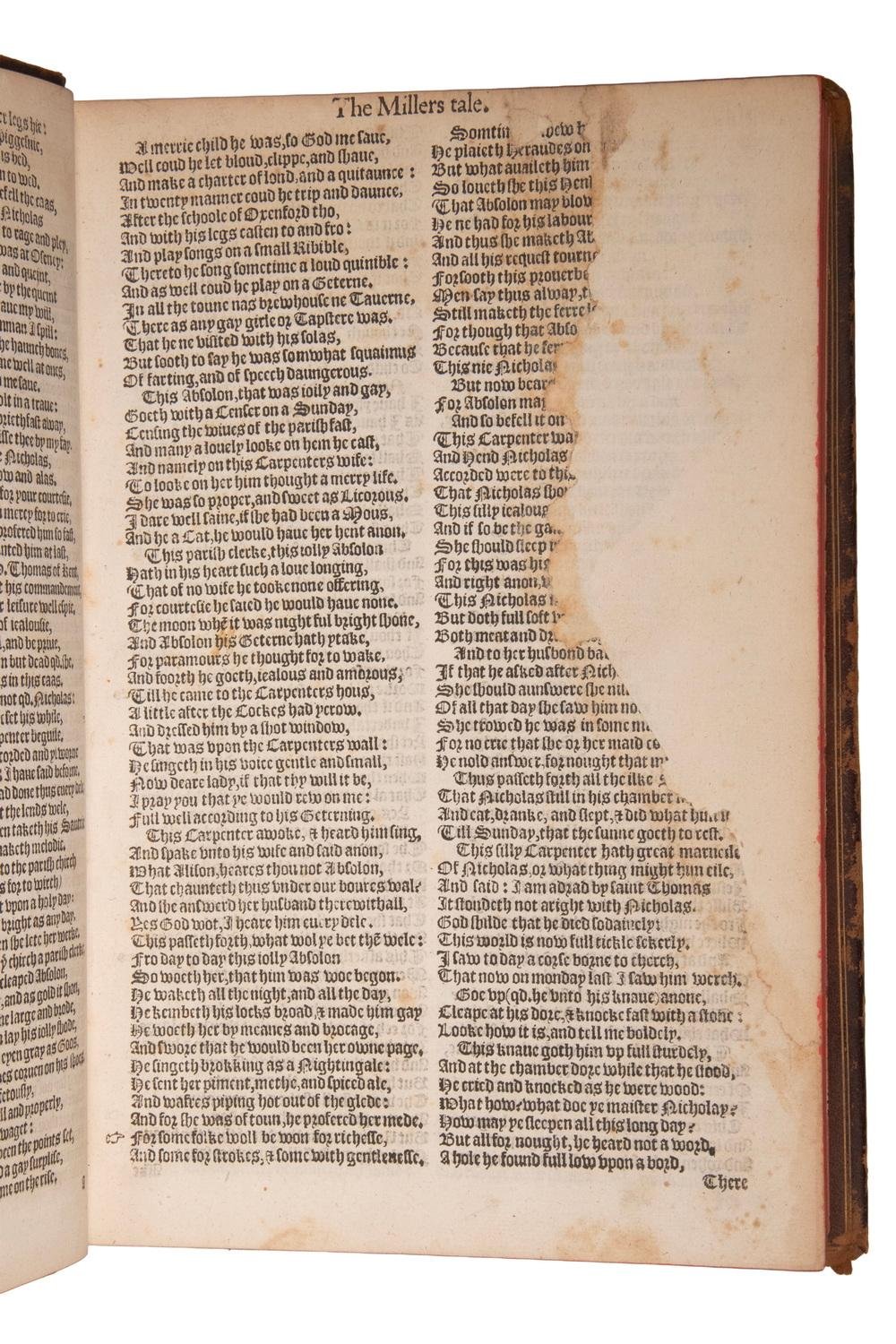
Preserved in a later Victorian binding with gilt edges, this copy shows the honest evidence of use and survival over centuries, including select repaired leaves, minor losses, and early ownership marks.
These early editions, as was common for many volumes in the earliest years of European printing, imitated the look and texture of hand-copied manuscripts, rendering the text in black-letter type cut to resemble calligraphic strokes, augmented by hand-applied rubricated letters indicating the beginning of chapters. For a 1483 revision of his original 1477 printing, Caxton introduced woodcut illustrations of key scenes, with further elaborations on these original cuts added by appointed King's Printer Richard Pynson nine years later. These woodcuts, copied and recopied by subsequent publishers, would become standard in editions of Chaucer for decades to come.
Printing in England itself likewise took major steps toward standardization over the course of the Sixteenth Century. The Church and the Crown, both conscious of the rapid spread of printed literature of all kinds, moved to consolidate control over the nascent craft, as did printers themselves, seeking to protect their commercial interests. By the middle of the century the Worshipful Company of Stationers, originally a guild for the producers and distributers of hand-copied manuscripts, assumed official supervision of the printing and publishing trades, with authority to regulate the operation of printing presses and to seize volumes considered inimical to the interests of the Church or the Crown. From 1557, the Stationers held a legal monopoly on the operation of printing presses and the printing of books in London, and membership in the guild was compulsory for those wishing to openly practice the printing trade.
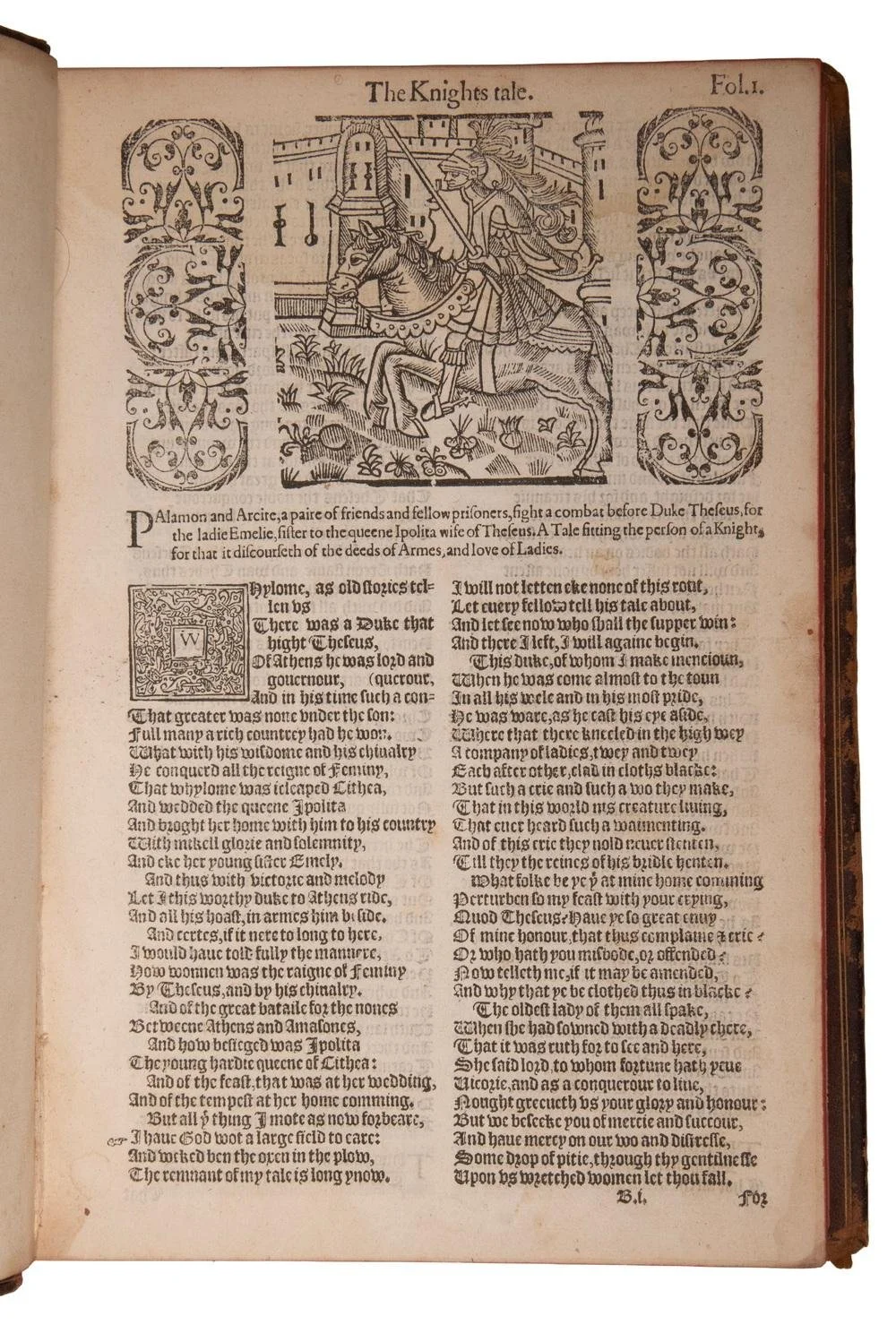
Rare Tudor-era editions of Chaucer seldom appear at auction.
Lot 3483 offers collectors the chance to bid on a significant 1561 printing of “The Woorkes of Geffrey Chaucer”, incorporating early additions attributed to John Stow. Interested bidders are encouraged to register in advance and make bidding arrangements prior to the sale.
One such member was Jhon Kyngston, or, in modernized spelling, John Kingston. Born in the early 1530s, he learned the printing trade as an apprentice under Richard Grafton, appointed King's Printer during the reigns of both Henry VIII and Edward VI, and following that apprenticeship established his own press in time to be included among the list of printers recognized as members at the time the Stationers' Company received its royal charter in 1557. Printers and booksellers congregated by official edict around the West Door of St. Paul's Churchyard, and it was there that Kingston established his own shop, on the premises of a Protestant printer who had fled London during the religious strife that accompanied the reign of Queen Mary. Forming a partnership with fellow printer Henry Sutton, Kingston first specialized in the production of Catholic religious literature, earning a reputation for skill and quality workmanship in the printing and binding of the books produced. With the end of Mary's reign, demand for such books faded, and around 1559, Kingston and Sutton dissolved their partnership, with Kingston carrying on the printing work on his own.
Kingston shifted his emphasis to a broader range of publications, and around that time set out to publish a new edition of Chaucer's complete works, a version incorporating John Lyndgate's addenda to the Tales, as edited by self-taught antiquarian scholar John Stow. In his zeal, Stow took it upon himself to add to the text numerous short poems and ballads he attributed to Chaucer, but which are likely not from the master's pen. To illustrate this edition, Kingston incorporated, from a worn set of woodblocks, a series of cuts originally created for Caxton's edition of 1492. The edition was produced for sale by John Wight, who operated a bookstall under "The Sign Of The Rose" in St. Paul’s Churchyard near Kingston’s printing shop.
An opportunity to acquire a cornerstone of English literary and printing history.
This rare 1561 fourth collected edition of Chaucer’s Woorkes, printed by Ihon Kyngston for Ihon Wight, stands as a testament to the endurance of the written word and the early English press. Collectors and institutions are invited to register and participate in the auction to become the next custodian of this remarkable survivor.
Kingston printed two versions of his Complete Works of Chaucer, the second omitting several woodcuts from the Prologue. We present as Lot 3843 a specimen of this second-state printing, as rebound in the Victorian Era. To turn its still-supple pages, to decipher the bold imprint of its hand-cut Black Letter type, to explore the words of Chaucer through the context of its time, and to consider the centuries that brought this volume to your eyes is to experience for yourself the true romance of the printed page, in a way that no impermanent digital simulacrum will ever duplicate. Though John Kingston died in 1584, we are proud to serve as stewards in passing his printed legacy on for the appreciation of a new generation.
An opportunity of uncommon distinction awaits.
Lot 3843, Rare 1561 Works of Chaucer, Fourth Collected Edition, Second Issue, will be offered in our Winter Enchantment Auction on Sunday, February 22, 2026, beginning at 11:00 AM EST.
Opportunities to acquire such an artifact—one that bridges the manuscript age and the English press, and that has endured for nearly five centuries—are exceedingly rare. Collectors wishing to participate are encouraged to make arrangements in advance, as in-person registration and phone bidding are strictly limited.
To register or to place a phone or absentee bid, please telephone us at 207-354-8141, or submit a Phone/Absentee Bid Form. For additional bidding information, visit our How to Bid page.
Contact us directly to speak with a specialist. We would be pleased to guide you through these pages of history and becoming the next custodian of this sixteenth-century landmark of the printers’ art.