
Picasso’s Tête de faune and the Crommelynck Collaboration
Behind every great Picasso print lies a story of collaboration—and in our upcoming Winter Enchantment auction, we present one that unites twentieth-century mythology with exceptional technical mastery. Nowhere is this collaboration more evident than in Picasso’s work with the Paris atelier of master printmakers Piero, Aldo and Jean Crommelynck, whose renowned studio became an essential extension of the artist’s creative process in the later years of his career.
Celebrating the legacy of major twentieth-century artists, Winter Enchantment 2026 opens with an outstanding selection of international fine art. Highlights include important works by Jean Dufy and André Lanskoy, together with a rare limited-edition print by Pablo Picasso, hand-signed by the artist and pencil-numbered, printed by Atelier Crommelynck, Paris, and bearing the atelier’s embossed blindstamp.
A standout example of this extraordinary collaborative partnership, Tête de faune captures Picasso’s mythological imagination with striking economy, while exemplifying the refined and technical sophistication that defined work from the Crommelynck studio.
A Mythic Subject, Masterfully Rendered
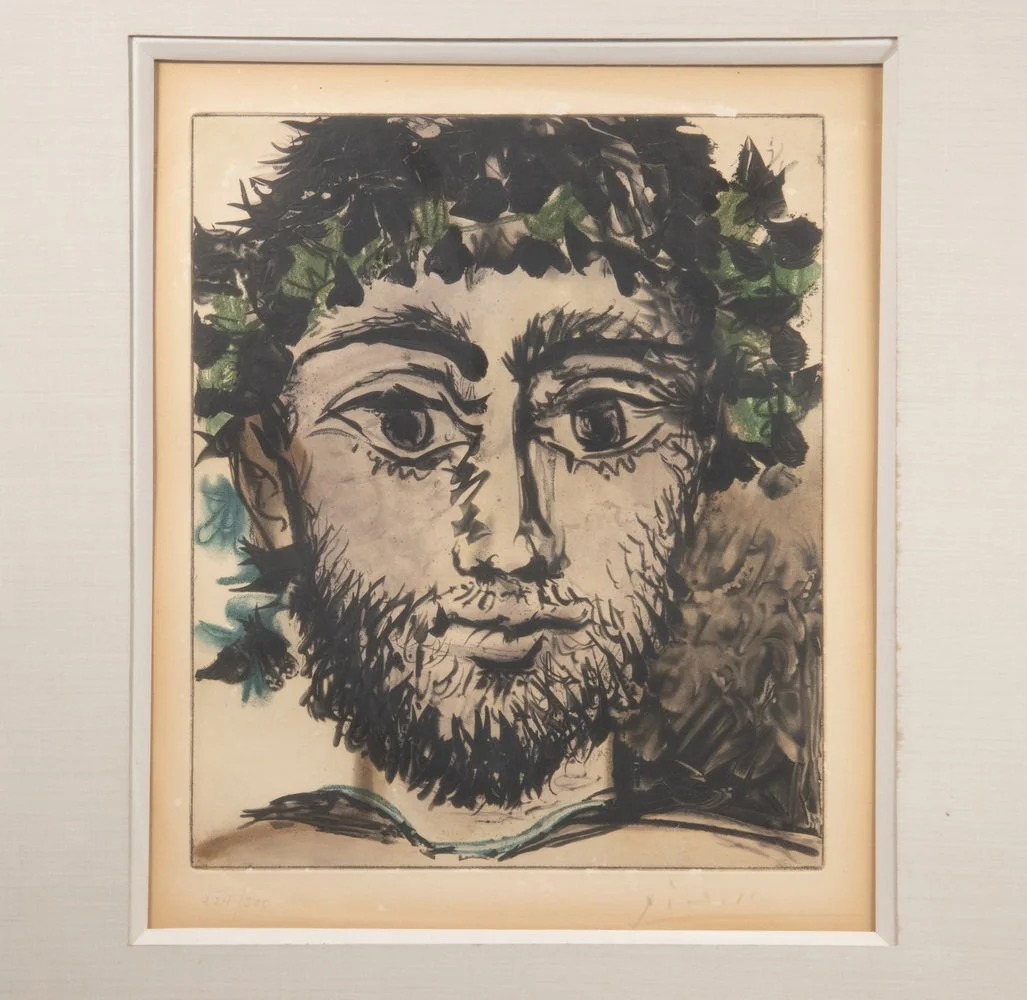
Lot 2334: Signed and numbered 224/300 in pencil in the lower left margin; published by Crommelynk, Paris.
Created in 1958, Tête de faune is a lifetime print, signed in pencil by Pablo Picasso in the lower right margin and numbered in pencil from the limited edition of 300 in the lower left, and documented in the catalogue raisonné as Maeght 2101.
The work depicts a faun, a mythological half-human, half-goat creature from Roman mythology, often associated with nature and fertility. The print reflects Picasso’s enduring engagement with classical mythology, particularly the figure of the faun—a recurring motif in his postwar oeuvre that functions as both a symbol of instinct and sensuality and a proxy for the artist himself. Rendered with a bold economy of line, the composition conveys immediacy and expressive force, while the surface reveals a nuanced interplay of texture and tonal depth.
Executed as a soft-ground etching (vernis mou) and aquatint in colors, the print demonstrates Picasso’s mastery of graphic media and his ability to translate spontaneous drawing into a technically sophisticated printed form. The aquatint enriches the image with velvety tonal fields, while the soft-ground etching preserves the fluidity and immediacy of the artist’s hand.
Faun imagery occupies a significant place within Picasso’s work, reflecting his sustained interest in antiquity and its connection to primal human nature. Prints from this period are particularly prized by collectors for their synthesis of mythological subject matter, assured line, and refined printmaking technique, underscoring Picasso’s collaboration with one of the twentieth century’s most innovative and influential printmakers.
Collaboration at Its Finest
Published by Crommelynck, Paris, the work exemplifies the relationship between artist and printer.
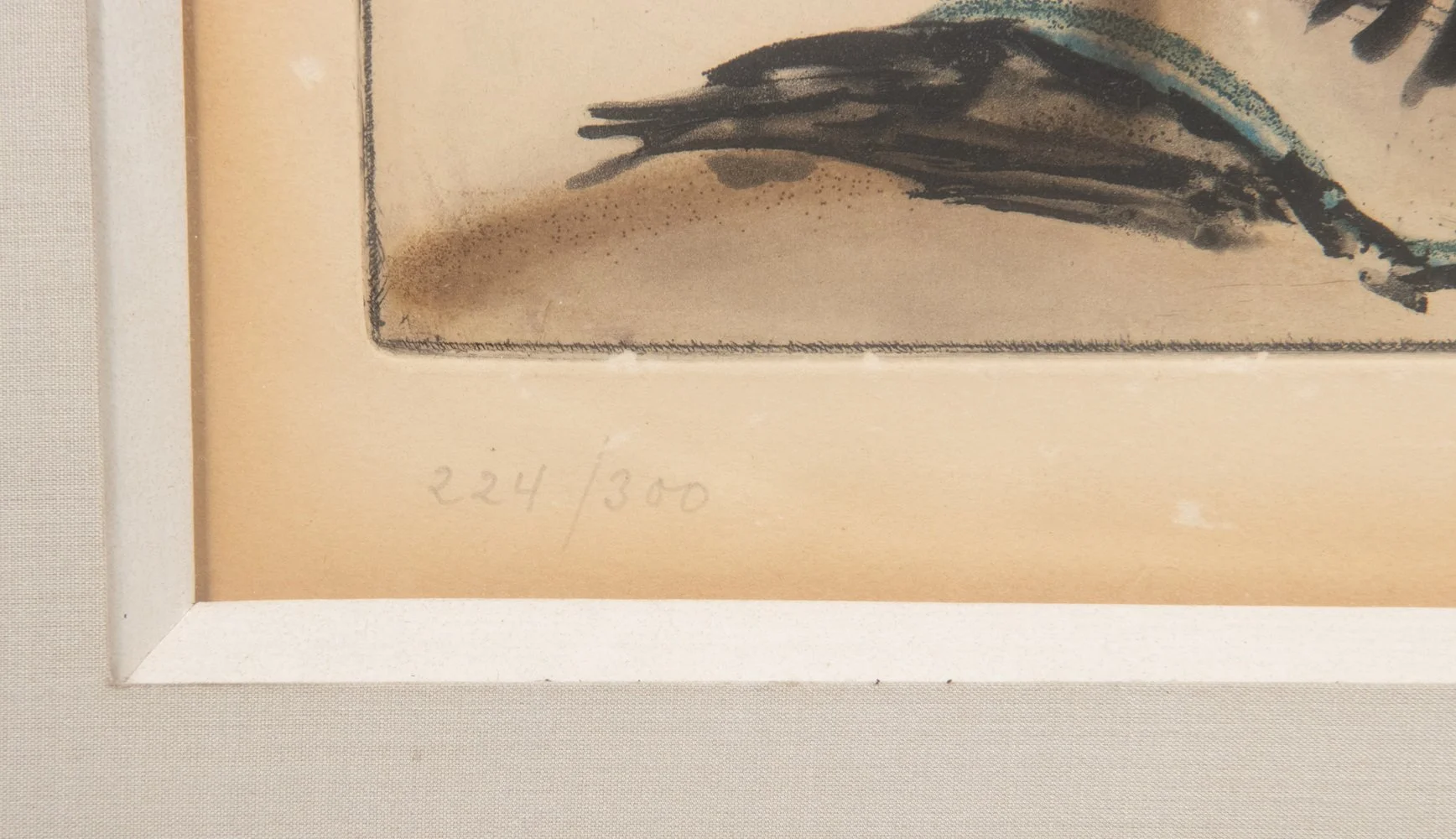
Numbered 224 of 300 in pencil in the lower left margin.
The Crommelynck studio was not merely technical in function; it was a creative collaborator in its own right, pushing the boundaries of printing while preserving Picasso’s expressive intent. Together, artist and studio produced some of the most ambitious and technically accomplished prints of the twentieth century.
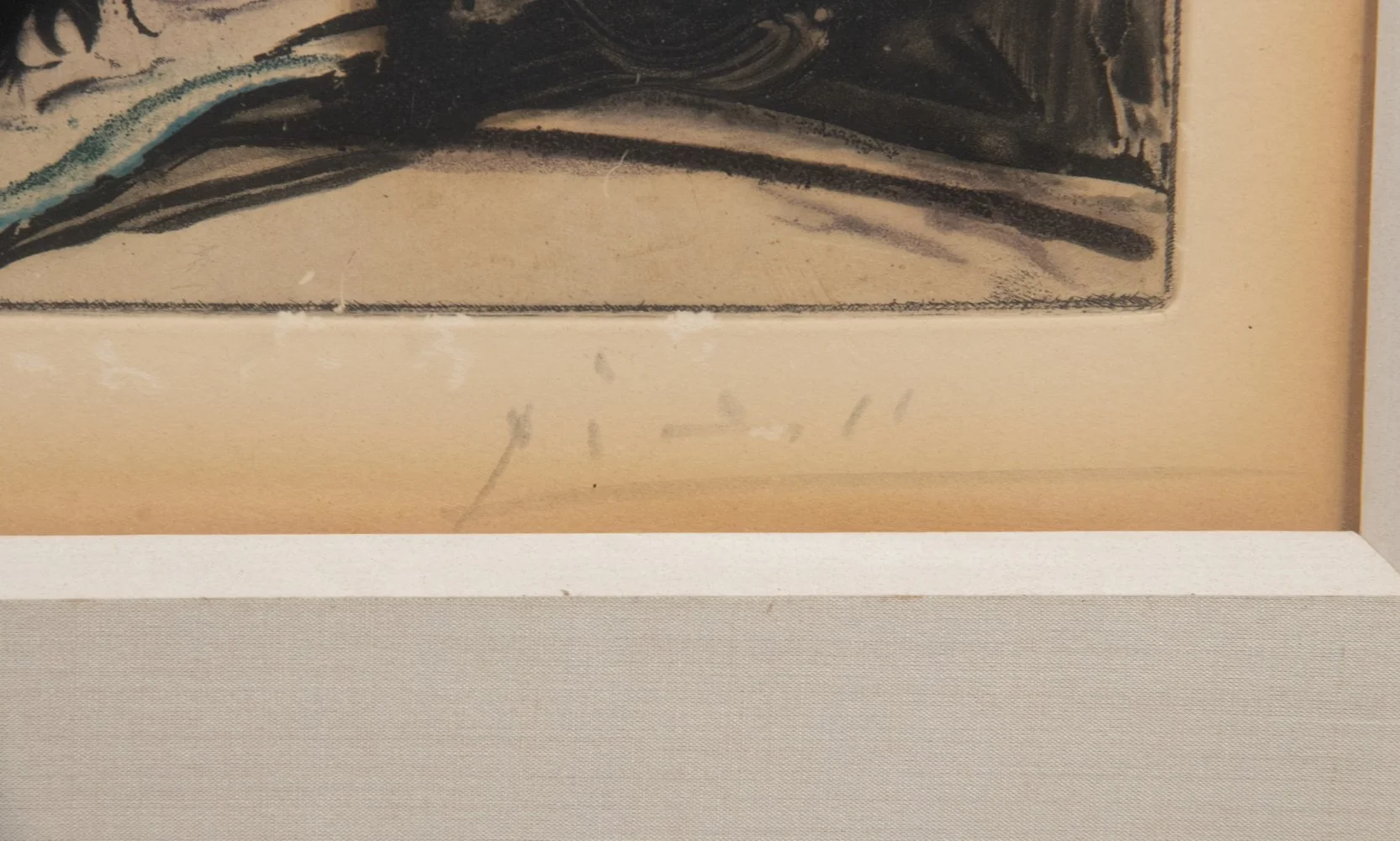
Hand-signed by the artist in pencil lower right.
The present work is printed on wove paper, selected for its smooth, even surface, which allows for crisp line definition and stable color saturation. The sheet is signed and numbered in pencil (224/300), indicating an impression issued as part of the original limited edition during the artist’s lifetime. The embossed blindstamp of Atelier Crommelynck, Paris, further confirms the authenticity.
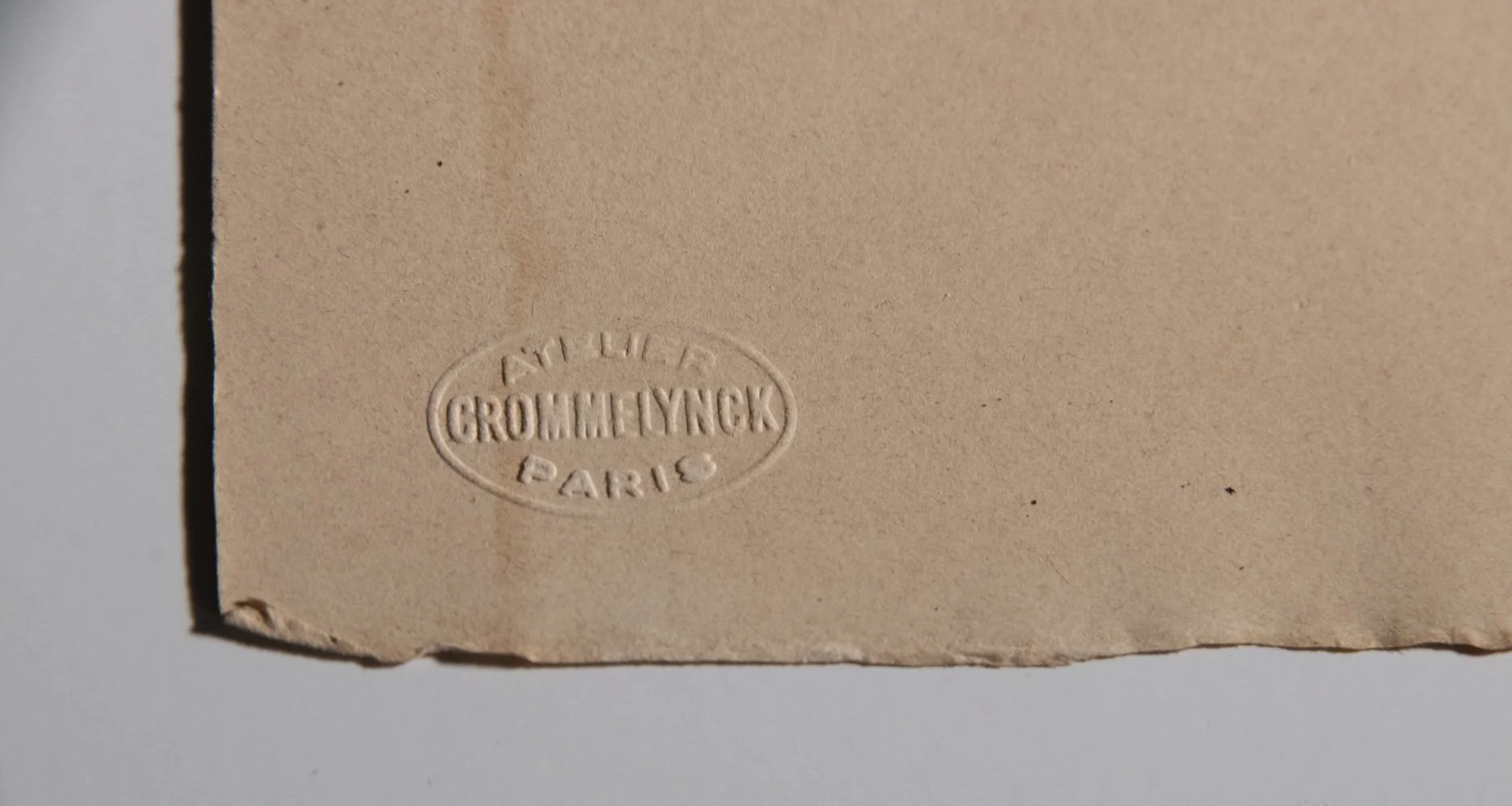
Published by Atelier Crommelynk, Paris, embossed seal lower left corner of sheet.
Why This Work Matters
Referenced in Maeght 2101, Tête de faune stands as a compelling example of Picasso’s graphic work during a period of experimentation. For collectors, it represents more than a signed edition—it is a testament to the collaborative achievement between Picasso and one of the most important printmakers of his time.
Works such as this remind us that printmaking, at its highest level, is not secondary to painting or sculpture. It is a medium in which innovation, technical mastery, and creative vision converge—resulting in works that are both historically significant and highly collectible.
Presentation and Condition
Enhancing its presentation, Tête de faune is mounted and framed under glass, with overall framed dimensions of 27 × 24 inches. Complemented by a distinguished provenance from an important New York estate, the careful framing reflects the attention given to its preservation.
Connect with a Specialist
To gain early access to Tête de faune Lot 2334 and other highlights, call 207-354-8141 or complete the form below to connect directly with a specialist. Subscribe to stay informed on future announcements and the release of the full catalog.