
Revealing a Hidden Duality — A Double-Sided Masterpiece Authenticated by The James Fitzgerald Legacy
James Fitzgerald (1899–1971) lived and worked between two seas—the Pacific and Monterey, California, and the Atlantic and Monhegan Island, Maine—leaving behind a prolific body of work that embodies a profound dialogue and duality of two worlds. Best known for his seascapes and expressive watercolors, Fitzgerald captures both a physical vitality and a spiritual resonance, translating raw observation into geometric, elemental forms.
Featured in our upcoming Autumn Majestic Auction, a newly discovered double-sided painting—Two Dories (recto) and Island Women (verso)—perfectly exemplifies Fitzgerald’s balance of spontaneity and contemplation. Thomaston Auction is honored to be the first to reveal this important discovery. The question surfaces, quiet but insistent—was this double-sided work made for philosophical or economical reasons?

Lot 4380: "Two Dories", CR# 1354, watercolor on paper.
Rendered in watercolor on paper, the first composition, Two Dories (CR#1354), reveals the artist’s sensitivity to light, color and the rhythms of the sea and coastal life. When the frame was opened during the cataloging process, it was discovered that the work is double-sided—and on the verso a second composition, Island Women (CR#1353), an expressive brush and Chinese ink drawing in black and white that offers a deeper glimpse into Fitzgerald’s studio practice and the duality of his creative vision.
Viewed together, these dual compositions—one almost finished, one purely exploratory—exemplify the artist’s movement between medium and subject, offering a rare glimpse into his studio practice.
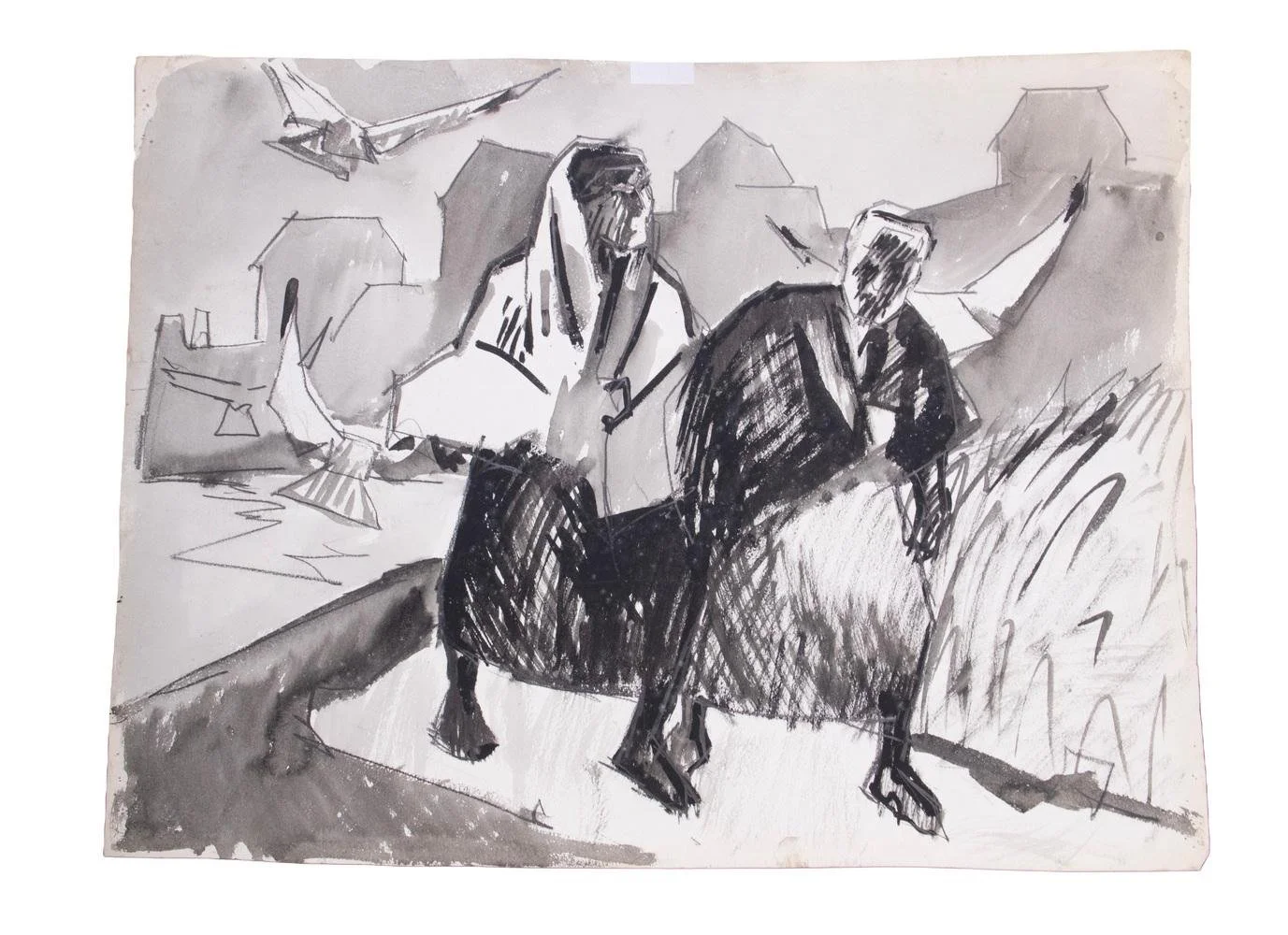
Lot 4380: "Island Women" CR# 1353, brush and Chinese ink on paper.
One of the figures, the woman on the left, is believed to be Mrs. Wincapaw, an island resident whom Fitzgerald painted several times in similar poses. This identification was provided by the Monhegan Museum of Art, where the work has been confirmed and authenticated through the Catalogue Raisonné and will be included in The James Fitzgerald Legacy.
Fitzgerald’s double-sided works are a recognized part of his oeuvre and an area of scholarly interest. The James Fitzgerald Legacy has documented several such examples in its ongoing Catalogue Raisonné, including now, this latest confirmation of Two Dories and Island Women. These double-sided works perhaps demonstrate how Fitzgerald treated the sheet as a dynamic field of exploration rather than a single-image plane.
New discoveries like this, often made during conservation or cataloging, continue to expand our understanding (and appreciation) of his experimental methods and underscore his restless innovation within the traditional media of watercolor and ink.
And whether driven by economical reasons (as materials were often scarce on remote Monhegan) or by philospophical experimentation, Fitzgerald viewed each sheet as a dynamic surface, not a static one. His double-sided compositions frequently pair quick, gestural studies with more resolved paintings, revealing his process of observation and refinement. Thematically linked, these recto-verso pairings often juxtapose maritime scenes with figures, reflecting his fascination with rhythmic continuity rather than isolated subjects.
Influenced by Eastern philosophy and abstraction with time spent in California, Fitzgerald sought to capture form through fluid, layered mark-making. Working on both sides of the paper allowed light to subtly filter through, imbuing his washes with luminosity and creating a dialogue between presence and absence. This approach blurs the boundaries between study and finished work—and a motif found in Fitzgerald’s contemplative and process-based practice.
Born in 1899 in Milton, Massachusetts, Fitzgerald demonstrated promise from an early age. He pursued formal studies at the Massachusetts School of Art (1919–1923) and the Boston Museum of Fine Arts School (1923–1924), where he studied under influential American Impressionists Philip Hale, Leslie P. Thompson, and Edmund C. Tarbell. Yet even as he absorbed their disciplined approach to drawing and color theory, Fitzgerald was already seeking something more immediate and intuitive and lived experiences.
From 1923 to 1928, he took a detour from academic life, embarking on voyages as a sailor and crewman aboard fishing schooners and freighters along the coasts of North America. These years at sea transformed his creative vision, where the rhythm of waves, the physicality of work, and the isolation of life at sea became recurring motifs throughout his career. They instilled perhaps, an enduring fascination with a relationship to the natural elements—a theme that would later define his work.
In 1928, Fitzgerald’s seafaring travels brought him to Monterey, California, where he established a studio and entered one of the most dynamic and creative communities on the West Coast. In California, he became associated with a circle of artists and intellectuals that included John Steinbeck, E. F. Ricketts, Martha Graham, Joseph Campbell, and John Cage. Immersed in this philosophical environment, Fitzgerald absorbed ideas about rhythm, philosophy, and ecology that deepened the spiritual underpinnings of his own work.
From 1936 to 1942, he taught painting in California and exhibited widely, winning recognition for his bold, gestural watercolors. These early works often depict the Monterey waterfront—fishermen mending nets, seagulls wheeling over harbor boats, waves crashing against rocks—subjects rendered not in documentary detail but in sweeping, fluid compositions that pulse with the tides of life and the sea itself. His California period also included public commissions such as murals completed under the Works Progress Administration, which testify to his mastery of composition and form.
In 1943, Fitzgerald sold his Monterey studio and resettled on Monhegan Island, Maine, an artist colony he had first visited in 1923. The island’s isolation and rugged beauty offered the ideal setting for his philosophy of direct, contemplative observation. On Monhegan, he lived among fishermen and fellow artists, forming friendships with Rockwell Kent—whose former house and studio he later purchased—and with Anne and Edgar Hubert, his lifelong patrons and eventual executors.
Monhegan became both subject and muse. Fitzgerald painted the towering cliffs, storm-lashed coves, and lighthouse beacons, as well as the men and women whose lives were entwined with the sea. In these works, the human figure merges with nature in a symbiotic rhythm, the gestures of working hands echoing the motion of wind and wave. His watercolors from this period exemplify the artist’s pursuit of what he called “pure painting”—images distilled to their essential movement and light, freed from narrative.
From 1944 until his death, Fitzgerald made annual pilgrimages to Mount Katahdin in Maine’s north woods, producing powerful studies of its granite forms and shifting atmospheres. Late in life, he traveled to Ireland, drawn to its remote western coasts and spiritual landscapes. It was there, on the island of Arranmore, that he died suddenly in 1971—fittingly, in a place defined by sea, rock, and solitude.
The work of James Fitzgerald starts in observation yet transcends into realism, and remains a testament to his belief that painting is not merely a representation but a revelation. In the sweep of a brushstroke or the bold curve of a ship’s hull or a seagull’s wing, Fitzgerald captured the rhythm of nature—a rhythm both external and inward, elemental and eternal.
Fitzgerald’s legacy endures in both Maine and California, his two spiritual homes. His paintings are held in major collections including the Smithsonian American Art Museum, the Museum of Fine Arts, Boston, and the Farnsworth Art Museum.
Through the stewardship of the James Fitzgerald Legacy at the Monhegan Museum of Art & History —where his house and studio, originally built by Rockwell Kent, are preserved as a National Historic Landmark and open to visitors—it is a great privilege for Thomaston Auction to serve as steward of this remarkable work.
For a deeper look into this discovery, watch Uncovering Hidden Artwork by James Fitzgerald here on YouTube, a short film that captures the moment this remarkable double-sided composition was revealed for the first time.
Don’t miss your chance to acquire a remarkable masterpiece of American art history. Lot 4380 will be offered during our upcoming auction November 6th, 2025, beginning at 11:00 AM EST. Phone bidding and in-person registrations are limited—secure today by calling 207-354-8141 or by submitting a Phone/Absentee Bid Form.
For questions on bidding, visit our How to Bid page, or please contact us directly.
For all other enquiries, please contact us.