
Signs Of The Times: From Flowers to Fountain Pens to the Flying Red Horse
Icons of Main Street and the Great American Roadside—signs are the visual identity we give to the ways we earn our living. The art of the signmaker is often an evanescent one: an image seen racing past a moving window, a trademark glimpsed out of the corner of an eye in a crowded store or on a bustling sidewalk.
A successful sign cannot whisper, it must shout out sharp and loud. Consider some of the examples of commercial signage up for bids in Thomaston Place Auction Gallery's spectacular Summer Grandeur Auction.
At the dawn of the signmaker's art, the language was strictly visual. Signs stood out as pictograms, literally displaying the purpose of the business transacted below. Ancient Roman signs found in the ruins of Pompeii identify the stands of streetside food vendors by means of whimsically colored images of ducks and chickens, a row of wine jars proclaims the delights of a vintner's shop. Whether literal or figurative the use of such imagery continued down through the centuries, marking every type of business from a barbershop to a moneylender's establishment to a tavern with distinctive visual icons declaring its function.
An early 20th Century florist might mark their place of business with a brightly colored bouquet, hand painted on wood, as seen with our Lot No. 2016. A neighborhood butcher, as seen in our Lot 3154, might commission an exuberant collage of the tools of his trade, surmounted, in case the viewer might misinterpret the tools as those of a carpenter, by a majestic swine.
And as demonstrated by our Lot 2009, a dealer in Waterman's Ideal writing implements deserved no less than a yard-long replica of an uncapped fountain pen, shining brass nib at the ready, hanging suspended over the stationery counter.
Few American advertising icons, however, better demonstrate the power of a visual image to sell than Pegasus, the Flying Red Horse. For over thirty years he soared from the ramparts of thousands of automobile service stations from Maine to California, from Canada to Mexico, and all over the world. But he wasn't always red. And he wasn't even always American.
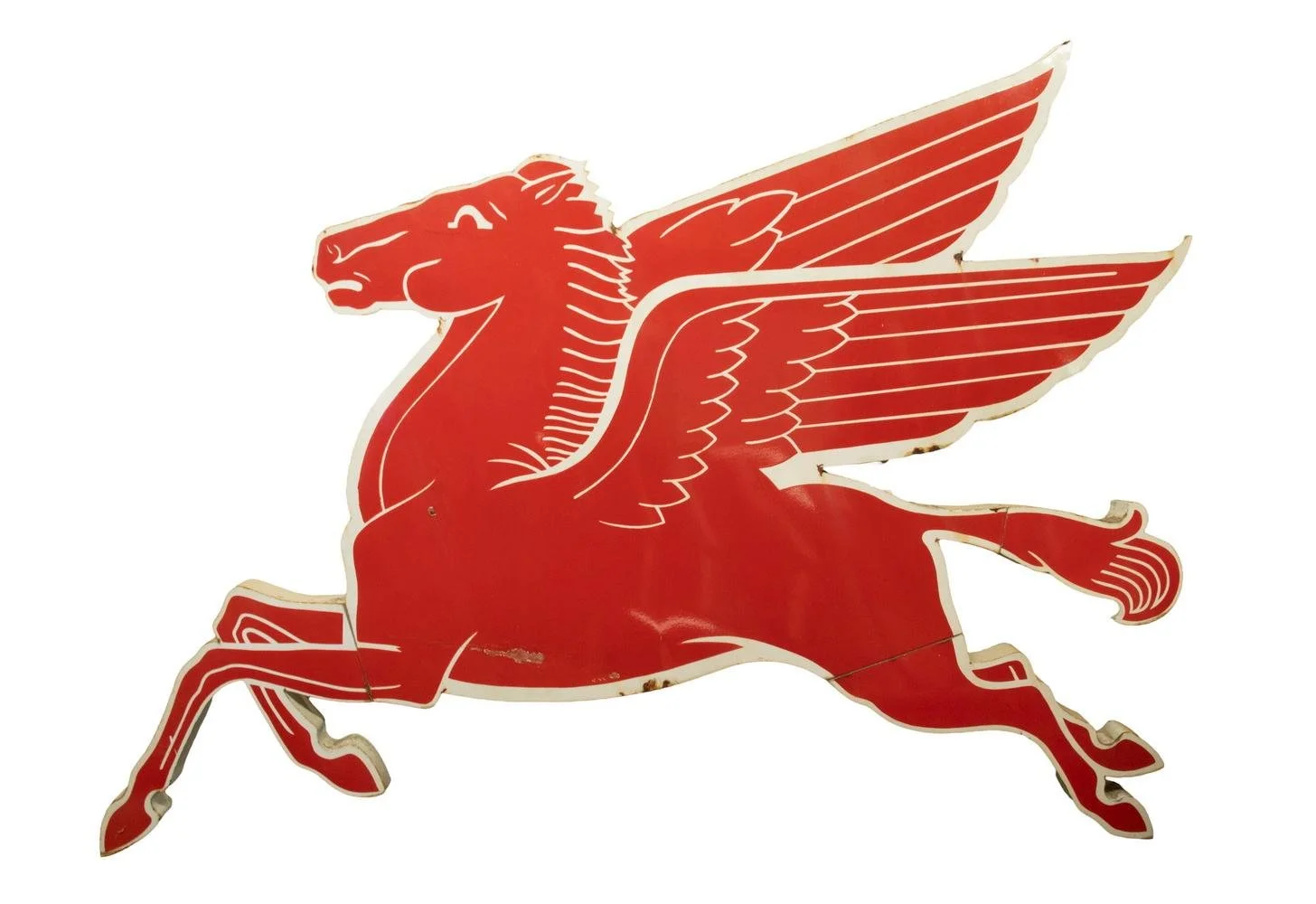
Lot 4002: 1950S LARGE MOBIL OIL PEGASUS ENAMELED SIGN
The image of the winged stallion, a figure out of Greek mythology, was first used to represent petroleum products by the Vacuum Oil Company, one of many oil firms created by the dismantling of the Standard Oil Company under a Federal consent degree in 1911.
Vacuum Oil, which marketed its products under the "Mobil Oil" brand, used a white Pegasus as one of several trademarks in its South African territory in the 1910s, but marketed in the United States not with the horse, but with a distinctively unappealing bright-red image of a leering gargoyle.
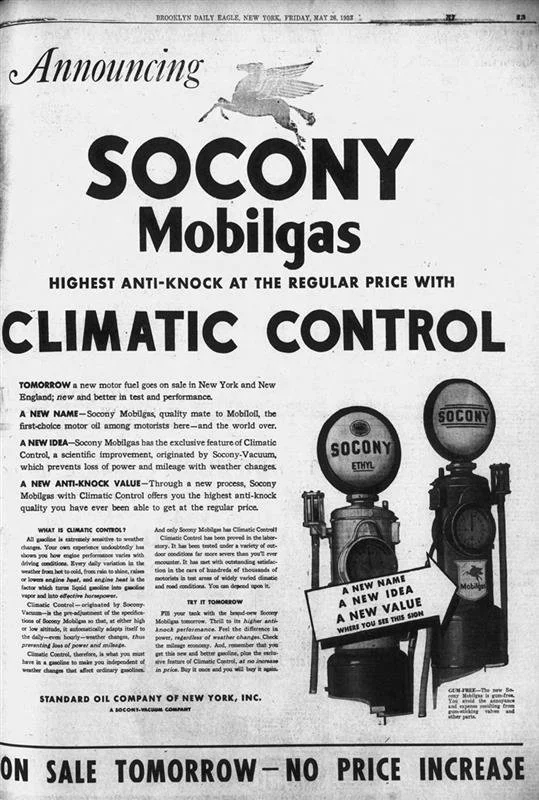
1933 newspaper ad showing the debut of the Pegasus logo.
When in 1931 Vacuum Oil merged with the Standard Oil Company of New York and several other smaller, regional firms to create the Socony-Vacuum Oil Company, corporate officials turned to the problem of creating a single, powerful visual identity for the new firm and its products. The gargoyle had grown no more appealing with the passing years, and the simple shield insignia Socony had used in its original New York-New England sales territory spurred no excitement whatsoever.
But the flying horse—that offered possibilities. Socony marketing executives turned the matter over to a commercial artist named Robert Elmer Lougheed, a young illustrator from Canada whose work displayed a particular flair for the equine. Taking the 1911 design as his template, he added an impression of muscular tension and barely contained energy to the figure, and set its face in an aggressive, charging expression. Posing the wings, legs, and tail at just the right angle to create the sense that the Pegasus is leaping into action, he then, following an example set by the Vacuum Oil affiliate in Japan, colored the figure a vivid red.
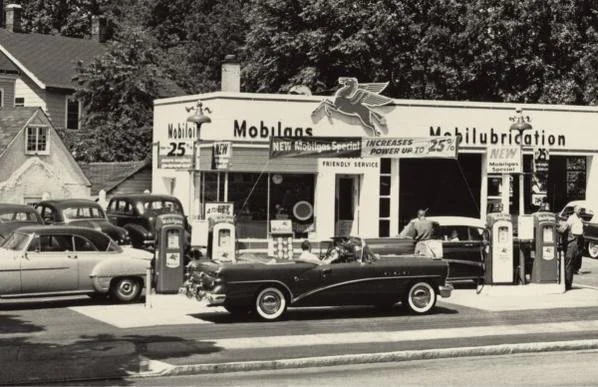
1950s photo showing how these signs were displayed.
Company executives, taken immediately with the new symbol, made it the centerpiece of the nationwide rollout of the new "Mobilgas" gasoline brand. Set against the shape of the old Socony shield, it soon swung from a pole in front of every Mobilgas dealer. And bold and broad and die-cut from porcelain-enameled steel, the Flying Red Horse leaped majestically atop each new station.
Thousands of these so-called "cookie cutter" Pegasi soared across the American landscape from the 1930s into the 1960s, until a new marketing initiative heralding the firm's 1966 transformation into the new Mobil Oil Corporation demanded a "fresh and modern" reimagining of the company's visual identity. The result reduced the proud symbol of the Flying Red Horse to a smaller, simplified icon screen-printed onto a white plastic disc.
Pegasus still flies today under the auspices of the ExxonMobil Corporation, but you must look hard to find him, tucked away on the back label of a motor oil bottle or as a tiny logo on a gas pump topper. But every now and then this proud symbol of the American road soars high on the side of an old garage, a restored service station—or wherever the winning bidder on our Lot 4002 decides to fly him!
If you would like to find out how to make the Mobil Oil Pegasus part of your collection, or for scheduling a private viewing, please telephone us:
+1 (207) 354-8141
For all other enquiries, please contact us.