
Home Is Where The Art Is — Maine's Own Maurice "Jake" Day
They say "art is where you find it," but for Maurice "Jake" Day, inspiration lay as close as his own back yard. Nature was his métier, whether the rugged realism of the Damariscotta coastline or the fanciful magic captured in a Disney forest, and it was his ability to bridge the real world and the fanciful that made him one of the most beloved figures in the expansive world of Maine art.
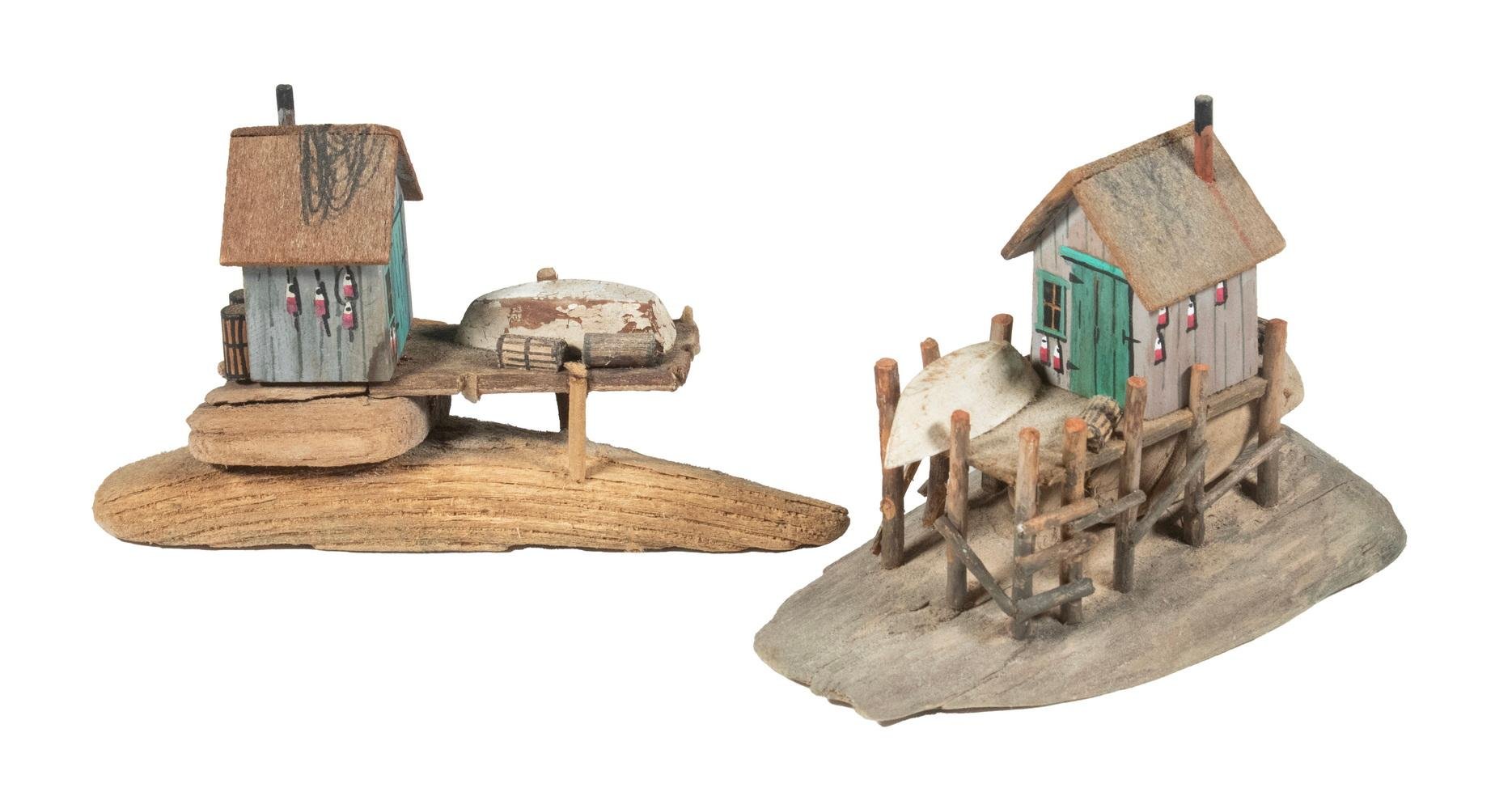
Lot # 4373: Group of (2) Driftwood Lobster Shack Sculptures, by Disney animator and Maine artist Maurice "Jake" Day/The Whittle Shop (Damariscotta), with painted highlights, both signed "Maurice Day" on base, one also marked "The Whittle Shop", 3 1/2" high.
Maurice Ellicott Day was born in 1892 was born in Damariscotta, Maine, son of a longstanding Maine shipbuilding family, and they called him "Jake" for no reason anyone could recall. From earliest childhood he loved, not just to draw, but to engage with the subjects he drew. The wildlife surrounding the family homestead, the scampering woodland creatures and the majestic denizens of the deeper forests all energized his budding talent. He painted, he sketched, he carved in wood and sculpted in clay, he learned about dioramas — a popular pastime of the early 20th Century recreating three-dimensional scenes at tabletop size. When he ventured off to Boston for college, he was already a well-rounded artist, needing only polish to refine and focus his skills.
His earliest major professional accomplishments came in the field of illustration, where following his service in the First World War, Day furnished artwork for several well-received children's books published by the Boston-based Atlantic Monthly Press. These volumes, filled with fanciful imagery, brought him to the attention of some of the leading magazines of his day, at a time when magazine illustration work was seen as bridging the gap between commercial and fine art. But it wouldn't be in print that he would achieve his next major success — but on the motion picture screen.
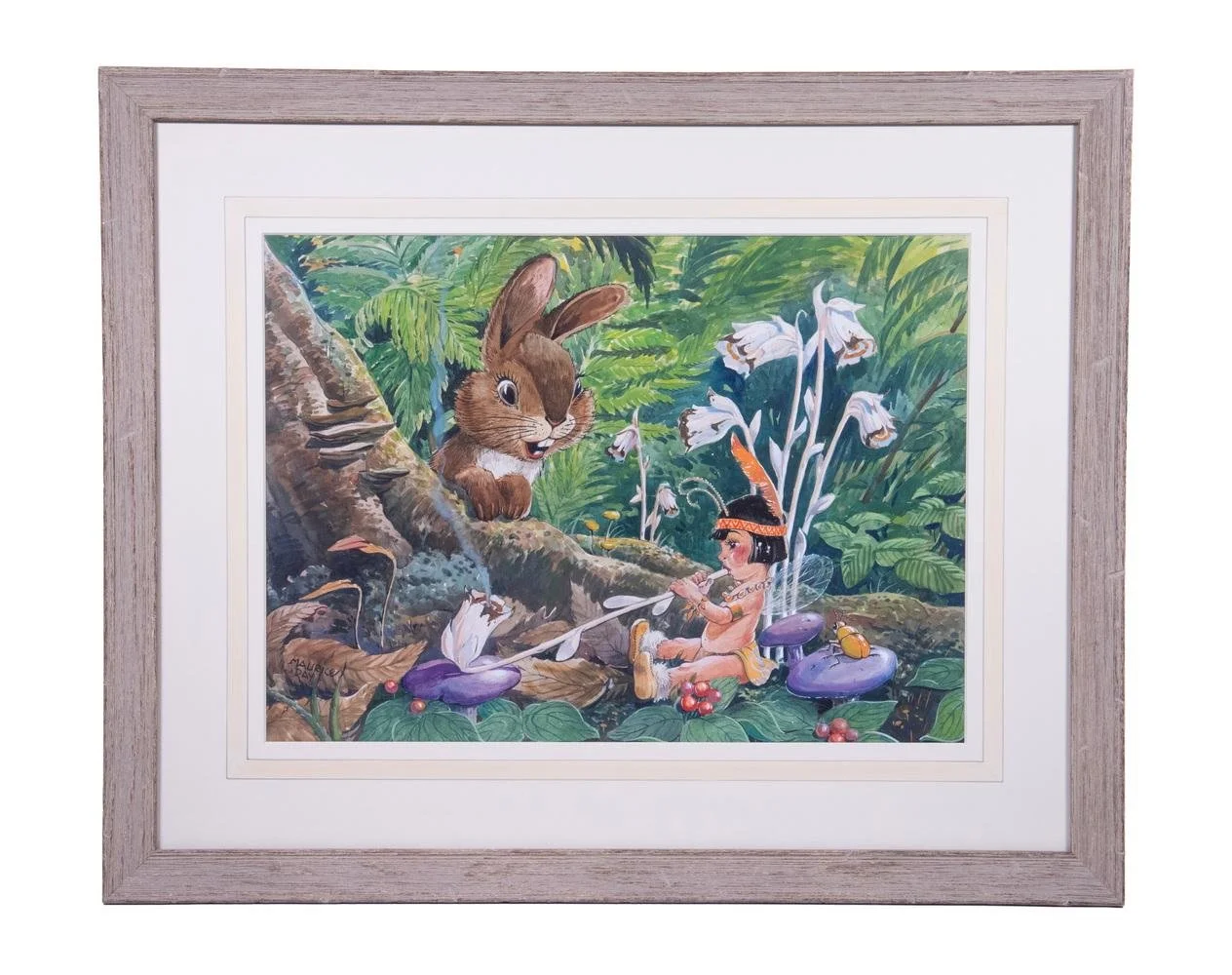
Lot # 4371: Rabbit Discovers an Indian Sprite using Flower Peace Pipe, watercolor on board, signed lower left, in modern barnwood frame, matted under glass.
Animated cartoons came into their own with the coming of talking pictures in the late 1920s, and there was plenty of work for an ambitious young artist willing to put in long hours. The Walt Disney studio in Hollywood led this growing new field, but his was far from the only outlet. Two former Disney artists, Hugh Harman and Rudy Ising, broke away in 1929 to form their own animation studio, releasing their films first thru Warner Brothers — where they created the first "Looney Tunes" — and subsequently through Metro-Goldwyn-Mayer, where, bolstered by elevated budgets, they resolved to "out-Disney Disney." One of the talented artists they brought on board to accomplish this goal was Jake Day.
With Technicolor cartoons now all the rage, Day brought his impressive abilities as a color stylist to bear at Harman-Ising, and was soon promoted to layout artist. Second only in importance to the director himself, a layout artist was responsible for the overall visual design and blocking of a cartoon, figuring out how to move the two-dimensional characters under the camera to create the illusion that they were moving in a three-dimensional space.
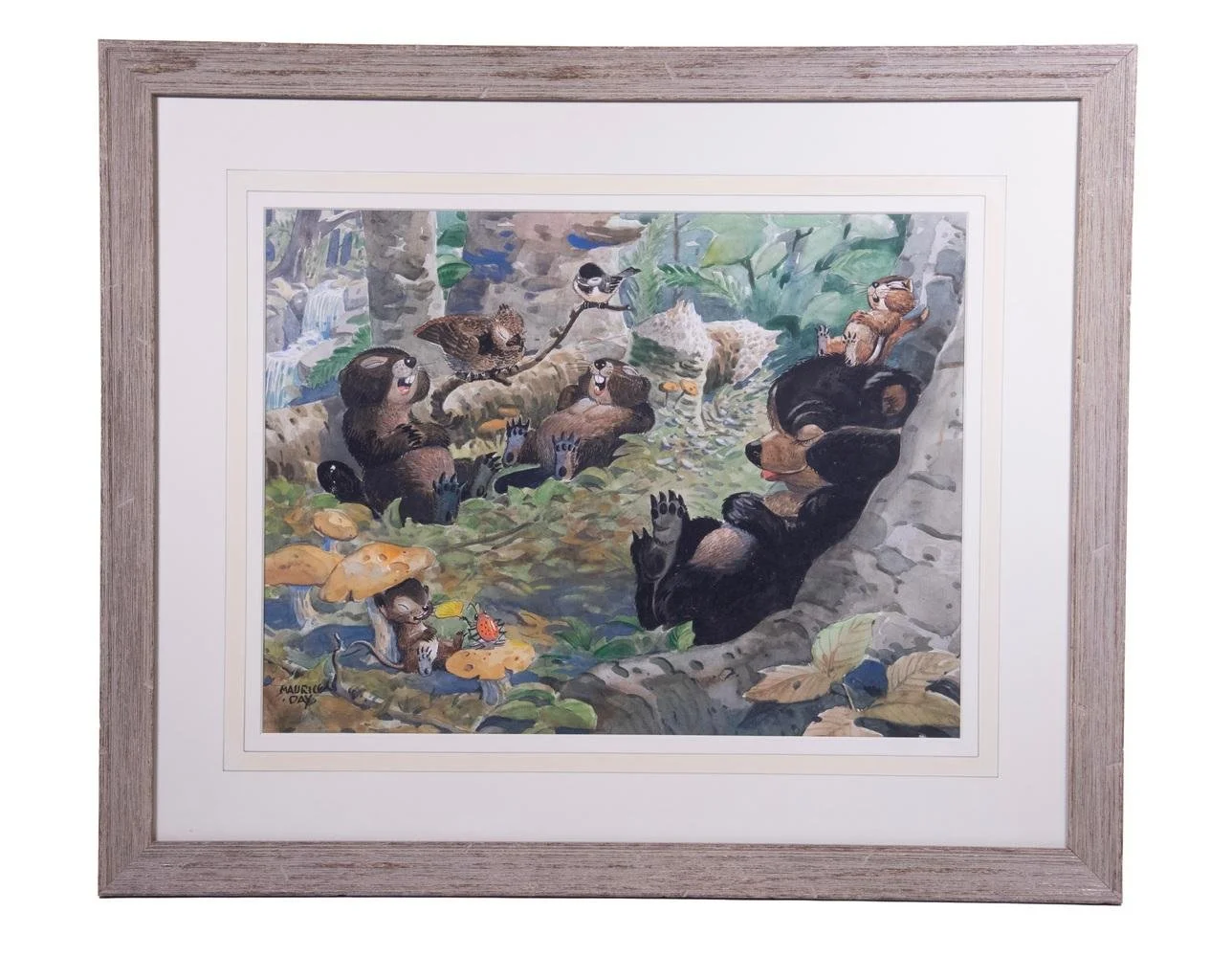
Lot # 4372: Mid Day Siesta, depicting a range of wildlife on a "jobsite" taking a snooze, watercolor on board, signed lower left, in modern barnwood frame, matted under glass.
Disney viewed the Harman-Ising Studio as second only to his own in skill, to the point where, when, he fell behind on his release schedule, he sub-contracted an upcoming film to his former colleagues. This cartoon, "Merbabies," depicting frisky young sea-beings capering in time to music, showcased Day's ability to create screen characters that, though exaggerated, nonetheless had substance and personality. Disney noticed. When Disney noticed a rising talent, the result was inevitable. In due time, Jake Day was on the Disney payroll.
He arrived at the Disney studio at a propitious time. Walt Disney was losing interest in short cartoons, with feature-film projects taking up more of his attention. Jake Day had an idea that fit right in with this new studio agenda. Realizing that his new employer wanted to do a feature based around animal characters, he called to Disney attention the 1923 novel "Bambi," by the Austrian author Felix Salten, widely popular with American children since its release in an English translation in 1928.
Disney read the book, was impressed, and listened attentively when Day urged him to Americanize the story by taking Salten's depiction of Bambi as a European Roe Deer and making him, instead, a North American Whitetail, such as he had known back home in Maine. Disney agreed, and assigned Day to prepare the necessary character designs — not simply by going back to Maine and making a few reference sketches, but instead by going to Maine, and bringing a couple of actual Whitetail deer back to California as live models. With all expenses paid, Day did just that.
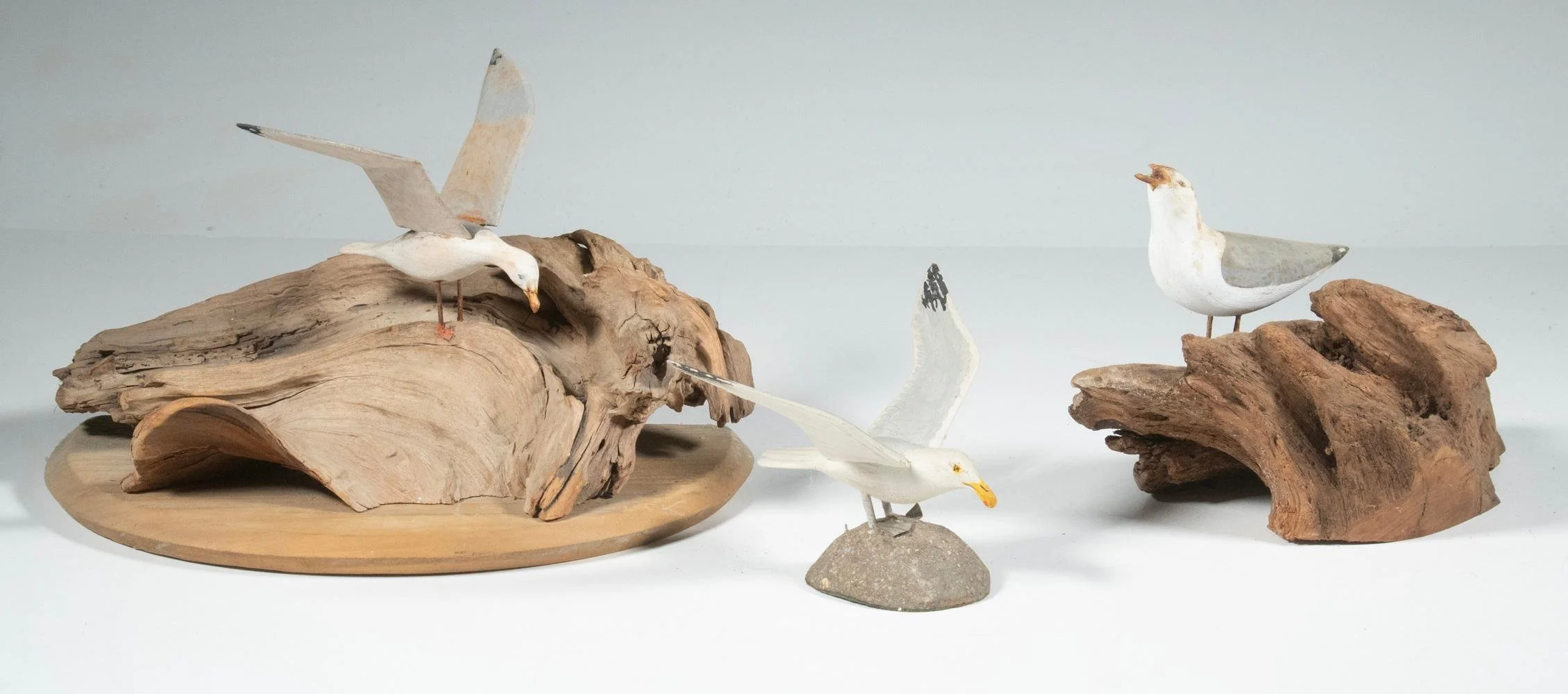
Lot # 4374: Group of (3) Folk Art Seagull Sculptures, by Disney animator and Maine artist Maurice "Jake" Day, the largest signed on base and with a paper "The Whittle Shop, Damariscotta, Maine" label affixed to base (5 1/2" high, 9 1/2" wide), the other two unsigned (3 1/2" and 5" high).
His designs for the film, featuring an entire forest full of cheerful large-eyed, open-faced woodland friends alongside his leading deer, influenced Day's own artwork for the rest of his life. Though he was a talented nature artist long before he ever heard of Walt Disney, his time at the studio gave him inspiration for a continuing series of works in which anthropomorphized forest animals gently parodied the conventions of the everyday human world.
These works offer a fascinating combination of cartoony humor and rigorous spatial realism, with Day's cast of characters performing against backgrounds that seem substantial, honest, and genuine. No matter how hardened a viewer might be, no matter how devoid of personal whimsy, it is impossible to view these works as mere "funny animal" pictures. Just for a moment, Day's gifted brush and unerring sense of design convinces you that the world they depict is real.
Jake Day was a master of multiple artistic disciplines. After retiring from animation and returning to Damariscotta, he spent several years selling his own delightful carvings of birds and animals from his own Damariscotta storefront. He built increasingly impressive and elaborate dioramas. He mastered nature photography. And he spent as much time as he possibly could in the embrace of his beloved Maine woods. By the time of his passing in 1983, he was an elder statesman of Maine art, and a man who never lost touch with the world from which he came.
Bring works of this remarkable artist into your own home by selecting from among eleven outstanding examples appearing Sunday November 9th, the climactic Day Four of Thomaston Place Auction Galleries' Autumn Majestic Auction.
Preview our Upcoming Auction: Autumn Majestic
Join us for a preview of our upcoming feature auction, taking place November 1st — 5th.
Saturday November 1st: Noon – 5 PM
Gallery Hours Weekdays: 10 AM – 5 PM
Explore our extraordinary auction galleries, showcasing a world of treasures — fine art, rare antiques, exquisite Asian masterpieces, timeless collectibles, classic automobiles, vintage timepieces, and more.
The auction runs November 6–9, 2025, beginning daily at 11:00 AM EST. Phone bidding and in-person registrations are limited—secure yours today by calling 207-354-8141 or submitting a Phone/Absentee Bid Form.
For questions on bidding visit How to Bid, or please contact us directly