
The Wyeth Legacy—Three Generations that Shaped American Art
The name Wyeth does not refer to a single artist, but rather to an enduring legacy—the first Maine family of American art—and whose contributions span three generations that helped define the visual language of realism in the United States. Nowhere is this American legacy more deeply rooted than in the majestic landscapes and rugged coastlines of Maine, a region that served as both sanctuary and source of inspiration for the Wyeth family across generations.
As a tribute celebrating one of the most influential families in American art history, Thomaston Place Auction Galleries is honored to present a special collection during Summer Grandeur—a major auction event taking place at the end of August 2025. The distinguished and scholarly collection—The Wyeth Legacy: Three Generations of American Art—is a thoughtfully assembled presentation with fully documented ownership, exhibition history, and references to scholarly publications. The Wyeth collection represents the depth, continuity, and emotional resonance of the Wyeth lineage, underscoring three generations of contributions to American art history.
N.C. Wyeth: The Visionary Illustrator and Patriarch
Newell Convers (N.C.) Wyeth (1882–1945), born in Needham, Massachusetts, was the eldest of four brothers and a prodigiously talented artist whose early influences came from his mother, who included both Henry David Thoreau and Henry Wadsworth Longfellow among her acquaintances. Her literary inclinations helped shape N.C.’s unique aesthetic sensibility—one that seamlessly bridged visual storytelling with narrative depth.
N.C. Wyeth is best known for his luminous and dynamic illustrations, particularly those created for Scribner’s Classics editions, including Treasure Island, Robin Hood, The Last of the Mohicans, and The Deerslayer. These works—vivid, theatrical, and emotionally charged—achieved their fullest expression when paired with the narratives they were designed to accompany.
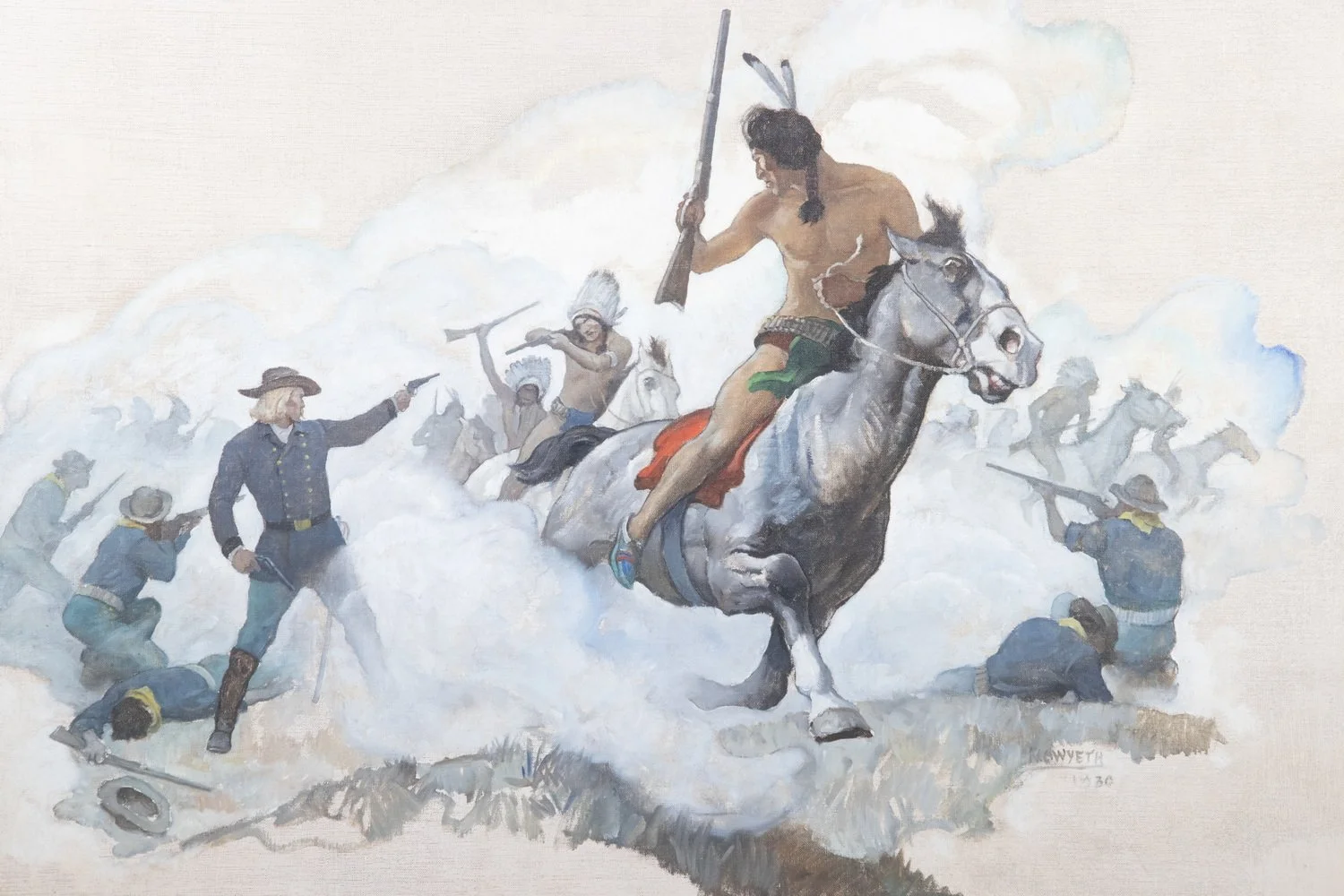
"Custer's Last Stand", oil on canvas, signed and dated lower right "N.C. Wyeth", 1930', titled and inscribed lower right "To Martin Pyle from NCW'.
At the age of 21, N.C. Wyeth received one of his earliest and most formative commissions as an illustrator—a dynamic image of a bucking bronco for The Saturday Evening Post. To prepare, he journeyed westward to Colorado and New Mexico, where he immersed himself fully in the unfamiliar terrain. Determined to authentically capture the spirit of the American West, he spent extended periods on cattle ranches, observing and participating in daily life to gain a nuanced understanding of the landscape and its people. When his funds were stolen during the trip, he took on local work to finance his return to the East Coast.
Over the course of his career, N.C. completed more than 100 illustration projects, including prominent commissions for major advertisers such as Coca-Cola and Lucky Strike. His personal explorations in painting evolved from American Impressionism, as practiced by the New Hope Group, to a deeply felt American regional realism marked by a masterful command of light and atmosphere—qualities that would become hallmarks of the Wyeth aesthetic.
Andrew Wyeth: The Poetic Realist
Andrew Wyeth (1917-2009) inherited both the technical skill and creative intensity of his father, learning to draw before he could read. His works are instantly recognizable for their emotional restraint and haunting stillness—scenes that often convey a sense of absence, where the mundane is imbued with a quiet tension, suggesting what has just occurred or provoking what is about to unfold.
From a young age, Andrew assisted his father in the studio, absorbing the practices that would come to define the Brandywine School of painters—artists who found profound meaning in the landscapes and lives of rural America. At the age of 19, Andrew was given his first solo exhibition in Philadelphia; one year later, his watercolors were shown at Macbeth Gallery in New York. The exhibition sold out, launching his career into national prominence.
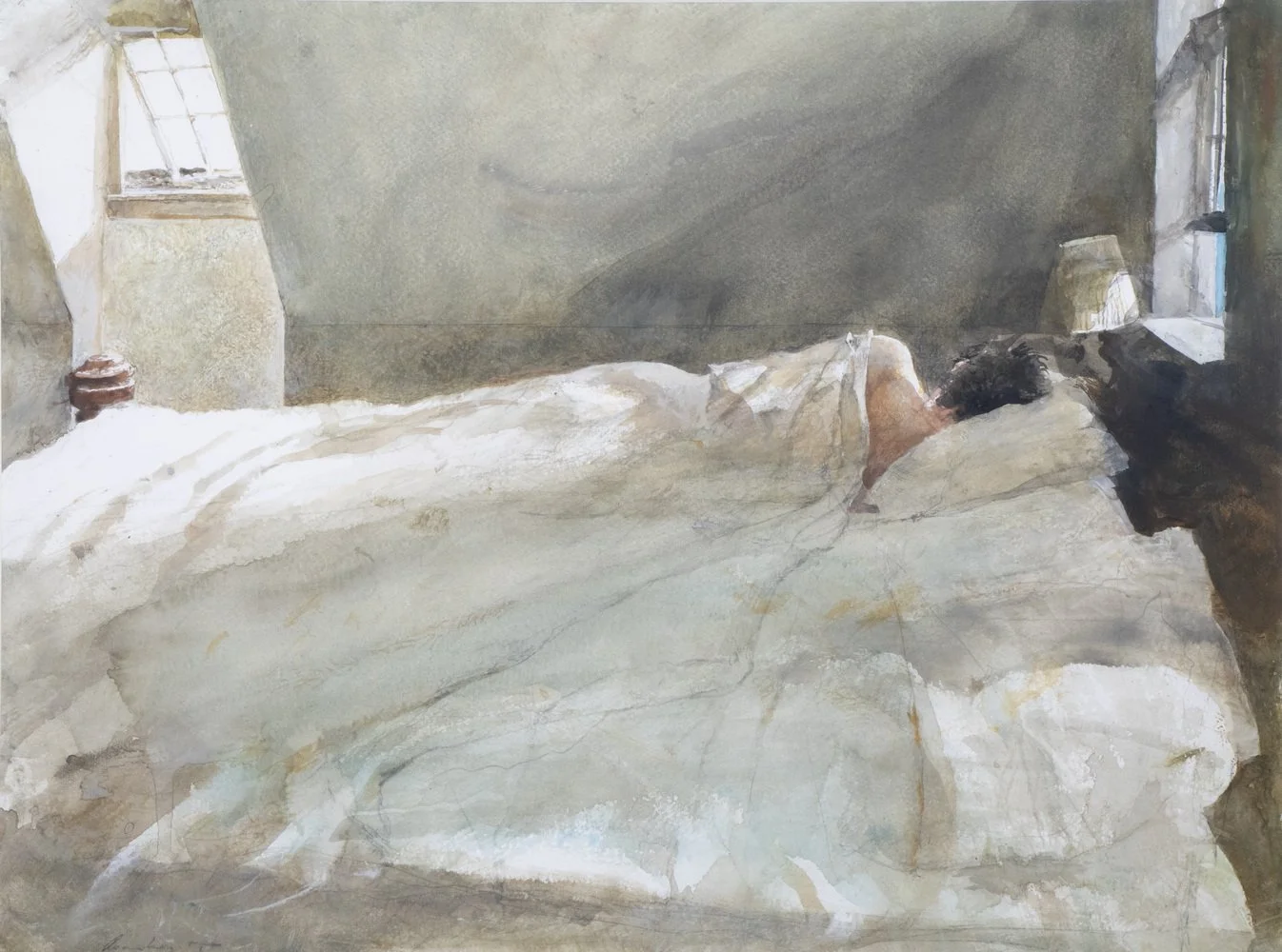
"Gone Ashore", watercolor on paper, signed lower left. In a thick white mat w/ metal casement frame.
By the age of 26, Andrew was featured in MoMA’s Americans 1943: Realists and Magic-Realists, affirming his place among the country’s most important representational artists. Andrew’s traditional realist aesthetic, inspired by Winslow Homer and Victorian narrative painting, portrayed an America of solitude, endurance, and an intimate connection to the land—a deeply evocative vision that resonated with the public during an era increasingly captivated by abstraction.
As Abstract Expressionism emerged and gained prominence in the United States in the late 1940s and the 1950s, it became a dominant force in American art, influencing subsequent movements and solidifying America’s place as a center of the art world. Emerging critics championed artists like Jackson Pollock and Willem de Kooning. Yet for many Americans, Wyeth’s quiet introspection and emotional depth, exemplified by Christina’s World (1948), offered a more relatable vision of American life and values—rooted in endurance, dignity, and place.
Jamie Wyeth: The Contemporary Visionary
Jamie Wyeth (b. 1946), grandson of N.C. and son of Andrew, inherited the poetic flame that burned brightly in his family. Immersed in the arts from a young age, Jamie chose an unconventional path by apprenticing under his aunt, Carolyn Wyeth, rather than pursuing formal academic training. Like his predecessors, Jamie was required to master drawing before venturing into painting—an initiation that provided the framework for the technical precision that defines his work.
At age 20, Jamie gained national attention when the Kennedy family invited him to paint a posthumous portrait of President John F. Kennedy for the White House. Though he declined the official commission, the resulting unofficial portrait, now held by the Museum of Fine Arts, Boston, affirmed his place as a very accomplished young talent.
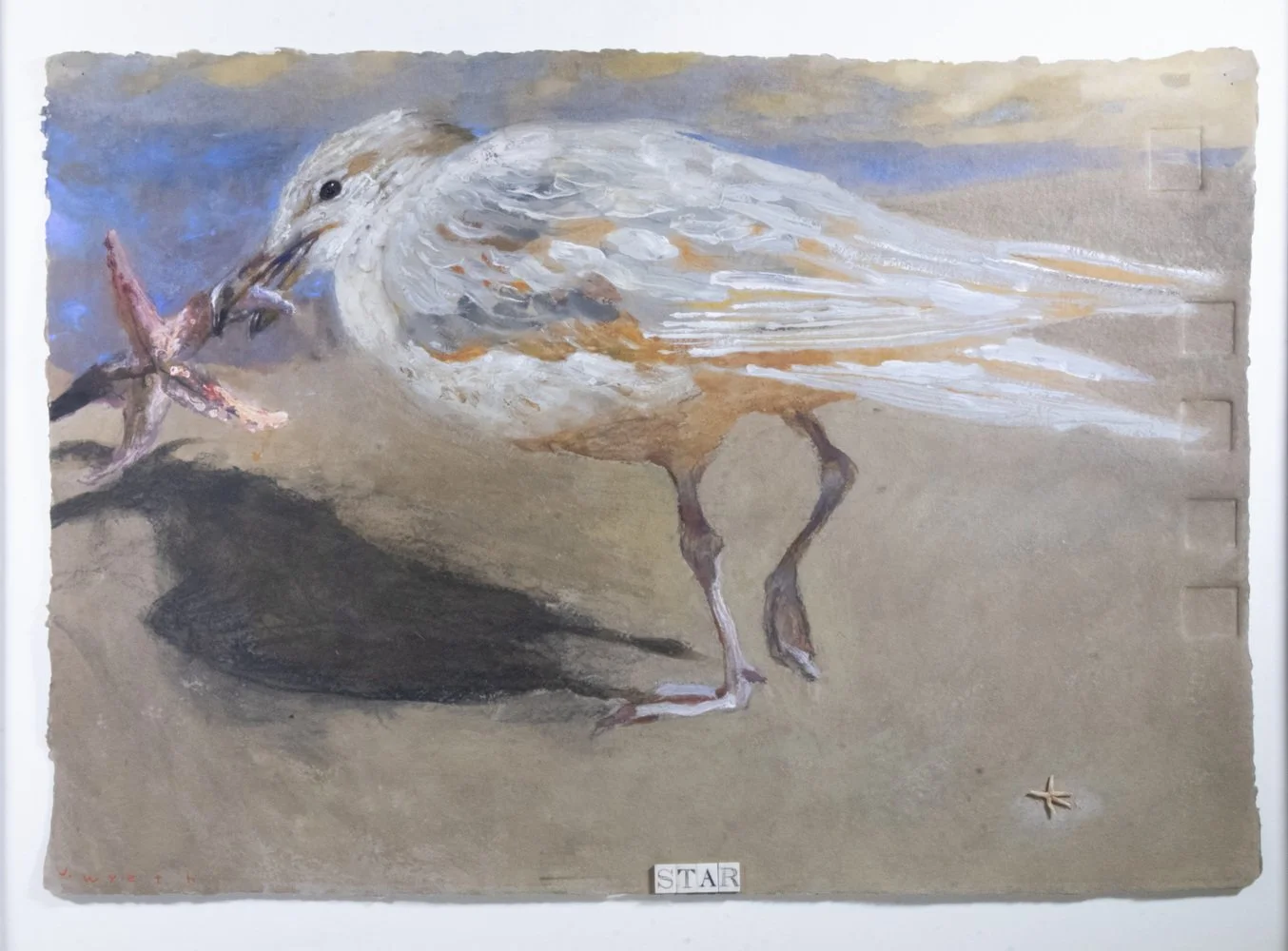
"Star", 1999, combined medium, bone title and starfish collage on hand-made deckled edge wove paper with embossing, signed lower left, having labels verso from Adelson Galleries & James Graham Galleries.
Jamie’s work balances tradition with innovation. And while his technique diverges from that of his father and grandfather, their influences are unmistakable. The striking palette and narrative quality of his work echoes N.C.’s illustrations, while his introspective tone and psychological nuances evoke Andrew’s haunting realism. Notably, the sale also includes a copy of The Stray (1979), a children’s book illustrated by Jamie, offering a poignant example of the narrative continuity that unites all three generations.
Featuring a selection of works representing the Wyeth lineage, the special collection ranges from iconic landscapes to rarely seen early studies. Executed across a rich variety of media—including oil on canvas, watercolor, pen and ink drawings, illustrations, and lithographs—this once-in-a-lifetime offering presents a highly focused and thoughtfully arranged assemblage. Together, these pieces—brought together in a rare and unprecedented presentation of all three generations—embody the technical mastery, narrative depth, and enduring vision that define the Wyeth family’s extraordinary legacy.
Gain Exclusive Access to the Wyeth Collection
Sign up for emails here to gain early access to the catalog and collection before it goes live with our 2025 Summer Grandeur catalog.
For private viewings or registration support, please call us at +1 (207) 354-8141.
For all other enquiries, please contact us.