
Chimes of the Coast: Maine’s Master Clockmakers and Their Grandfather Clocks
Many may remember “Vacationland” for its lobster rolls, charming coastal towns, and captivating natural scenery, and while all those things stand true, it is difficult to mention Maine without discussing the contributions and talents of the local craftsmen of both the past and present. These craftsmen, much like the push and pull of the tide, have been motivated and moved by the scenery of the coast that has shaped the state's development.
Back in the early 19th century, well before Maine was Maine, settlement in the area offered uncertainty but drew people further up the New England coast due to its vast number of natural-based resources and settlement ventures that would drive the economy. By the beginning of the 19th Century, the number of Maine residents had grown to more than 150,000 thanks in part to the French ending all claims to the territory, a decrease in Native American discourse, and encouragement by the Massachusetts government to settle up North with the offer of 100-acre lots free of charge to those who moved.
With the immigration of folks to the area, so came the craftsmen and tradesmen, such as Benjamin Swan, who moved from Haverhill, MA to Augusta, ME in 1808 when he was 16 years-old with his family. Soon after, he would begin his apprenticeship with Frederic Wingate, who had established his clock business as early as 1803. Benjamin Swan went on to expand his repertoire of skills to be a jewelry maker and repairer, a goldsmith, a silversmith, and a clock and maker in Augusta, ME from 1815-1867.
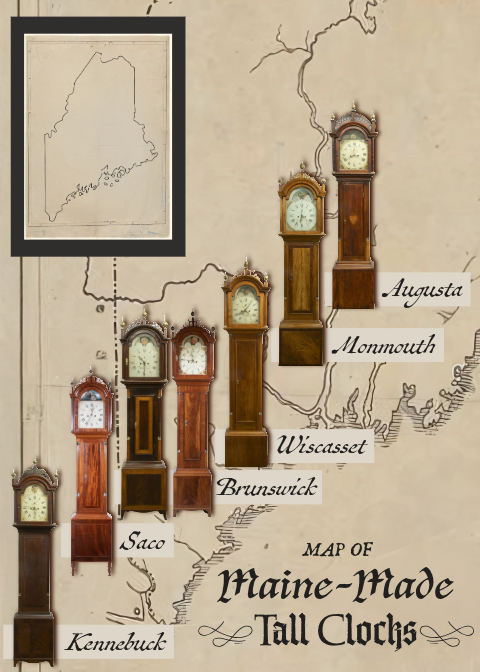
These 7 Maine-made tall clocks that travel as far down to Kennebunk and as far inland as the now state capital, Augusta, were created by 6 makers. They stand as a prime example of Maine craftsmen inspired by the natural scenes around them and the materials of which their pieces are executed. In the early 19th century, heavy, dark woods like mahogany, cherry, and walnut were some of the most popular woods for both solid furniture and veneers – a thin layer of wood used to create intricate designs on the surface while saving costs on favorable grains. These dark woods contrasted exquisitely with lighter woods like birch, Birdseye maple, and white pine – all of which are commonly found in Maine.
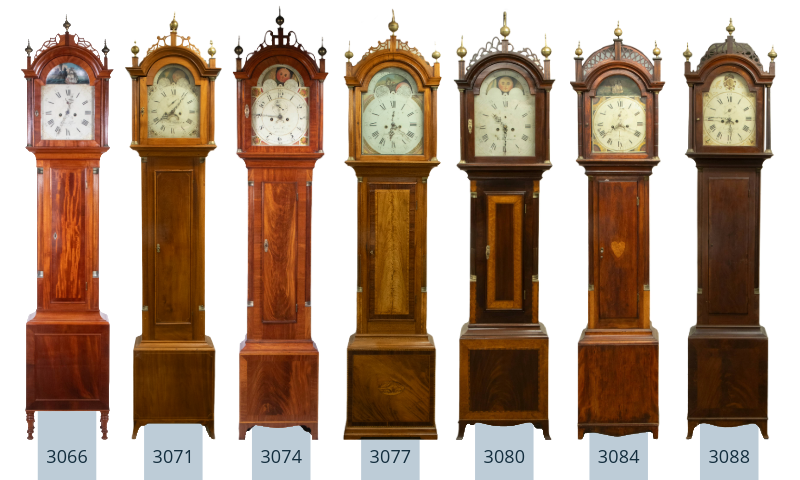
The collection of tall clocks featured in the upcoming Summer Grandeur Auction showcases a diverse collection of mixed influences. Clockmakers in Maine, like Swan, were greatly influenced by the Boston style of tall clock case. The proportions of the Boston tall clock created a simple, refined appearance. The waist or trunk of the case, which holds the pendulum, is slender, and the base is often much shorter and slightly wider. The dials of the clock, inspired by Maine’s coast and fame for shipbuilding, are works of art in themselves, beautifully complemented by the architecture of the case, some even housing a moving part, such as a ship, rocking on the waves, such as lot 3080. Veneered inlays are simple and restrained, as is other ornamentation like carvings. Others, such as Robert Eastman of Brunswick, ME, who made lot 3080, were influenced by the Philadelphia style of tall clocks, which favored elaborate decoration, moving beyond the common string inlaid veneers to create more drastic contrast between woods. The dial of the clock (otherwise known as the face), similarly, influenced by the great Maine landscape, would have more detailed paintings and often showcased their mechanical prowess with a moon phase dial, as showcased on lots 3071, 3074, and 3080. These dials were a rotating disk, often in a lunette, operated on a 29.5-day cycle and took about 59 days to complete a full rotation. Two moons were painted on the opposite sides, and as they rotated, the moon would change phases behind the hemispheres on the dial. In many cases of our clocks, rather than the moon set in a starry sky, sits between scenes of landscapes and seascapes. None of the clocks in this collection would be categorized as a fully Philadelphia-style clock, as many of the cabinetmakers showed an essence of restraint in both their bonnet tops and case details.
This diverse selection of tall clocks truly highlights the talents of Maine clockmakers, cabinetmakers, and artisans to blend their talents and materials to create a functional, utilitarian work of art. The immigration of ideas and styles thorough the early American people, deeply influenced by other cultures both within states and foreign entities, traveled across thousands of miles and minds to reach to the northern most part of the United States during the 19th century.

Stylized animation created to suggest how the clock’s automaton features may have moved.
What is a Tall Clock?
A tall clock, originally known as a longcase clock and more modernly known as a grandfather clock, is a type of pendulum clock characterized by its tall, slender case that stands on the floor. These clocks are about 6 ft to 8ft tall on average and have a pendulum, weights, and a visible clock face. The term “longcase clock” originated in the late 17th century and improved accuracy in timekeeping by utilizing escapement mechanisms and long pendulums, typically 39 inches in length, to create a one second swing. These are no alarm clocks; they chimed every hour on the hour and had 8-day movements requiring weekly winding or a less expensive option for 30-hours as they would have to wind these pieces once a day.
The term “longcase clock” has English origins, used in the mid-to-late 17th century and was historically used to identify the titans of the horological world. Later, “tall clock” was primarily of American usage from colonial America through the 19th century until the famed song “My Grandfather’s Clock” by Henry Clay Work was released and has since been a common term.
Gain Exclusive Access to the Maine-Made Tall Clock Collection
Sign up for emails here to be notified when the collection goes live in our 2025 Summer Grandeur catalog.
For private viewings or registration support, please call us at +1 (207) 354-8141.
For all other enquiries please contact us.