
A Soldier's Life—The Civil War Artifacts of Benjamin F. Goodwin
Wars are fought by the young. And those who return home after those wars have a lifetime ahead of them to reflect on their experiences. Imagine a young man from a tiny Maine farming town in the middle of the 19th century, a youth who might never have left that town had he not taken up the great cause of his era and become, not just an eyewitness to history but a direct participant in its unfolding. His name was Benjamin Franklin Goodman. His story was that of an entire generation of young American men, but the most remarkable element in that story is how much of it he preserved and passed along.

Recruiting ad for Goodwin's regiment, early 1862
Benjamin Goodwin was born in 1846 in Acton, Maine and raised in Stetson, a Penobscot County farming village of about 600 people. He was one of twelve children born to Joseph and Eliza Goodwin, and until the age of sixteen lived the typical life of a New England farm youth. But destiny had another plan for young Ben. The outbreak of the Civil War ballooned the size of the United States Army from a mere 15,000 men at the start of hostilities, to nearly 700,000 by the end of 1862. Rigorous recruiting drew young men from all walks of life to the military colors, and in many communities a minimum enlistment age of 18 years was given only winking enforcement. Benjamin Goodwin was a husky, healthy young man who could easily pass for 18, and when on September 16, 1862 he gave the enlistment officer a birth year of 1844, he drew not a second glance. The farmer's son was now a private in Company I of the Sixth Maine Volunteer Regiment.
The Sixth Maine was already a battle-hardened unit when Pvt. Goodwin took his place with Company I, having already distinguished itself during the hard-fought campaign of the Virignia Peninsula. Scarcely three months after Goodwin's enlistment, the Sixth Maine, now attached to the Sixth Army Corps, plunged into an even bloodier conflict around Fredericksburg, Virginia, as Union forces mounted a fierce frontal assault against Confederate troops fighting from trenches. The Sixth found itself in the center of the line of battle, and the young man from Stetson saw the horror of the war unfold first hand as the Union forces suffered more than twice the casualties of the dug-in rebels. Nearly 1300 bluecoats were killed, nearly 10,000 were wounded, taken prisoner, or reported missing.
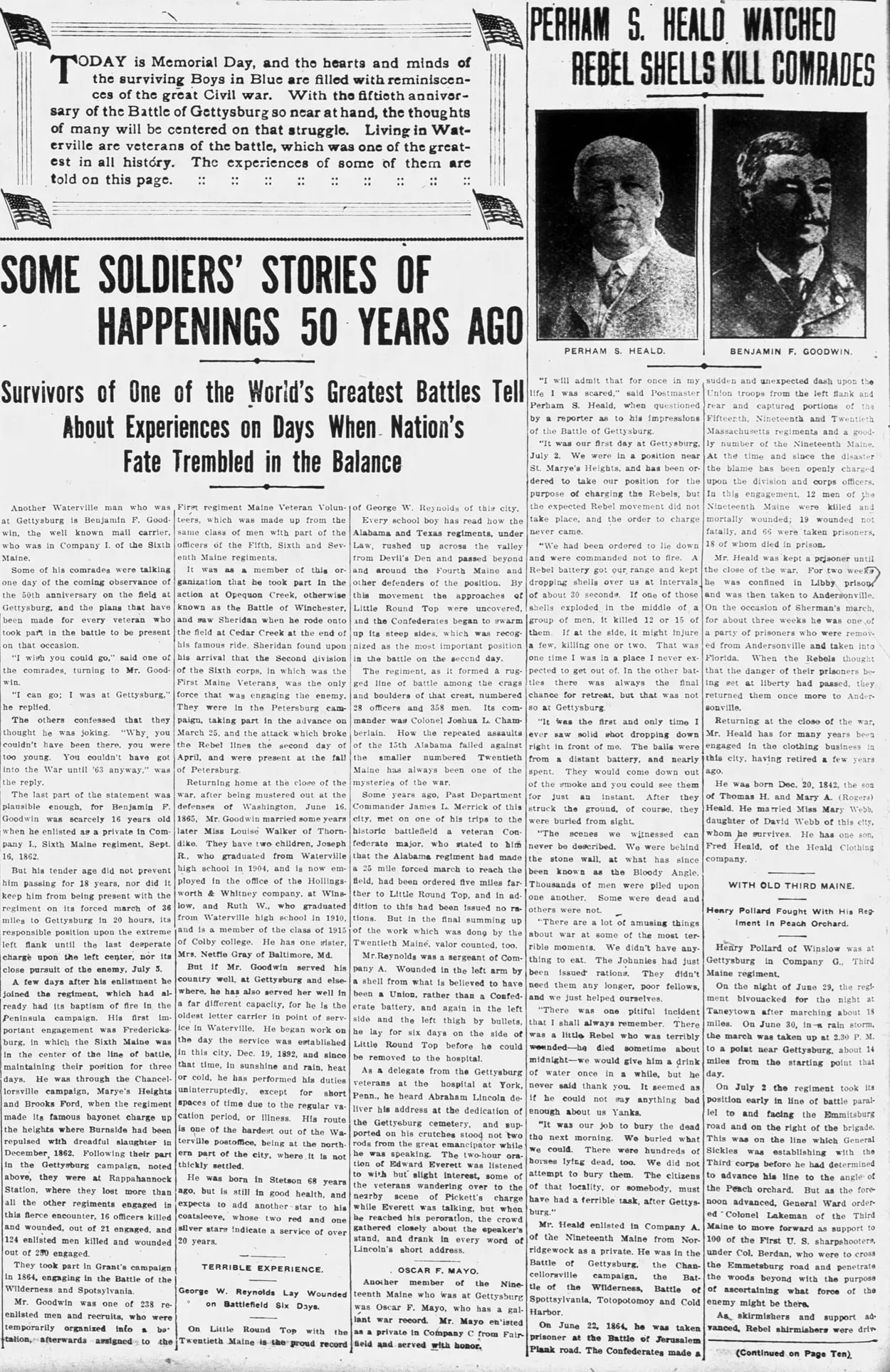
Feature article from 1913 spotlighting Goodwins attendance at the 50th Anniversary Reunion of Gettysburg veterans.
Still the Sixth Maine fought on. Benjamin Goodwin was present for Maj. Gen. Ambrose Burnside's second futile attempt to cross the Rappahannock River, the infamous "Mud March" of January 1863. He was there in May for the bloody Battle of Chancellorville, at Maryes Heights and Banks' Ford, charging up the heights with bayonet fixed. And in July, Benjamin Goodwin, farmer's son of Stetson, Maine, stood with his comrades on the battlefield at Gettysburg as at unfathomable cost the tides of war were finally turned against the Confederacy.
And still on the battles raged. At Rappahannock Station, the 6th Maine lost nearly half the enlisted men it sent into battle. But Benjamin Goodwin survived, to join the remnants of his unit in General U. S. Grant's Overland Campaign. Goodwin survived the Battle of the Wilderness and the bitter stalemate at the Spotsylvania Courthouse. And when the 6th Maine mustered out at the end of 1864, Benjamin Goodwin, now promoted to corporal, fought on with the First Regiment of Maine Veteran Volunteers. He fought at Opequon Creek in the Battle of Winchester, and was an eyewitness as General Philip Henry Sheridan rode onto the battlefield at Cedar Creek, to find the First Maine among the few units still engaging the enemy. Finally, Petersburg fell and the end of the war was at hand.
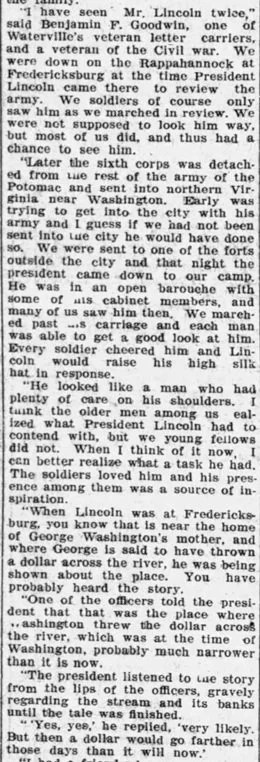
Goodwin's reminiscence of seeing Lincoln.
Corporal Benjamin Goodwin mustered out on June 16, 1865 carrying along with a lifetime of memories his bundled possessions. Over his shoulder he carried the Springfield musket upon which he had carved the cross insignia of the 6th Army Corps. In his haversack he carried his battered mess gear. On his head the battle-ornamented McDowell-pattern kepi. Around his waist the worn leather belt that supported his cartridge case. And stitched to his sleeves, hand-made in wool and cotton, his hard-earned chevrons of infantry blue. He came home first to Stetson, where he again took up his duties on the family farm, no longer an eager youth but a matured man ready to take his place in the civilian world. Not there to greet him upon his return was his older brother Phineas, who had followed him into the Army at the end of 1863, but died while encamped in Mississippi with the 30th Maine Volunteer Infantry after just six months in uniform.
Benjamin married late for his era, to Louise Walker of Thorndike. They established their home on Silver Street in Waterville, where they would raise two children. For a time he worked as a mechanic in a cotton mill, but in 1892 he chose again to don his country's uniform — this time not Army blue, but Post Office Department gray. Benjamin Goodwin became the first letter carrier employed in the growing city, and for twenty-four years he would deliver Waterville's mail. By his own estimate he walked over a hundred thousand miles over the course of his postal career, rarely missing a day's work, and he became a beloved and well-respected member of his community, active in the affairs of the Civil War veterans' society, the Grand Army of the Republic. In 1913, he was privileged to be among nearly fifty thousand survivors to attend the 50th anniversary reunion of Gettysburg veterans, where he was pleased to reunite with old friends and recall the accomplishments of his youth. In his home he proudly displayed the preserved relics of his wartime service.
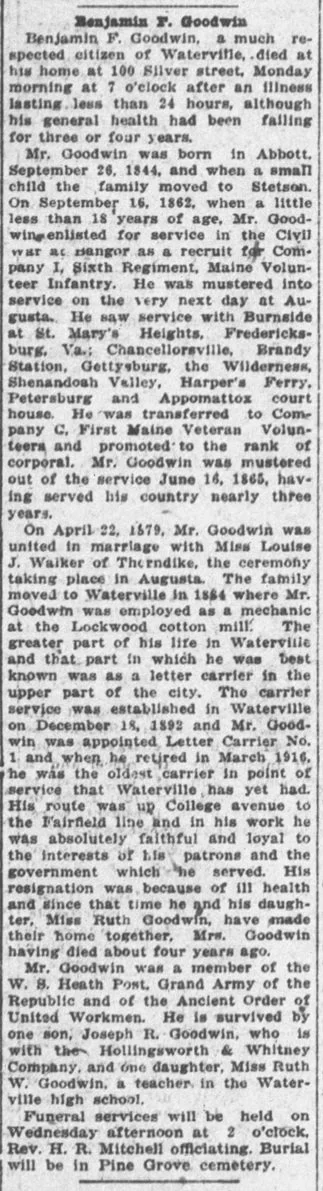
Goodwin's obituary, 1920. Note that the obituary uses the false birth year he used to enlist in the Army in 1862. Census records indicate his correct birth year was, in fact, 1846 not 1844.
The passing years took their toll on Benjamin Goodwin as the 1910s wore on. Louise Goodwin died in 1916, and that same year, after a lengthy struggle with bronchial pneumonia, Goodwin was forced to retire from the Post Office Department. The following year, Federal authorites took note of his advancing infirmity, citing rheumatism, heart and kidney disease, and arteriosclerosis, and recommended his soldier's pension be increased from $24 to $36 a month. He survived to see another generation of zealous young men march off to war, and also to see the survivors return home again to take up their lives, much as he had done two generations before.
Corporal Benjamin Goodwin died at his Waterville home early in the morning of November 29, 1920. He was buried next to his wife, following the rituals of the G. A. R., at the city's Pine Grove Cemetery. His prized possessions, the cherished mementoes of his military service, remained in his family for over a century. They now await the consideration and the respect of discerning collectors during Day 1 of our Autumn Majestic Auction.
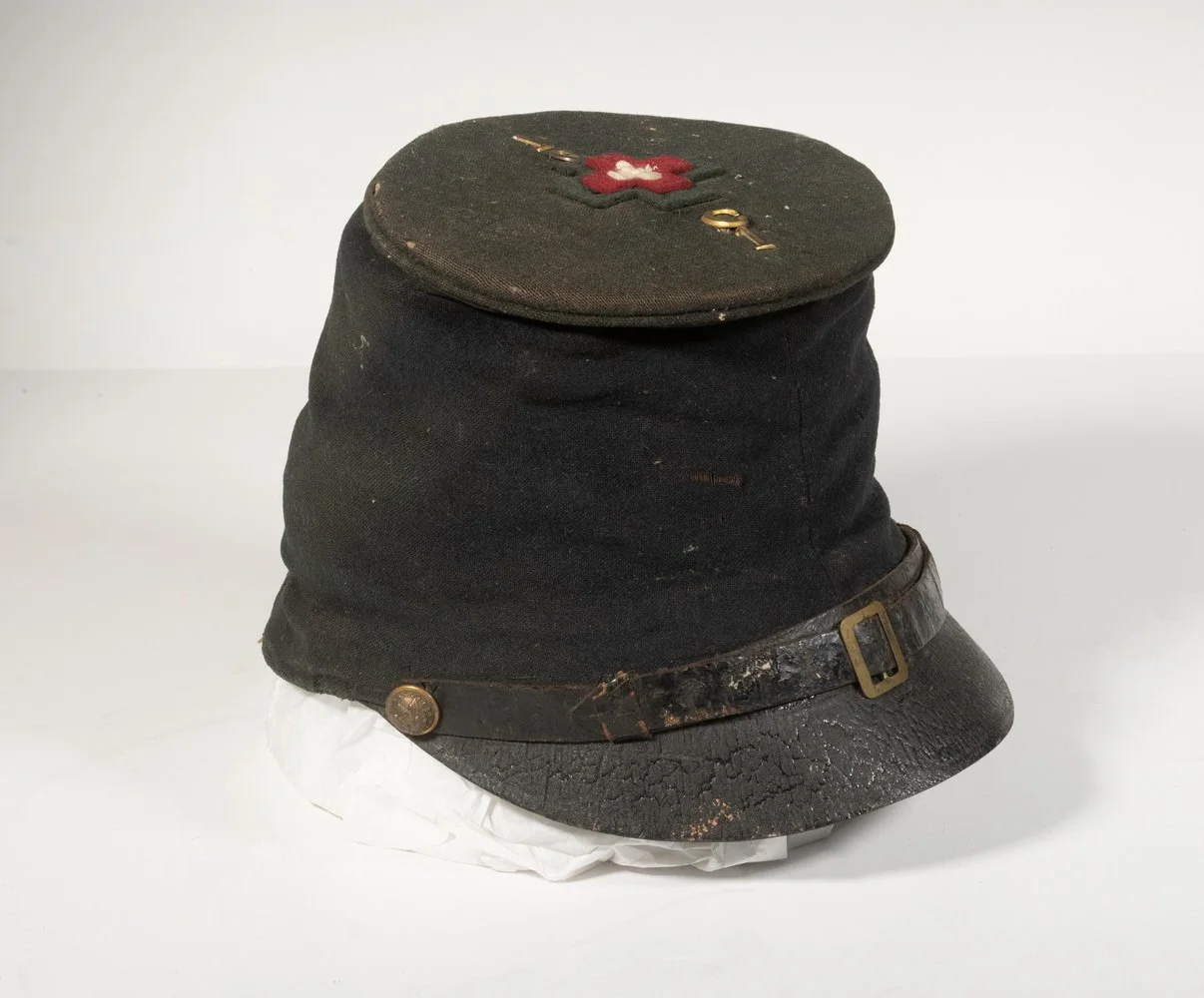
Lot 1004: Identified Kepi 6th Maine Volunteer Infantry, Antietam Fredericksburg Gettysburg
The entire collection begins at Lot 1004 with the Kepi of Private (later Corporal) Benjamin Franklin Goodwin, accompanied by his Rifle-Musket Cartridge Box, 1863 Springfield Musket, 1858 canteen with its original cotton strap, tin top, and cork secured by a chain loop. The grouping also includes an identified mess kit belonging to the 6th Maine Volunteer Infantry (Gettysburg), along with other personal relics of Goodwin, all consigned by descent, and continuing through Lot 1023.
Don’t let this extraordinary moment in history pass you by! Experience a rare, museum-quality collection presented in our upcoming auction on November 6, 2025, at 11:00 AM EST.
Phone bidding and in-person registrations are limited—secure today by calling 207-354-8141 or by submitting a Phone/Absentee Bid Form.
For questions on bidding, visit our How to Bid page, or please contact us directly.
For all other enquiries, please contact us.