
This Audemars Piguet Isn’t a Royal Oak: Unlocking the Legacy Inside the Reference 5111BA
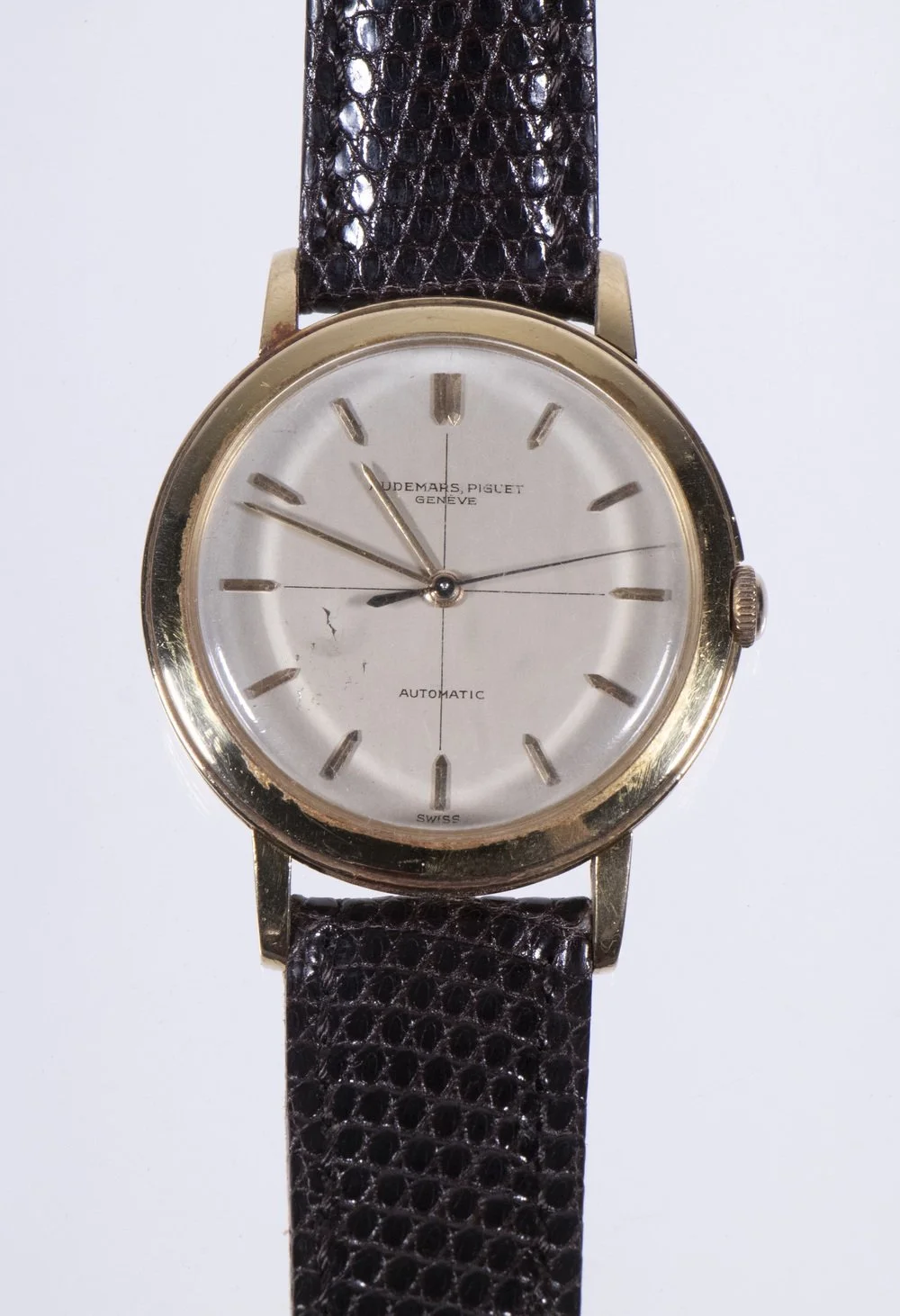
Lot 3090: Ref 5111BA represents a significant moment in the brand’s history.
Featured in our upcoming Summer Splendor Auction on June 29th — Lot # 3090 is especially noteworthy for what’s locked inside — as it’s not the story of it’s elegant exterior that makes this piece intriguing.
Instead it is for the engineering marvel that lies locked inside—showcasing a remarkable movement and the caliber 2499 automatic that truly elevates this watch as a distinguished timepiece of horological excellence.
On the surface, ref. 5111BA may appear to be a humble yet refined dress watch, but it occupies a significant place in Audemars Piguet’s historical lineage. It represents AP’s first step into automatic wristwatches, an important evolution for a brand renowned for high-end watchmaking.
By mastering the self-winding mechanism in the 1950s, the distinguished brand engineered the foundation for several milestones that would come later—including the development of ultra-thin automatics and the movement that powered the Royal Oak.
With the association of the AP Heritage, this watch is recognized as a precursor to the Royal Oak’s automatic movement. Royal Oak collectors which are many, given the Royal Oak’s fame, will certainly be interested in seeking Lot # 3090 to round out an AP collection. The Royal Oak’s 50th anniversary brought renewed interest to AP’s back catalog. Hodinkee and other watch media have in recent years published introductions to vintage Audemars Piguet, shining light on references like these which “aren’t the Royal Oak” but are important in their own right.
The Audemars Piguet ref. 5111BA presents itself on the one hand as a classic 1950s wristwatch in 18K yellow gold, and on the other hand, notable for being one of the company’s first automatic models and a design precursor to the Royal Oak. This particular case # 5474 is powered by Audemars Piguet’s very early self-winding movement ref. 61461 which is referring to the classical ref. 5111BA (BA stands for Yellow Gold), and inside is the caliber 2499 automatic, circa mid 1950s—which makes this a standout feature in our upcoming sale.
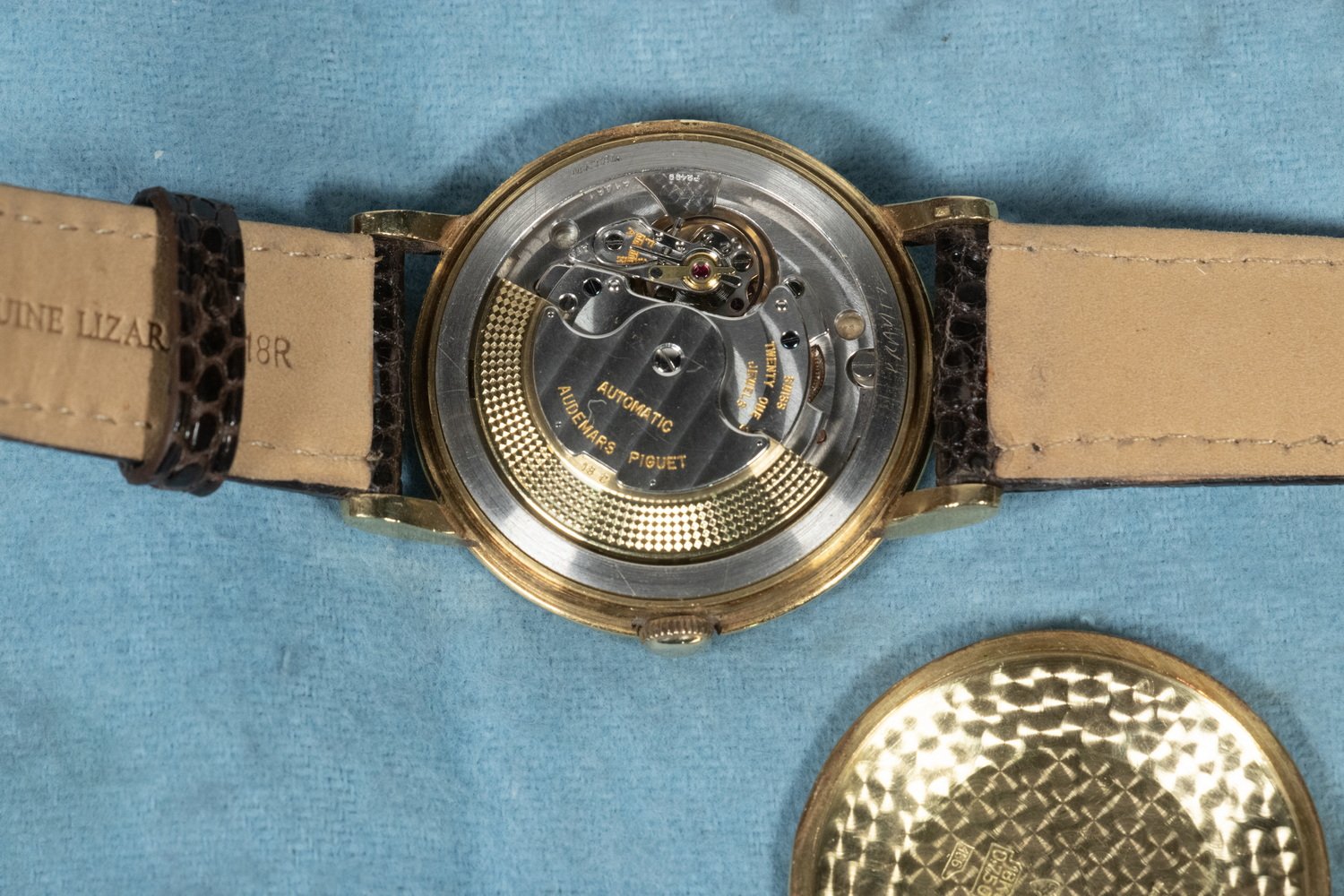
Lot Detail 3090 with the movement # 61461, caliber 2499 automatic
First presented in the 1950s, the design of the case continues today to showcase itself as an impressively ultra-thin dress watch of pure class and sophistication. However it is on the inside where the story really begins, as technically, this watch is an extraordinary work of art in terms of engineering as it introduced AP’s first automatic caliber 2499—a robust, absolutely beautifully finished movement that would set the stage for future AP innovations.
With the introduction of the Royal Oak in 1972, and as radical as it was, the design language is inherited from the same ideas of finishing and proportions that are here exemplified as most paramount. From the Classical ref# 5111BA is where the design is rooted as one of understated luxury and exudes vintage charm—except with a contemporary edge with a case diameter of 35mm and 18mm lug width. Modern watch enthusiasts will certainly appreciate this as it is somewhat larger than many 1950s watches.
Yet behind the extremely slim 11mm case and the minimalism of the dial, the profile gives it a certain sleek formality, and it is the movement inside and the finishing details of the rotor that Horology aficionados will undoubtedly appreciate. The mechanics of the Cal. 2499 is remarkable and of course notably it’s AP’s first automatic—a milestone movement in watchmaking history.
Please note that the dial has a small, visible indentation at the 8:30 position. While the damage is somewhat conspicuous during normal wear, it is the inconspicuous movement itself that truly stands out. For collectors who appreciate the intricate workings of a timepiece, the 18k rotor with its guilloché pattern is a stunning feature—an undeniable conversation piece when the watch is unlocked. Perhaps an exhibition case would be a fitting display. Regardless, collecting this watch is like owning a piece of Audemars Piguet's pioneering legacy in watchmaking history.
61461 Movement Aesthetics:
The Caliber 2499’s large rotor immediately draws attention. As mentioned, the rotor has an 18k gold rim which Audemars Piguet decorated with hobnail Clous de Paris patterns. The central part of the rotor and the bridges beneath are finished with Geneva stripes. Heat-blued screws and polished bevels glint in the light. It’s a beautiful movement to behold, reflecting AP’s haute horlogerie values. While this is a technical element, Audemars Piguet clearly intended the movement to be as aesthetically pleasing as the exterior, given the level of decoration—something that connoisseurs can appreciate when they see one of these watches unlocked.
This technical advancement made the classic 5111BA a cutting-edge piece of its time, as it combined AP’s renowned hand-finishing and quality with automatic winding—a first for the brand.
Summary of Key Specs:
Manufacturer: Audemars Piguet, Le Brassus/Genève
Model Reference: 5111BA (BA = 18k yellow gold case)
Production Year: Mid-1950s (circa 1954–1958 for Cal. 2499 series)
Case: ~35 mm diameter, solid 18k yellow gold
Dial: Silvered/cream opaline dial, applied gold baton indices, crosshair detail, signed “Audemars Piguet, Geneve, Automatic, Swiss”
Movement: Calibre 2499 automatic; 21 jewels, center seconds, full rotor self-winding (with 18k gold rotor segment), based on JLC ébauche, 18k gold rotor with guilloché, swan-neck regulator, Breguet overcoil balance. Power reserve ~40 hours (typical for the period).
Functions: Hours, minutes, sweep seconds (time-only). No date, no complications (a pure dress watch).
Crystal: Domed acrylic (likely, given the era) or plexi crystal.
Bracelet/Strap: Originally fitted on leather strap with gold pin buckle.
Collectibility and Rarity
Vintage Audemars Piguet watches have, for many years, flown under the radar relative to their Patek Philippe and Vacheron Constantin counterparts—and the ref. 5111BA is no exception. In terms of rarity, the 5111BA (and its close relatives like 5112, 5113, 5115, etc.) is extremely scarce.
Only on the order of a few hundred of these early automatic pieces were ever produced. Given AP’s choice of not repeating exact configurations very often, surviving examples show a range of dial variations and case metals, each potentially unique or in very small editions. This inherent rarity appeals to dedicated collectors of high-end vintage watches, as owning one is to own a piece of AP’s history and a piece that few other watch collectors will have.
Despite, or perhaps because of their rarity, these 1950s AP automatics have historically been undervalued compared to more famous watches of the era. For example, an 18k gold AP automatic (35mm Calatrava style) from the 1950s in good condition might sell at auction in the low five figures (USD/EUR/CHF). A specific auction result at Monaco Legend Auctions sold a well-preserved 35mm yellow gold AP automatic (mid-1950s) for €11,180 in 2019, please see:
monacolegendauctions.commonacolegendauctions.com.
The auction description praised the watch’s “handsome and classic mid-century” look and noted its importance with the original Cal. 2499 movement. This price, while respectable, is a fraction of what an equivalent Patek Philippe automatic (like a ref. 2526) might fetch, highlighting a relative undervaluation.
With that said, the growing and increased awareness of vintage AP watches has been rising, and collectors are starting to take notice and appreciate these timepieces for the historical and notable engineering significance. They offer a compelling mix of low production numbers, high level of detail and craftsmanship, and of course historical importance with association to the Royal Oak.
As the appreciation for Audemars Piguet’s history grows for watch collectors beyond Royal Oaks, these 1950s automatics are poised to continue to gain further recognition well into the future. For the savvy collector, owning one is owning a tangible link to AP’s early engineering, a quietly significant horological treasure, and understated luxury that exudes vintage charm and celebrates technical accomplishments in watchmaking history.
If you would like to find out how to make this timepiece part of your collection, or for questions and assistance with registration, please telephone: +1 (207) 354-8141
Don't miss this opportunity!
⏳ Time is ticking—secure your spot and register today before this classic sails away!
For all other enquiries please contact us.