
An Enduring Vision—The Paintings of William Thon
There is more to Maine than rocks and shore and sea. And there is more than one way to interpret the visual majesty of all that Maine was, is, and will be. Every artist who has formed their vision of the state, and carried that vision forward through whatever their medium of choice, has done so through the filter of their own personal experience, and none more so than William Thon.
This August, explore Thon’s enduring legacy and the many perspectives of Maine artists at our Summer Grandeur Auction, taking place Thursday, August 28th—Sunday, August 31st.
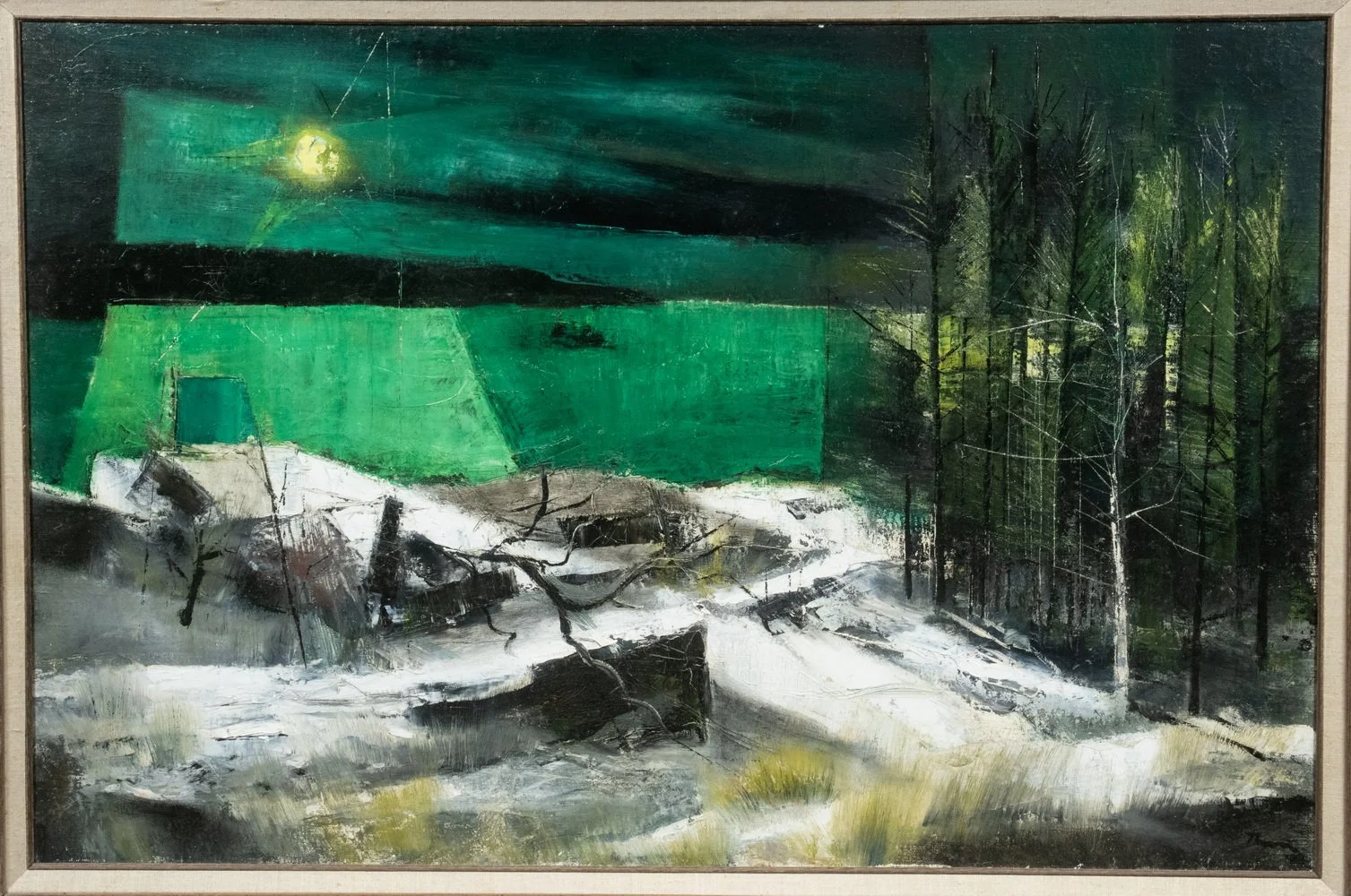
Lot 4142: William Thon “A Cold Sun", oil on board, signed lower right, in a distressed carved wood flat panel frame w/ linen liner and gold lip.
Artwork as bold and uncompromising as the artist himself, Thon's vision of Maine dealt not in frosty linework and subdued shades, but in vigorous bursts of color and form capturing the energy and power of the moment. A quiet seascape was never quite tranquil at the stroke of Thon's authoritative brush but seethed with power held back by a greater force. His forests bristled with jagged thrusts of green and umber and gold, his skies forever anything but liquid blue. Thon's Maine never left behind the mystery of its wilderness.
He was born in New York City, in 1906, a time and a place that tended to produce more than its fair share of self-sufficient original thinkers. The son of a 6th Avenue pharmacist, young William was far more interested in the outdoors than in compounding prescriptions or selling sodas, and relished his family's habit of escaping the roasting heat of a metropolitan summer by spending the hot months camped in a tent along a Staten Island shore. Here it was that he learned to draw and paint, sketching seaside scenes on scraps of canvas scavenged from the family tent, the untreated fabric absorbing the pigment in unpredictable patterns of color.
School held little appeal for the budding artist and after completing grade school Thon set forth in search of a career. Humdrum jobs from laying bricks to sweeping floors held no particular interest, but they did allow him to purchase art supplies. In 1925, he resolved to try formal education once more, and enrolled in the Art Students League, only to become quickly disillusioned by the dreary formalism of its methods. He had come to understand a vital principle of art: the way to learn to paint, is to paint.
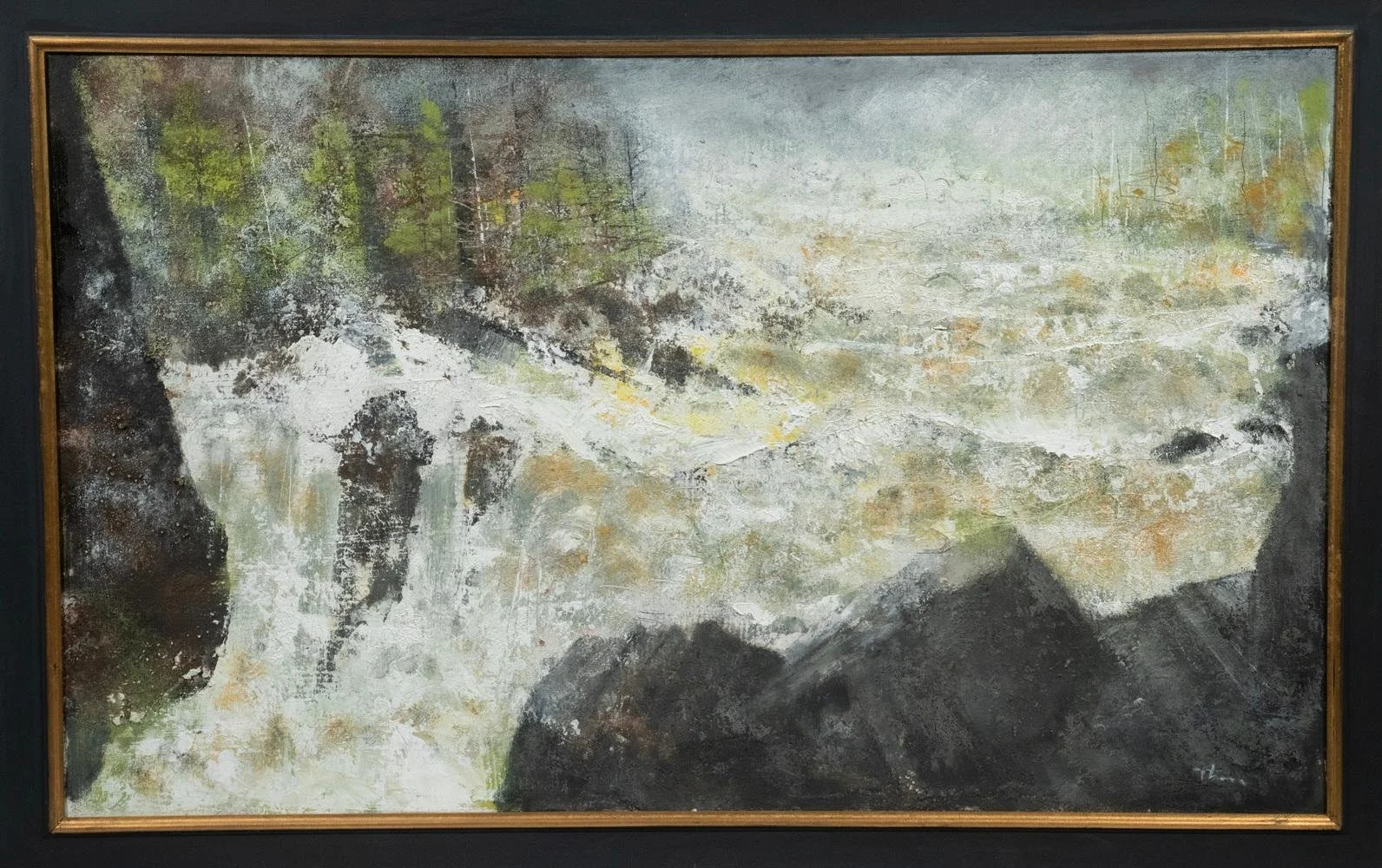
Lot 4141: "Waterfall", oil on board, signed lower right. In flat-black painted frame with gilded edge.
And paint he did. All through the Great Depression, through a succession of food-on-the-table jobs. He painted window displays for shops and stores. He paved sidewalks, He signed aboard a ship as a common sailor on a treasure-hunting voyage to Costa Rica. And through all this, Thon continued to explore his evolving aesthetic. He joined art organizations, he cultivated relationships with gallery owners, he did what he had to do to bring his work to the attention of those who might find it worthy.
One such man was a rising artist and printmaker from Brooklyn with the unforgettable name of Stow Wengenroth. Meeting Wegenroth offered Thon much in the way of artistic encouragement and inspiration, but the friendship also changed the young painter's life. Wegenroth found much to stimulate his own artistic ideas in his visits to the coast of Maine, and he suggested that Thon might find even greater inspiration there. Wengenroth noted in particular the unique beauty of the tiny fishing village of Port Clyde and urged his friend to go see for himself.
That he did, beginning a lifelong relationship with Midcoast Maine. Through World War II service, through postwar travels across the globe, through the ebb and flow of rising artistic prominence, through his shift in technique from oils to watercolors, coastal Maine offered an endless source of inspiration. Its harbors and its shorelines, its woodlands and abandoned quarries, all found expression in Thon's increasingly vigorous, increasingly energetic, increasingly abstract and expressionistic.

Lot 4143: "Winter in the Quarry", oil on board, in a distressed wood and silver leaf flat panel frame.
His reputation grew, even as his physical vision dimmed. In the 1990s, macular degeneration caused his sight to weaken and fade, but declaring "my eyes are in my fingers," Thon painted on, gradually shifting to a purely black-and-white style that perhaps harkened back to his long-ago mentor Stow Wegenroth, an artist who specialized in monochrome. His art in these last years lost none of its power.
William Thon died toward the end of the year 2000, at the start of the new century, on the edge of another Port Clyde winter. He left behind a body of work that continues to fascinate, compel, and inspire through his evolving vision of a Maine he loved.
If you would like to find out how to make the work of William Thon part of your collection, or for questions or for scheduling a private viewing, please telephone us at +1 (207) 354-8141.
For all other enquiries, please contact us.