
From Rome to London: Castellani and the Italian Workshop That Charmed Victorian England
Few names in the history of jewelry design inspire the reverence associated with Castellani. Born in Italy in 1794, the visionary Roman goldsmith Fortunato Pio Castellani was instrumental in reviving the ancient Etruscan technique of granulation—a painstaking process of fusing tiny gold beads to a surface without the use of solder.
The word granulation derives from the Latin granum, meaning “grain” and describes the extremely precise technique of attaching tiny gold granules to a base, forming complex and decorative patterns. Meticulously prepared and expertly executed, granulation is one of the most technically demanding of all ancient jewelry practices and remains a hallmark of Etruscan ornamentation.
Who Were the Etruscans—And Why Is Their Jewelry Still So Fascinating?
The Etruscans were early inhabitants of Italy and settled in the northern region of Rome in the late eighth century B.C., and their heritage can be traced to modern-day Tuscany. The Etruscans succeeded the Villanovan culture, a civilization that established early foreign trade and was adept in creating bronze jewelry. The influx of Greek colonization in Italy aided in the transition from Villanovan to Etruscan culture, which thrived until Roman imperialism succeeded around 200 B.C.
Dating back in Etruria to the second millennium B.C. , what makes Etruscan gold so remarkable is that this ancient civilization manipulated metals and implemented tedious applications without the modern convenience of a torch or other sophisticated tools. It’s incredible that such delicate works of art could be fused together by controlling an open flame instead of a precision controlled torch.
The significance of Etruscan jewelry is due to the extraordinary technical skill of ancient metalsmiths and their remarkable ability to manipulate gold with precision. Even today, with the aid of modern tools, many of the techniques developed in the 6th and 7th centuries B.C. remain difficult to replicate. This exceptional craftsmanship would later inspire a distinctive revivalist style, and one in particular that resonated deeply with 19th-century aesthetic sensibilities and captivated the high society of the Victorian era, is the work of Castellani and Italian archaeological jewelry.
What Are the Origins of the Castellani Workshop—and How Is It Connected to Victorian England?
Founded by Castellani in 1814, the workshop was located steps from Rome’s iconic Trevi Fountain. And while intially Castellani's designs followed the prevailing French and English fashions of the day, it was in the 1820s that his collaboration with the archaeologist Michelangelo Caetani, later Duke of Sermoneta, that would chart a new course in the aesthetics of the workhop inspired by archaeological discovery and ancient design.
The aesthetic choice was the result of the meeting between Castellani with Caetani, and inspired Castellani to draw inspiration from ancient and antique pieces, which translated into the revival of antique goldsmith techniques like filigree, cameos and Etruscan granulation.
This partnership also introduced Castellani’s creations to Rome’s nobility and ultimately established the workshop as a leader in what became known as “Italian archaeological jewelry.” Inspired by Etruscan designs, Castellani pieces were rich in history and technical complexity—utilizing granulation, engraved gems, enamel, and micromosaic techniques.
The workshop remained a family tradition, eventually passing into the hands of Fortunato’s sons, Alessandro (1824–1883) and Augusto (1829–1914). In the 1850s, Alessandro played a pivotal role in expanding the brand’s international presence, establishing workshops in Naples and opening retail outposts in Paris and London.
By 1874 the workshop’s London branch, under the stewardship of Carlo Giuliano at 115 Piccadilly, had won the favor of Queen Victoria—and later, King Edward VII and Queen Alexandra. Castellani and Giuliano’s designs appealed not only to royalty but also to members of the English avant-garde, including Sir Edward Burne-Jones, William Holman-Hunt and Charles Ricketts.
Lot 4064: A Castellani Masterwork
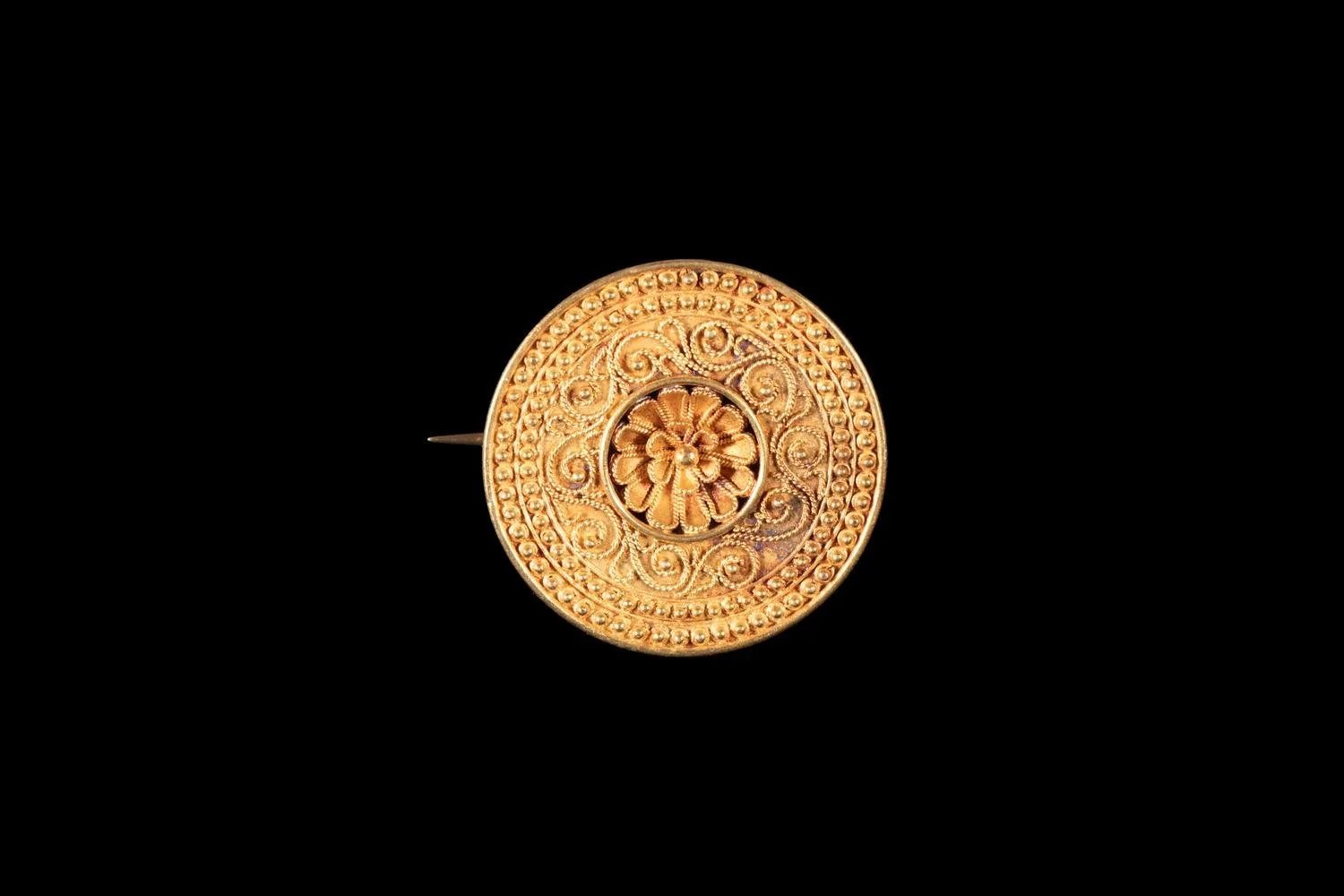
Lot 4064: Victorian Castellani 18k Gold Etruscan Revival Brooch
Our upcoming Antique, Vintage and Designer Jewelry Auction taking place Friday, July 11th, 2025 and Lot 4064 exemplifies the revivalist mastery of the Castellani workshop. This circular gold brooch, created in the Etruscan Revival style, was produced by the renowned 19th-century Roman atelier. A beautifully domed center showcases twisted wires and precious gold details, crafted in delicate Etruscan granulation, accentuating the brooch’s elegant geometry.

Lot 4064: The reverse is fitted with a C-clasp and pin stem and bears the interlaced double “C” hallmark of Castellani. It measures 7/8" in diameter and weighs 4.2 DWT.
The Castellani revival of ancient goldsmithing techniques did more than rekindle a lost art—it reshaped the very language of 19th-century jewelry design during the Victorian era. The contributions remain among the most important in the history of jewelry, embodying a profound respect for antiquity while offering timeless design to today’s modern collectors.
For a comparable impression, see a related bracelet by the Castellani firm (ca. 1860) in the collection of The Metropolitan Museum of Art New York (Accession No. 2021.7.9) which exhibits similar goldwork and the same interlaced CC hallmark.
Lot 4064 with its refined execution and historical importance is a standout piece in our upcoming auction, and with a direct link to this extraordinary lineage. If you would like to find out how to make this piece part of your collection, or for questions and assistance with registration, please telephone: +1 (207) 354-8141
For all other enquiries, we invite you to contact us.