
Remembering Frank Stella: A Master of Minimalism, Color, and the Printed Form
Thomaston Place Auction Galleries is honored to celebrate the legacy of Massachusetts native Frank Stella (1936–2024), a towering figure in American abstraction and contemporary printmaking. We are pleased to offer York Factory I—a rare and distinguished work emerging on the secondary market for the first time since its original acquisition, and appearing from a notable New England Estate.
Offered as a major highlight in our Summer Splendor Auction on Sunday, June 29, 2025, in Thomaston, Maine, this exceptional print exemplifies Stella’s innovative work within the Protractor Series and his collaborations in contemporary printmaking with Kenneth Tyler and the renowned publisher Gemini.
In the accompanying essay, we explore the genesis of this particular work, the story behind its technical mastery, and its place within the enduring memory of one of the 20th century’s most influential artists.

Frank Stella poses for a portrait at his studio in New York in May 1995. Photo by Bob Berg/Getty Images.
Frank Stella was born in Malden, Massachusetts, on May 12, 1936, to first-generation Italian-American parents and went on to produce one of the most expansive and experimental bodies of work in American art history. A leading figure in abstraction, and as an acclaimed painter and sculptor, Stella is considered one of the most influential artists whose contributions to modern printmaking remain equally significant. Stella attended Phillips Academy in Andover Massachusetts, where he studied painting under Patrick Morgan. He then studied history and painting at Princeton under Stephen Greene and Willliam Seitz, before moving to New York City in the late 1950s.
In New York, Stella was influenced by Abstract Expressionist painters such as Franz Kline and Jackson Pollock, and later his extension of their philosophy served as a catalyst for the Minimalist movement of the late 1950s. Throughout his career working across media—which encompassed painting, metal reliefs, sculpture, and printmaking—he reshaped the entire history of minimalism and abstraction.
Carrying forward the legacy of early 20th-century modernists like Vassily Kandinsky, Kazimir Malevich and Piet Mondrian, and evolving from the minimalism of his Black Paintings in the late 1950s to the expressive virtuosity of his later works, Stella presented forms that transcend all literal interpretation.
Working from the peripheries of painting and sculpture and between 1967 and 2001, Stella produced over 315 print editions, organized into 28 series—representing one of the most prolific and innovative bodies of numbered editions in the 20th century. Stella approached printmaking not as a mere reproduction, but as a medium for exploration, experimentation and innovation—composing prints of unprecedented scale and complexity and most notably in collaboration with master printers and renowned publishers.
Stella’s highly experimental use of the print media reveals the intimate conversation between screenprinting as a medium and his work in other forms—notably painting and sculpture. The prints represent a parallel career to painting, not a subsidiary one; instead as a translation of the formal explorations of painting into a series of works exploring techniques unique to the printed image.
During his lifetime, art critics consistently regarded Stella as equally “important as a printmaker as he is as a painter” and his work has been celebrated in major exhibitions and museum retrospectives. Stella’s work can be thought of as reimagining the traditional tools of printmaking, at the same time expanding the aesthetic boundaries with which technically accomplished complexities and poetic imagery remain.
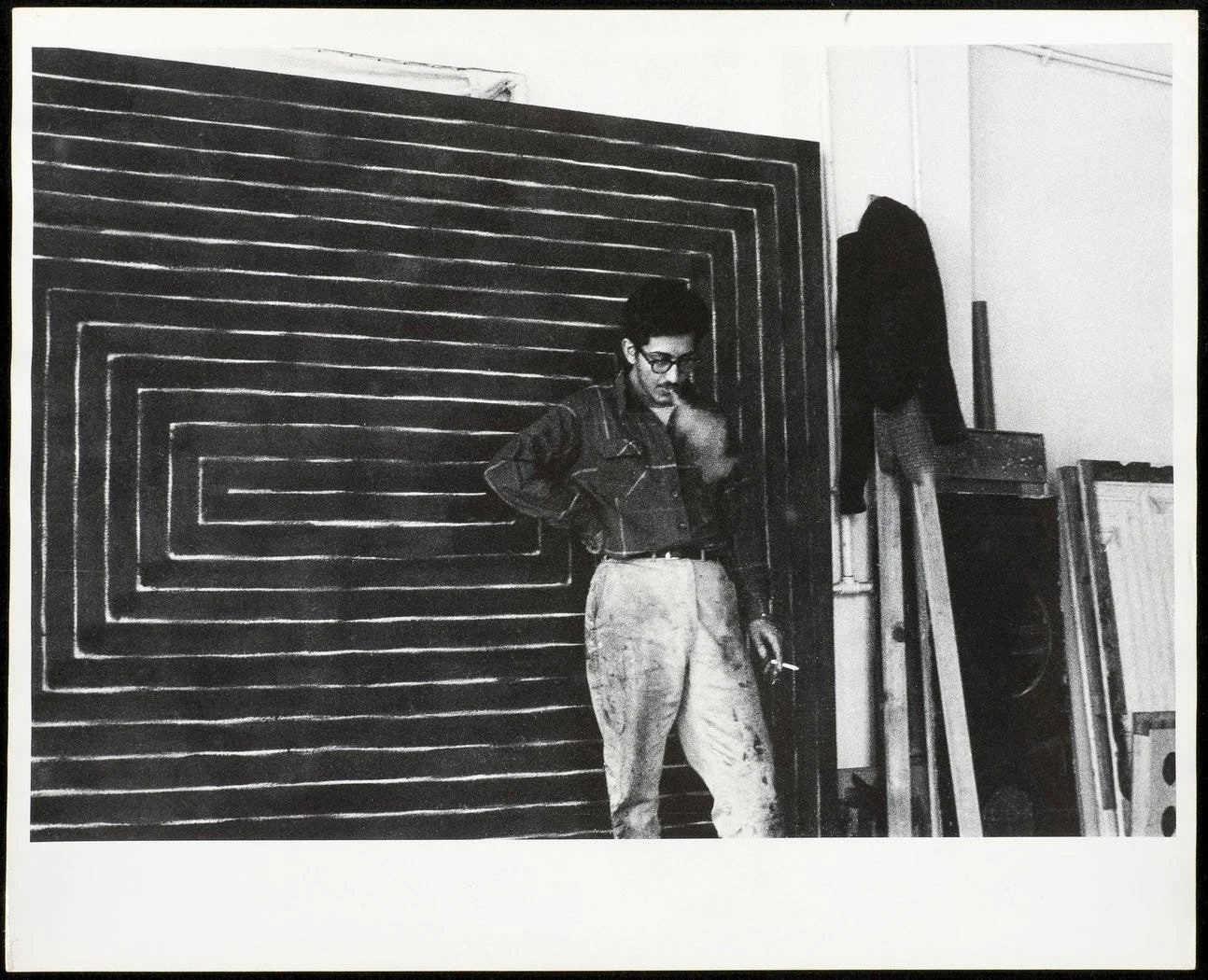
The Secret World of Frank Stella, 1958–1962, black-and-white photograph, Walker Art Center, © Estate of Hollis Frampton.
Stella embraced a reductionist approach and completely rejected the notion of art as a vehicle for emotional expression, emphasizing instead the inherent material qualities of the medium itself. For example, the Black Paintings which were intentionally devoid of color and visual stimulation and instead stripped down to only the formal elements. For more than six decades, Stella produced an expansive and varied body of work—paintings, reliefs, and sculptures—that trace the shifting currents of abstraction and expressionism from the 1950s onward.
During the 1960s, Stella traveled to the Middle East and inspired by his visit began the Protractor Series (1967–71), a group of paintings named after the common mathematical tool and measuring instrument—a half circle protractor. These works featured mathematically composed arcs, sometimes overlapping within square borders and were named after ancient, circular-plan cities encountered during his travels throughout Western Asia. Inspired by the decorative patterns and architectural forms he discovered in the Middle East and Iran in particular, the Protractor Series marked a transition from the monochromatic restraints to vibrant colors and the formal complexities found in his work after the 1960s. Protractor Variation I (1969), now held by the Pérez Art Museum Miami, exemplifies this shift.
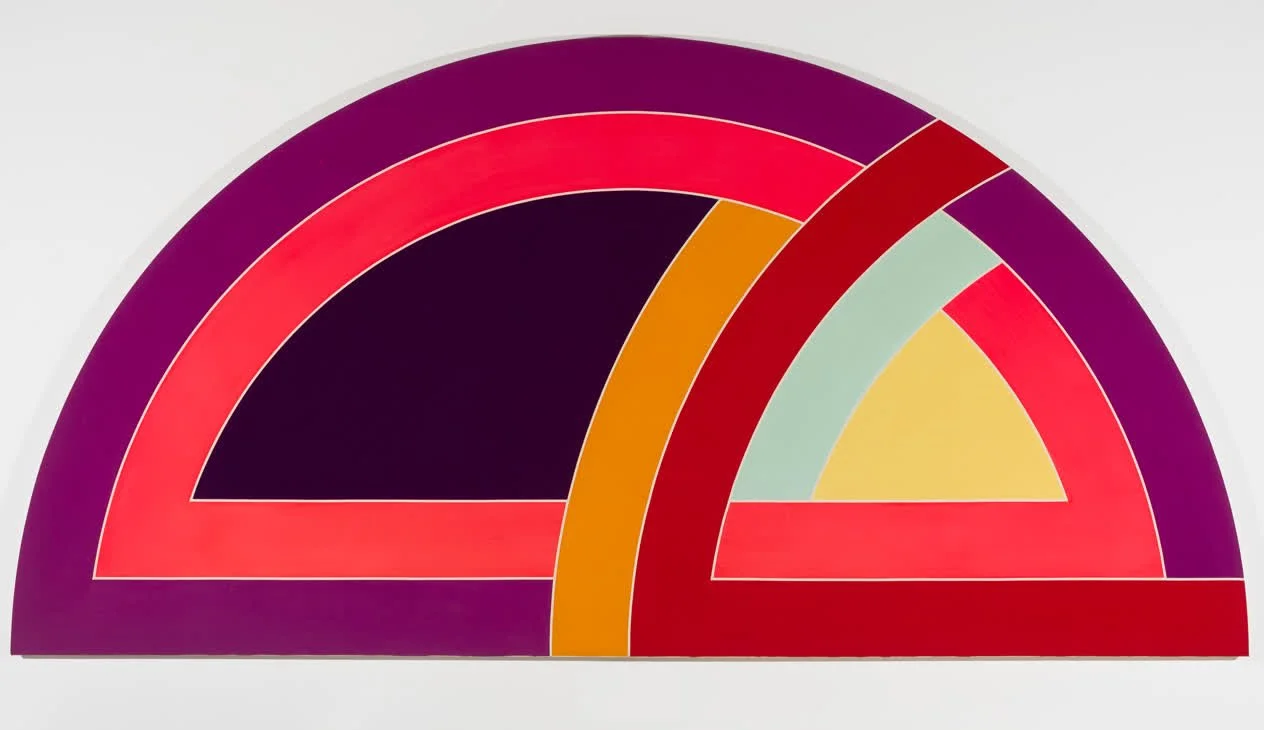
Frank Stella, Protractor Variation I, 1969 © 2022 Frank Stella / Artists Rights Society (ARS), New York
By 1967, Stella had accepted an invitation to collaborate at the Gemini G.E.L. publisher in Los Angeles—having previously been reluctant to engage with printmaking as an artform. At Gemini, and later at Tyler Graphics Ltd. in New York, Stella collaborated with the master printer Kenneth Tyler and discovered the medium’s potential as an extension of his own creative vision—particularly with the arches and decorative patterns he admired in ancient art and architecture. His first print, Untitled (Rabat) appeared in the portfolio Ten Works by Ten Painters, alongside works by Andy Warhol and Roy Lichtenstein, and marked his entry into printmaking as a medium and as an adaptation and reinterpretation of a painting from the artist's Moroccan painting series (1964-65).
By the 1970s, Stella’s printmaking evolved in parallel with his painting practice, incorporating increasingly vibrant, geometric compositions. Many prints from this period echo the motifs of the Protractor Series, particularly the contours of curving bands and interlocking arcs. As an extension of both the canvas and the language of sculpture, these were a breakthrough in the history of screenprinting in which form followed not only content but contour.
Among these works, York Factory I (1971) stands out as a hallmark of Stella’s exploration of geometric abstraction and spatial complexities. Though technically not part of a series, the print draws from the Newfoundland Series (1969–70) — a series of paintings and lithographs and is related to the subsequent York Factory II (1974). The entire series is named after a historic Hudson’s Bay Company settlement in northeastern Manitoba, a region of the Canadian province of Manitoba that had become a ghost town by the late 1950s. This time with Stella’s travels, the work invokes a poetic interplay between history, geography, geometry and spatial abstraction.
Inspired by the desolate factories and the empty spaces of Manitoba, Lot 3315 is a high-keyed variation from the series and features 41 pastel shades, 17 opaque and transparent color flats, and 24 contour lines. A single run of white brush strokes overlays the color fields, followed by a transparent white layer, lending the image a delicate, soft shimmer. Printed on Arjomari paper—renowned for its clarity and durability—the piece exemplifies Stella’s technical precision with his visual elegance, emphasizing the material qualities of the print. The production was a meticulous collaboration between Stella, Kenneth Tyler, and the entire team of master printers at the Gemini G.E.L. workshop in Los Angeles.
A similar impression of York Factory I is included in the permanent collection of the Whitney Museum of American Art (Accession no. 82.47.2), signifying its importance within Stella’s catalog ressionne. On offer during our upcoming Summer Splendor auction, York Factory 1",1971—numbered 87 of 100—was formerly held in the private collection of the late Herb Belkin, a distinguished music executive and prominent collector of numbered editions and archived in a white-painted casement frame under glass.
Accompanied by literature and original documentation, and highly sought after by collectors, York Factory I captures a pivotal moment in Stella’s printmaking journey—when structure gave way to dynamism, and form to expressive color. The associations with the technically accomplished Gemini G.E.L. workshop and the celebrated Protractor Series underscores the value as both a print in a larger body of work of painting and sculpture, and a significant milestone in contemporary art history.
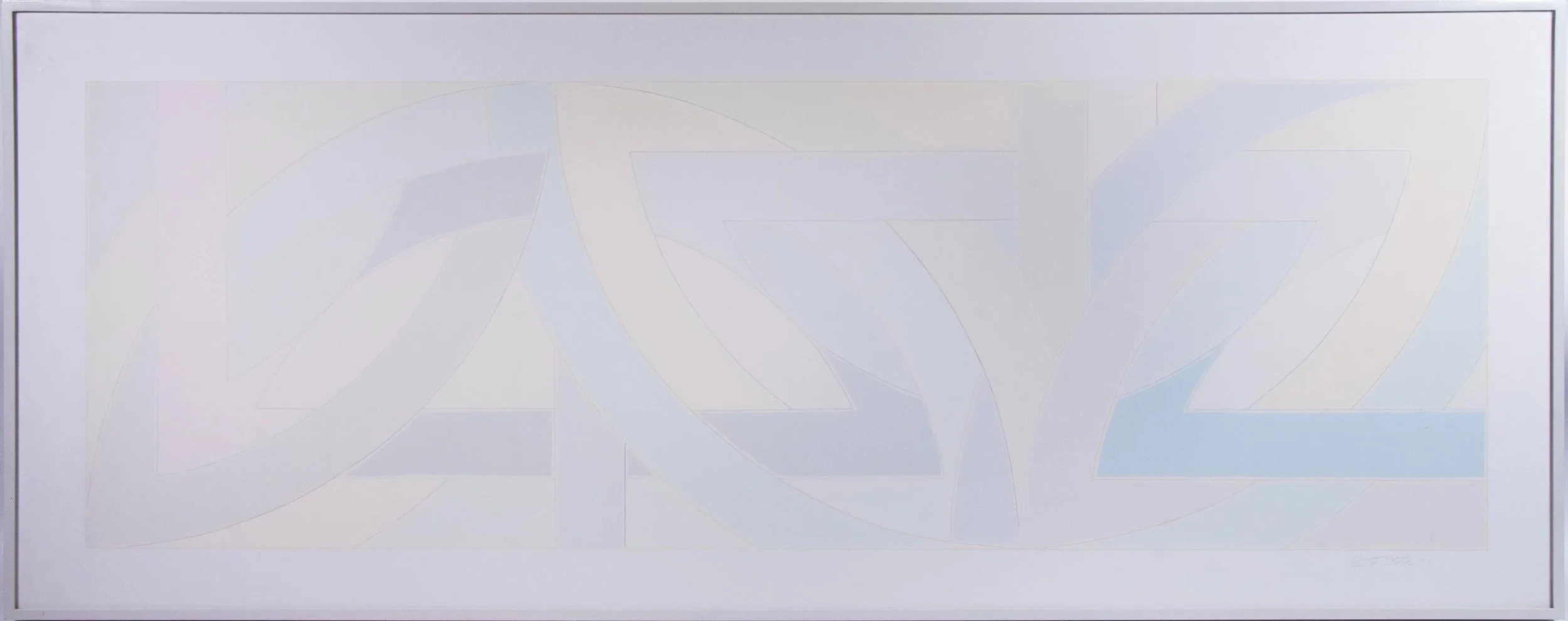
Lot 3315: York Factory 1",1971 — Screenprint on Special Arjomari paper
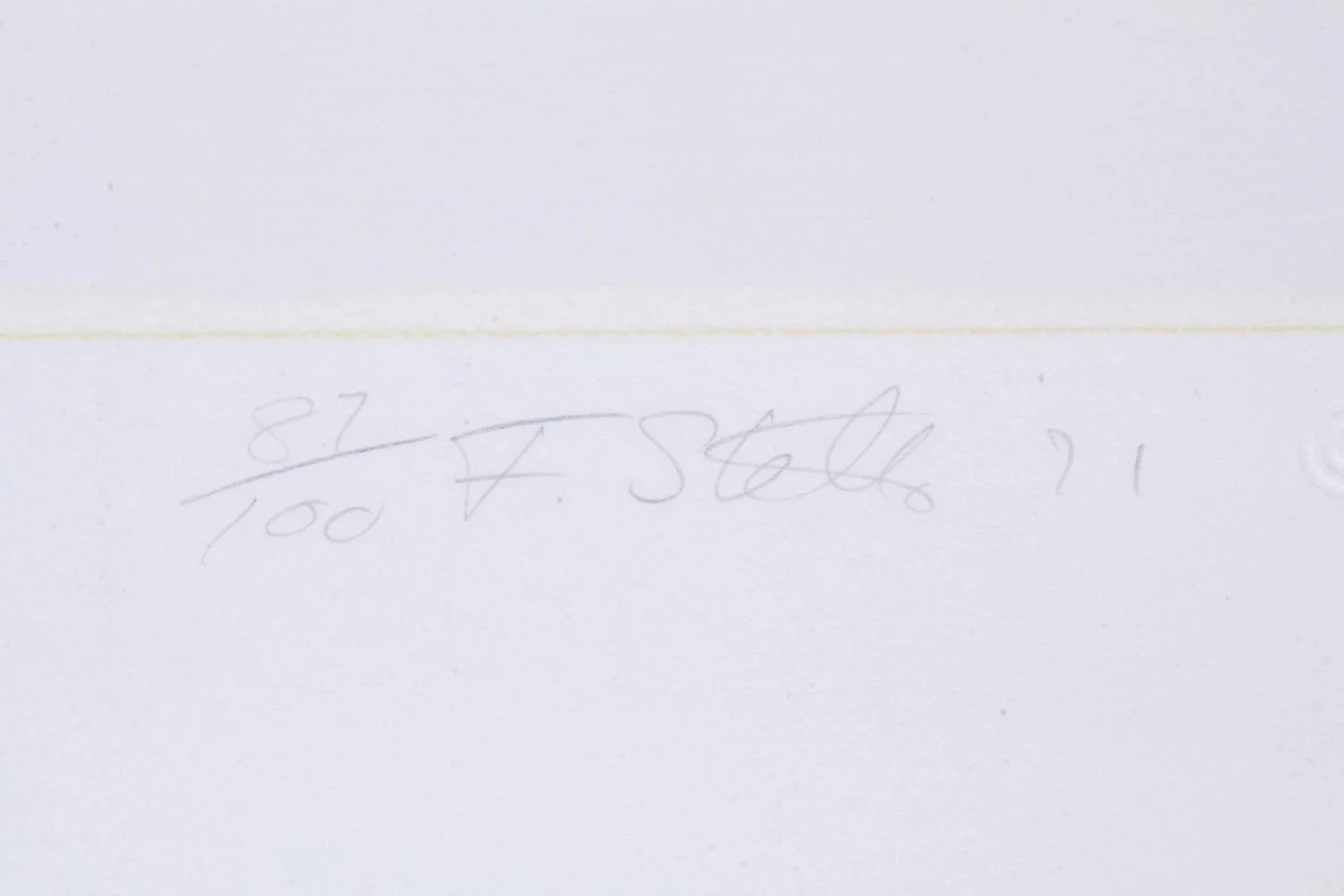
Detail Lot 3315: Signed and dated in pencil, lower right: F. Stella '71, numbered 87/100
Frank Stella
York Factory I
1971
Medium: Screenprint on Special Arjomari paper
Dimensions: 17 ¼ x 44 ½ (43.8 x 113)
Signature: Signed and dated in pencil, lower right: F. Stella ‘71
Inscriptions: numbered in pencil, lower right, Gemini G.E.L. blind stamp and embossed copyright, lower right. Stamped on verso: Gemini G.E.L. Los Angeles, Calif. Workshop inscribed in pencil on verso.
Edition: 100 – 43 runs from 43 screens
Proofs: 25 AP, 4 CTP, RTP, PPII, 3 GEL, C
Printers: Edition printing: Jeff Wasserman and assisted by Robert Dressen. Processing and proofing by Kenneth Tyler. Collaboration and supervision: Kenneth Tyler.
Publisher: Gemini G.E.L., Los Angeles
If you would like to find out how to make this important work part of your collection, or for questions on bidding and assistance with registration, please telephone: +1 (207) 354-8141
For all other enquiries please contact us.